Your customers are asking for AI voice agents. Your competitors are already launching them. Twilio released ConversationRelay, Vonage partnered with AWS for AI voice, and Bandwidth expanded with OpenAI integration.
The question isn't whether you need AI voice capabilities. It's how fast you can deliver them.
Here's the problem: traditional approaches don't want you to know that most CPaaS providers think they need months of development work to add AI voice. They're wrong.
Using extension-based registration, you can add production-ready AI voice agents to your CPaaS platform in 5 minutes. No infrastructure rebuild. No SIP trunk complexity. No new phone numbers.
Just add an extension.
The CPaaS Competitive Landscape in 2026
Market Reality:
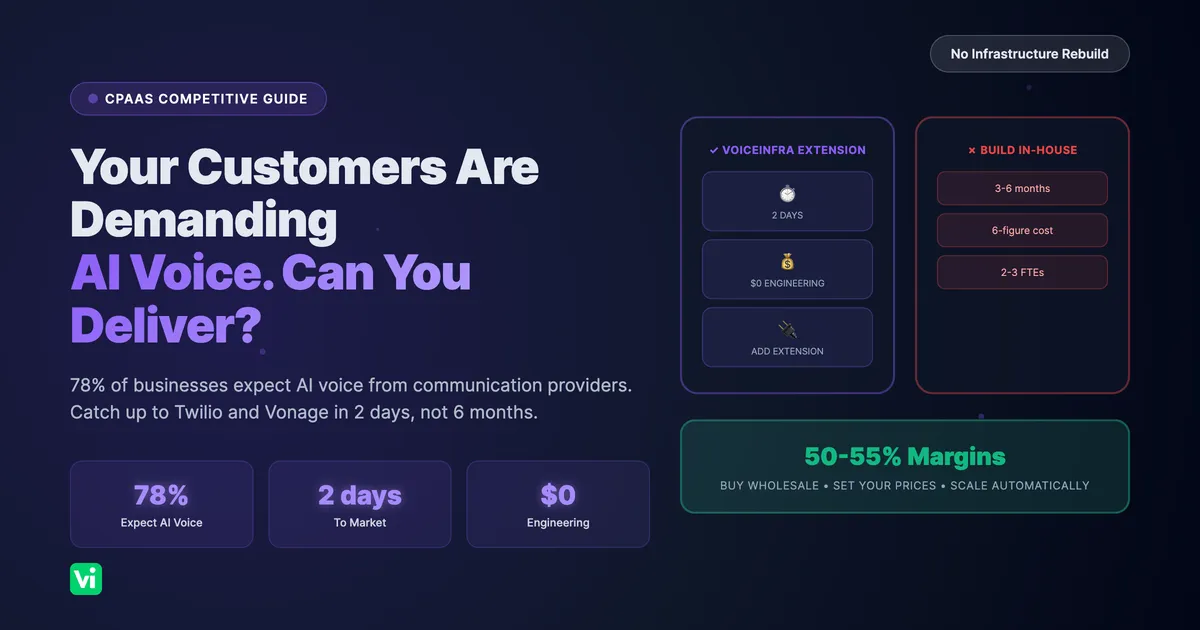
78% of businesses expect AI voice from communication providers
Voice AI funding surged 8x to $2.1B in 2025
Conversational AI market growing at 23.7% CAGR, reaching $41.39B by 2030
34% of restaurants have already adopted voice AI (canary in the coal mine)
Your Customers Are Demanding:
AI voice agents for automated customer service
Real-time transcription and sentiment analysis
Intelligent IVR replacement
Conversational analytics and insights
The Stakes: CPaaS providers who don't offer AI voice are losing deals to competitors who do. One customer put it bluntly:
"We love your platform, but we need AI voice capabilities. Can you deliver them by Q2, or should we migrate to Twilio?"
The deadline isn't technical. It's business.
Why Traditional Integration Takes Months (And What You're Actually Paying For)
Most CPaaS providers approach AI voice integration like this:
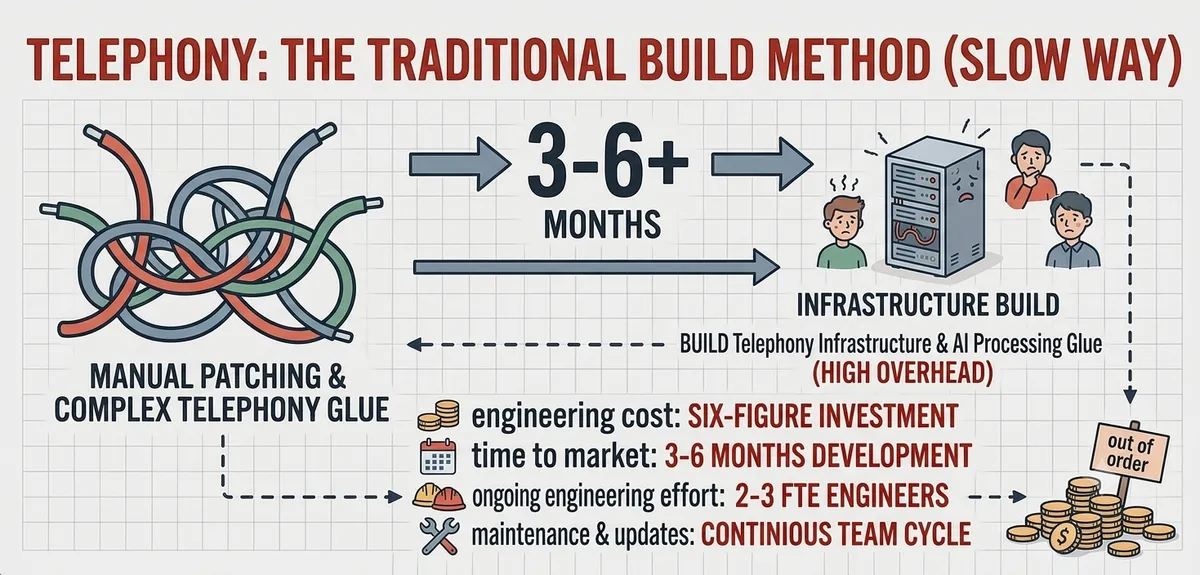
Timeline: 3-6 months Engineering cost: Six-figure investment Opportunity cost: Losing customers to AI-enabled competitors
What you're actually building:
Telephony infrastructure (you already have this)
AI processing capabilities (you don't have this)
Integration glue code (high maintenance)
Ongoing operational overhead (scaling, monitoring, updates)
The Hidden Costs No One Talks About:
1. Initial Development Cost
Traditional Build: Requires a significant six-figure financial investment.
Extension-Based: Costs $0 to start, as it leverages existing infrastructure.
2. Time to Market
Traditional Build: Typically takes 3 to 6 months to develop, test, and deploy.
Extension-Based: Can be launched in about 5 minutes.
3. Ongoing Engineering Effort
Traditional Build: Demands a dedicated team of 2 to 3 Full-Time Equivalent (FTE) engineers.
Extension-Based: Requires 0 FTEs, as the core engineering is managed by the platform.
4. Infrastructure & Scaling
Traditional Build: Necessitates provisioning and managing new servers, with all the complexity of scaling them.
Extension-Based: No infrastructure is required from you; it is all handled by the provider (VoiceInfra).
5. Maintenance & Updates
Traditional Build: Requires a continuous cycle of updates, security patches, and bug fixes by your team.
Extension-Based: All maintenance is handled by VoiceInfra.
6. Opportunity Cost & Business Impact
Traditional Build: Carries the high risk of losing customers and market share during the long development period.
Extension-Based: Enables you to begin generating revenue immediately upon launch.
The Extension-Based Advantage: How Integration Should Work
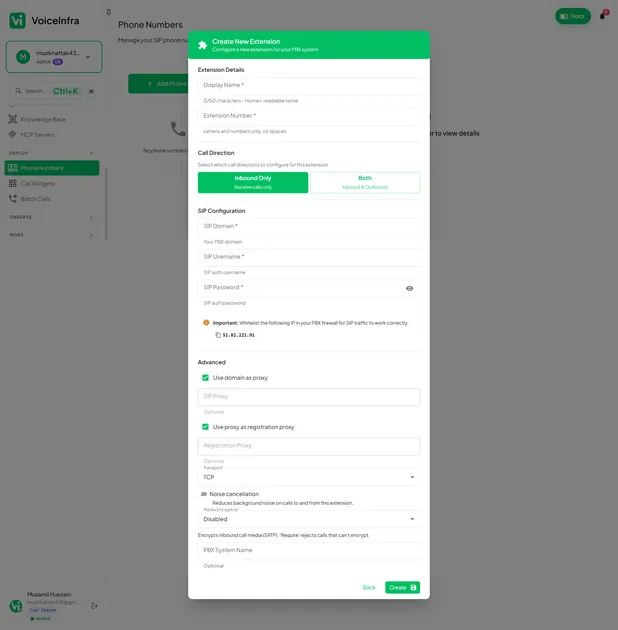
VoiceInfra takes a different approach. Instead of rebuilding your infrastructure, we register as extensions on your existing PBX.
The Process:
What This Means:
AI agents appear as extensions on your PBX (101, 102, 103, etc.)
No new infrastructure needed
No SIP trunk configuration
No firewall rules or network changes
Works with your existing carrier relationships
Zero duplication of configurations
The 5-Minute Setup:
Step 1: Identify available extension on your PBX (e.g., ext. 101)
Step 2: Enter extension credentials in VoiceInfra dashboard
Step 3: Assign AI agent to extension
Step 4: Done. AI is live.
From your CTO's perspective: You added an extension to your PBX. That extension happens to be an AI agent.
From your customers' perspective: They just got AI voice capabilities. They don't care how.
Why CPaaS Providers Win With Extension-Based Integration
1. Speed to Market: Days vs. Months
Traditional Approach:
Sprint planning: 1 week
Development: 8-12 weeks
QA/testing: 2-4 weeks
Total: 3-4 months minimum
Extension-Based:
Partner onboarding: 1 day
Sandbox testing: 1 day
Production deployment: 5 minutes
Total: 2 days
Competitive Impact: While competitors are still in sprint planning, you're already selling AI voice to customers.
2. Zero Engineering Debt
Traditional build creates:
Custom code you maintain forever
Scaling challenges as usage grows
Security vulnerabilities to patch
Compatibility issues with PBX updates
Technical documentation to write
Extension-based eliminates:
No custom code in your stack
VoiceInfra handles scaling
We handle security updates
PBX-agnostic (works with anything)
We provide documentation
Your engineering team stays focused on your core product.
3. Carrier and Infrastructure Flexibility
Problem with traditional AI platforms: They force you to use specific carriers or rebuild your routing logic.
Extension-based freedom:
Keep your existing carrier relationships
Use your current SIP trunks
Maintain your call routing logic
No migration of phone numbers
No changes to your dial plans
One CPaaS provider told us:
"We have carrier contracts in 12 countries. Every other AI vendor wanted us to replace all of it. VoiceInfra just... worked with what we had. That saved us millions."
4. Incremental Revenue, Not CapEx
Traditional build requires:
Upfront engineering investment (six figures)
Ongoing maintenance (2-3 FTEs)
Infrastructure scaling costs
ROI timeline: 12-18 months
Extension-based enables:
Zero upfront cost
No engineering headcount
Usage-based pricing (pay only for what you use)
ROI timeline: Immediate
Pricing flexibility:
Per-minute markup models
Tiered subscription packages
Value-based feature pricing
Custom enterprise contracts
Start generating revenue in week 1, not month 6.
Real-World Implementation: A CPaaS Provider's Journey
The Challenge: A mid-sized CPaaS provider (100+ business customers) was losing deals to competitors offering AI voice. Their CTO gave them a mandate: "Add AI voice capabilities in Q1 or we lose our top 20 customers."
The Traditional Proposal:
Build in-house: Six-figure engineering budget
Timeline: 5 months
Risk: Missing Q1 deadline anyway
The Extension-Based Solution:
Partner with VoiceInfra
Pilot with 10 customers: Week 1
Full rollout: Week 2
Engineering cost: $0
Customer retention: Saved
Their CTO's feedback:
"We went from 'we'll need to invest in new AI enabled CCaaS ' to 'not making any change to our existing infrastructure and have AI' in two weeks. No engineering effort, no infrastructure changes, just instant AI capabilities. This is how platform integration should work."
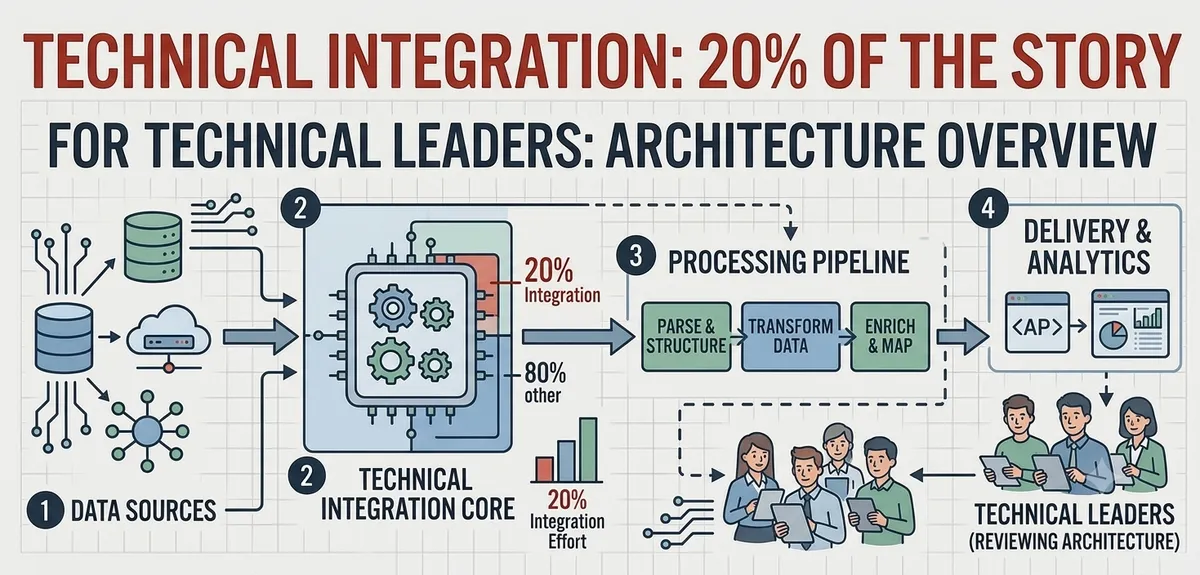
Technical Integration: 20% of the Story
For the technical leaders who need to know how this actually works:
Architecture Overview
API Integration (Optional)
While extension-based registration handles calls, you can optionally use REST APIs for advanced features:
// Optional: Trigger AI calls programmatically
POST /api/v1/dynamic_outbound_call
{
  "caller": "Izhar",
  "callee": "Muaz",
  "name": "VoiceInfra's Sales agent",
  "first_message": "Hey Muaz! I am calling about our new features in VoiceInfra, do you have a minute?",
  "call_transfer": true,
  "call_transfer_type": "cold",
  "transfer_config": {
    "sales": {
      "name": "support",
      "number": "42414",
      "transfer_message": "I am transferring your call to technical support, please hold."
    }
  },
  ...
}

// Webhook: Real-time call events
POST /webhooks/call-events
{
  "event": "call.ended",
  "extension": "101",
  "duration": 245,
  "sentiment": "positive",
  "summary": "Customer interested in enterprise plan"
}
This is optional. Extension registration handles everything without writing a single line of code.
PBX Compatibility
Works with any SIP-enabled PBX:
3CX, Yeastar, FusionPBX, FreeSWITCH
Asterisk, Kamailio, OpenSIPS
Cisco, Avaya, Mitel
Nextiva, RingCentral, 8x8
Custom/proprietary systems
The only requirement: SIP extensions (virtually universal).
Bonus Channel: WhatsApp Business Voice AI
Your customers don't just want traditional phone AI. They want to meet customers where they already are: on WhatsApp.
The Market Opportunity:
3 billion monthly active users on WhatsApp
35% of business calls happen after hours when staff isn't available
WhatsApp Business API now supports full SIP integration for voice calls
Zero cost for inbound WhatsApp calls (you only pay for AI processing)
Why This Matters for CPaaS Providers:
Your customers, primarily e-commerce, healthcare, and service businesses, are getting calls to their WhatsApp numbers. They're missing those calls. You can offer them AI voice capabilities for WhatsApp using the same extension-based approach.
How It Works:
Step 1: Customer enables WhatsApp Business API voice calling
Step 2: Provide WhatsApp SIP credentials to VoiceInfra
Step 3: Assign AI agent to WhatsApp extension
Step 4: AI handles inbound voice calls via WhatsApp
Key Benefits for Your Customers:
International Businesses:
No international calling fees; WhatsApp uses WiFi/data
30+ language support for global customers
No local phone numbers needed in each country
E-commerce & Retail:
24/7 order status and support via WhatsApp
Multilingual AI handles international customers
Customers are already on WhatsApp; no new apps to download
Healthcare & Services:
After-hours appointment scheduling via WhatsApp
Patients/customers prefer voice over texting
Real-time calendar integration
Use Cases That Work:
After-hours support: Capture calls when your team is offline
Multilingual support: Serve global customers in their native language
Appointment scheduling: Real-time booking without staff intervention
Order management: Check status, process returns, answer questions
International customers: No expensive international phone calls needed
Technical Integration:
Same extension-based registration approach
Works with WhatsApp Business API SIP trunk
No changes to your customer's WhatsApp Business setup
AI integrates with their existing business systems (CRM, calendar, etc.)
Revenue Opportunity:
Position this as a premium channel add-on
Higher value than traditional voice (international reach, multilingual)
Differentiator against competitors who only offer traditional phone AI
Your Competitive Advantage: Most CPaaS providers only offer traditional phone numbers. You can offer:
Traditional voice AI (via PBX extensions)
WhatsApp voice AI (via WhatsApp Business API)
Future channels (expand as new platforms emerge)
All use the same extension-based architecture. Same simplicity. Zero additional engineering effort.
Business Model: How to Monetize AI Voice
The Channel Partner Advantage
VoiceInfra's Channel Partner Program is built specifically for CPaaS providers. You buy at wholesale rates, resell at your own pricing, and scale with automatic volume discounts.
Core Structure:
Three Partner Tiers:
Silver – Entry-level partners building their voice AI practice
Gold – Established partners with consistent volume
Platinum – High-volume partners driving significant business
What You Get:
Volume-based platform discounts – Your margins improve automatically as you grow
Set your own pricing – You control what end customers pay (subscription, per-minute, or value-based)
Bulk add-on pricing – Purchase phone numbers, concurrent channels, voice clones, and storage at volume discounts
White-label option – Full branding customization for agencies wanting their own AI voice offering
Flexible AI costs – Either bring your own API keys (pay providers directly) or let us manage and bill at cost (pass-through)
Real-World Margin Potential
Across all partner tiers, margins typically range from 50-55% when marking up 2-2.5x on platform costs. This lets you:
Offer competitive rates to price-sensitive customers
Maintain healthy margins for your business
Scale revenue without adding engineering headcount
What Drives Partner Revenue:
Per-Minute Models:
Usage-based pricing aligns with customer call volume
Low barrier to entry for customers to try the AI voice
Predictable wholesale costs for you
Revenue scales automatically with customer growth
Tiered Subscription Models:
Higher ARPU with defined minute allowances
Easier sales conversations for business customers
Predictable recurring revenue
Better customer retention
Value-Based Add-Ons:
Premium features (sentiment analysis, transcription, multilingual support)
Voice cloning for brand consistency
Advanced analytics and reporting
Industry-specific agent templates
Bulk Add-On Revenue Streams
Beyond minutes, partners can resell:
Call Concurrency:
Purchase concurrent channel pools at volume discounts
Resell to customers needing higher call capacity
Draw down from bulk pools as needed
Voice Clone Slots:
Bulk voice cloning for customer deployments
Premium feature for brand consistency
Higher margin opportunity
Phone Numbers & Extensions:
Bulk provisioning for customer rollouts
Volume discounts on large deployments
Recurring monthly revenue
Knowledge Base Storage:
Document management for AI agents
Tiered storage pricing
Scale with customer document needs
White-Label: Build Your Own AI Voice Brand
For CPaaS providers wanting complete brand control:
What's Included:
Custom domain (app.yourbrand.com or your own domain)
Your branding, colors, and logo throughout
White-labeled dashboard and user interface
Custom email templates with your branding
Removal of VoiceInfra branding from customer-facing elements
Co-branded marketing materials
Perfect For:
Agencies building their own voice AI offering
System integrators adding AI to their portfolio
CPaaS providers wanting complete brand control
Your customers see YOUR brand, not ours.
Support That Scales With You
Tiered support options to match your needs:
Basic – Self-service with documentation and email support
Standard – Email support, onboarding assistance, integration guidance
Professional – Priority support, dedicated account manager, advanced training
Custom – 24/7 support, white-label options, executive business reviews
You provide first-line support to your customers. We support you with the resources you need.
Go-to-Market Strategy
Phase 1: Pilot (Week 1-2)
Identify 10-20 beta customers
Offer free AI minutes for testing
Gather feedback and use cases
Measure success metrics
Phase 2: Launch (Week 3-4)
Announce AI voice capabilities
Create marketing materials (we help)
Train sales team (we provide scripts)
Enable self-service setup
Phase 3: Scale (Month 2+)
Expand to all customers
Introduce tiered pricing
Add advanced features
Develop industry-specific templates
Grow into higher partner tiers for better margins
Competitive Moat: Why Extension-Based Wins
Comparison Against a DIY (Do-It-Yourself) Build
Time to Market
DIY Build: Takes 3 to 6 months.
Extension-Based: Takes only 2 days.
Engineering Cost
DIY Build: Requires a six-figure financial investment.
Extension-Based: Costs $0 to start.
Ongoing Maintenance
DIY Build: Requires a dedicated team of 2 to 3 Full-Time Equivalent engineers.
Extension-Based: Requires 0 FTEs.
Risk Level
DIY Build: High, due to unforeseen challenges and "unknown unknowns."
Extension-Based: Effectively zero, as it leverages a proven, ready-made solution.
Flexibility
DIY Build: Locks you into your own technical implementation.
Extension-Based: You can switch or adapt the solution at any time.
Comparison Against Other AI Platforms (e.g., Twilio/Vonage)
Setup Time
Twilio/Vonage Approach: Takes weeks, involving SIP trunk configuration and complex setup.
VoiceInfra Extension: Takes about 5 minutes.
Need for New Phone Numbers
Twilio/Vonage Approach: Requires purchasing and porting new phone numbers.
VoiceInfra Extension: Does not require new numbers; uses your existing ones.
Infrastructure Changes
Twilio/Vonage Approach: Yes, requires significant changes to your call routing and infrastructure.
VoiceInfra Extension: No changes required.
Carrier Relationship
Twilio/Vonage Approach: Requires you to replace your current carrier.
VoiceInfra Extension: Allows you to keep your existing carrier relationship.
Configuration Duplication
Twilio/Vonage Approach: Yes, you must duplicate settings and configurations.
VoiceInfra Extension: No duplication is needed.
Vendor Lock-in
Twilio/Vonage Approach: High.
VoiceInfra Extension: Low.
ROI Calculator: What AI Voice Means for Your CPaaS Platform
Conservative Scenario (100 customers adopt AI):
Average usage: 1,000 minutes/customer/month
Moderate markup on platform costs
Immediate monthly recurring revenue
Zero engineering investment
Moderate Scenario (500 customers adopt AI):
Scale economies improve margins
Automatic tier upgrades as volume grows
Revenue multiplies with customer adoption
Aggressive Scenario (1,000+ customers adopt AI):
Platform-level optimization at Platinum tier
Maximum margin potential
Market leadership position
Compare to DIY Build:
Engineering cost: Six-figure investment
Time to market: 3-6 months of lost revenue
Ongoing maintenance: 2-3 full-time engineers
Extension-based partnership pays for itself immediately.
Implementation Timeline: From Decision to Revenue
Day 1: Partner Onboarding
Sign a partnership agreement
Receive sandbox access
Technical intro call (30 min)
Day 2: Sandbox Testing
Configure test extension
Make test calls
Verify integration
AI working in your environment
Day 3-7: Pilot with 5-10 Customers
Select pilot customers
Enable AI extensions
Monitor usage and feedback
Already generating revenue
Day 8-14: Expand to All Customers
Marketing announcement
Self-service setup enabled
Sales team trained
Full rollout complete
Day 15+: Ongoing Revenue
Scale based on demand
Add features as needed
Optimize pricing
Growing monthly recurring revenue (MRR)
Common Concerns (That Aren't Actually Concerns)
"Our Engineering Team Wants to Build This"
Reality: They want to build cool AI tech. But do you want to spend six months and a significant engineering budget to recreate something that exists today?
Better question: What else could your engineering team build in those 6 months that's actually unique to your business?
"We Want Control Over Our Stack"
Reality: You keep complete control. AI agents are just extensions of your PBX. You can remove them anytime, no vendor lock-in.
Better question: Do you want control over AI infrastructure (not your core business) or control over your customer relationships (your actual business)?
"Extension-Based Sounds Too Good to Be True"
Reality: It works because SIP is a standard protocol. Registering an extension is what every desk phone, softphone, and conferencing system does. We're just another endpoint.
Better question: Would you rather believe it's too good to be true, or test it in 5 minutes and see for yourself?
"What About Custom Requirements?"
Reality: We support custom AI agents, knowledge bases, integrations, voice cloning, and advanced routing. If you have unique needs, we can probably handle them.
Better question: What's the cost of building unique features vs. configuring what already exists?
Why This Matters for Your CPaaS Platform's Future
The Market Doesn't Wait:
Your customers are asking for AI voice today
Your competitors are launching AI voice capabilities
The window for differentiation is closing
Extension-Based Registration Changes the Game:
No months-long development cycles
No six-figure engineering investments
No infrastructure rebuilds
No vendor lock-in
Just add an extension and start selling
The Decision Matrix: Comparing Your Three Paths
Here is a breakdown of the three main options, comparing them across four critical factors: Time, Cost, Risk, and Reward.
1. Build In-House (DIY)
Time: 3 to 6 months.
Cost: A six-figure investment.
Risk: High (due to development unknowns, scaling challenges, and maintenance burden).
Reward: Full control over the final product, but only after a long and costly process.
2. Use a Traditional AI Platform (e.g., Twilio/Vonage)
Time: 4 to 8 weeks for setup and configuration.
Cost: Significant initial setup and ongoing usage costs.
Risk: Medium (involves changing core infrastructure and carrier relationships, leading to vendor lock-in).
Reward: Faster than building yourself, but comes with partial vendor lock-in and complexity.
3. Use an Extension-Based Solution (e.g., VoiceInfra)
Time: Just 2 days.
Cost: $0 to start.
Risk: Effectively zero (leverages a proven, ready-made solution with no infrastructure changes).
Reward: Immediate revenue generation and market entry without technical debt or lock-in.
The strategic choice is clear.
Get Started: Your 5-Minute Test Drive
See extension-based integration in action:
Schedule a 15-minute demo
We show you the platform
Answer your technical questions
Discuss your use cases
Access the sandbox environment
Test with your PBX
Make sample calls
Verify it works
Partner agreement
Simple, straightforward terms
No long-term commitments
Scale as you grow
Go live
Enable AI extensions
Start selling to customers
Generate revenue immediately
The question isn't whether you need AI voice capabilities.
The question is: Do you want to wait 5 months with significant engineering investment, or start selling in 2 days with zero upfront cost?
Your competitors are already moving.
Your customers are already asking.
The integration takes 5 minutes.
Ready to Add AI Voice to Your CPaaS Platform?
👉 Partner with VoiceInfra - Start integrating today
👉 See Extension-Based Integration - Book a demo