A customer is locked out of their account at 11pm. They have two options on your website: type into a chat window, or call a number.
Which one they pick depends on urgency, context, and personal preference. But which one you've actually built to handle that moment determines whether the interaction resolves cleanly or turns into a frustrating dead end.
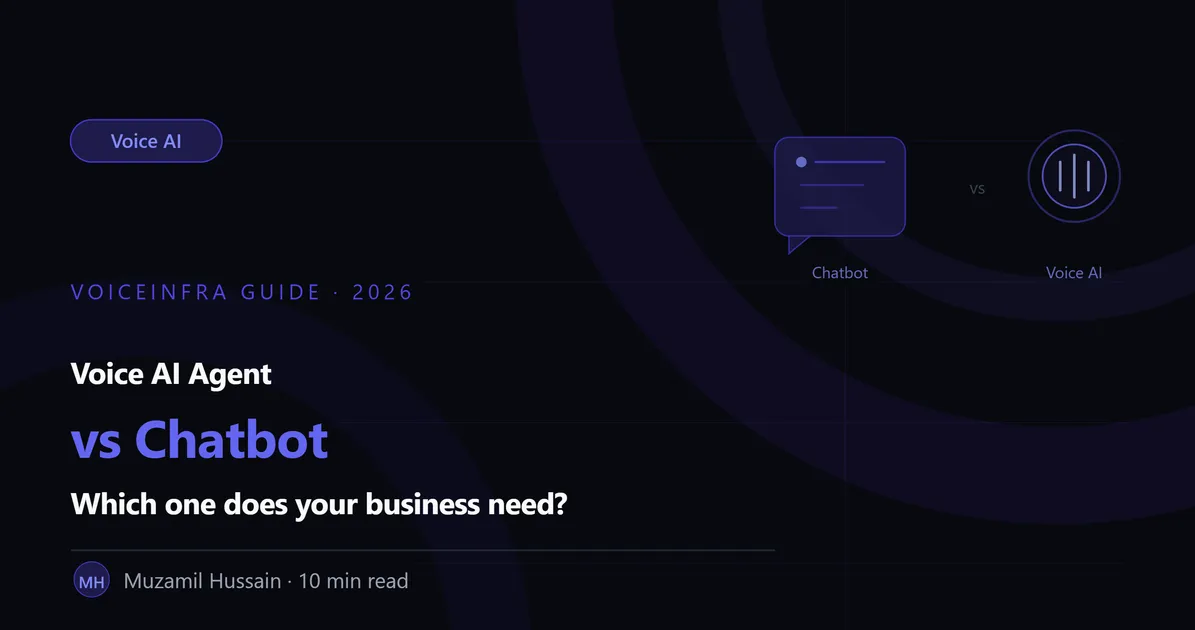
Voice AI agents and chatbots get bundled together constantly in vendor conversations, both labelled "conversational AI," both powered by LLMs, both marketed as customer service automation. They are not the same product, they don't solve the same problems, and choosing the wrong one for your situation produces a worse outcome than choosing neither.
This guide breaks down the real differences, where each one genuinely wins, and how to figure out which one (or both) your business actually needs.
The Core Difference: Channel, Not Just Technology
The most important distinction between a voice AI agent and a chatbot isn't the underlying AI, both can run on the same LLM. The distinction is the channel and everything that channel implies about how people use it.
A chatbot operates in text, asynchronously, with no real-time pressure. The person reads at their own pace, can take 30 seconds or 30 minutes to respond, can switch tabs and come back, and the conversation persists as a visible record they can scroll back through.
A voice AI agent operates over a live phone call, synchronously, with real-time pressure. The caller is on the line right now. There's no scroll-back, no re-reading, no pause-and-return. Every response needs to land correctly the first time because the caller can't easily review what was said three turns ago.
This single difference, synchronous spoken versus asynchronous written, shapes almost every other distinction between the two systems.
Side-by-Side: What Actually Differs
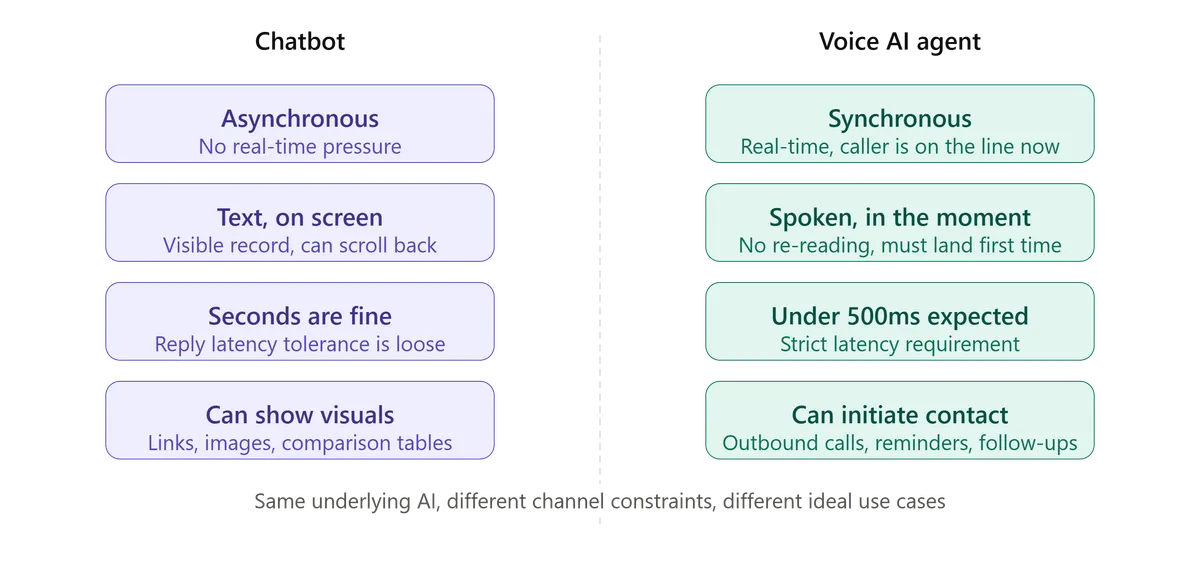
| Dimension | Chatbot | Voice AI Agent |
|---|---|---|
| Channel | Web chat, app, messaging (SMS, WhatsApp) | Phone call (inbound or outbound) |
| Pacing | Asynchronous, no time pressure | Synchronous, real-time |
| Review Capability | Caller can scroll back and re-read | No re-reading, must land first time |
| Latency Tolerance | Seconds are fine | Under 500ms expected |
| Input Method | Typed text | Spoken natural language |
| Output Format | Text, can include links, images, buttons | Spoken audio only |
| Multitasking | Caller can do other things while waiting | Caller's full attention is on the call |
| Accessibility | Requires literacy, device, and typing ability | Works for anyone who can speak and hear |
| Reach | Limited to people actively on your site or app | Reaches anyone with a phone, including existing callers |
| Best for Urgency | Lower-urgency, can wait for a reply | Higher-urgency, needs resolution now |
Where Chatbots Genuinely Win
It's not a competition where one option is universally better. Chatbots have real, specific advantages in certain situations.
Asynchronous convenience. A customer browsing your website at 2am with a simple product question doesn't want to make a phone call. They want to type a question and get an answer without interrupting whatever else they're doing. Chat fits naturally into that browsing behaviour.
Visual and structured information. If the answer involves showing an image, a link to a help article, a comparison table, or a multi-step visual guide, text-based chat delivers that naturally. Voice cannot show a product photo or a pricing table. It can only describe them, which is a worse experience for visually-oriented information.
Lower-stakes, high-volume queries. "What's your return policy?" or "Do you ship to Canada?" are perfectly suited to a quick chat exchange. The customer doesn't need a phone conversation for a single factual lookup.
Discretion and privacy. Some customers prefer not to speak their issue aloud, particularly for sensitive topics (certain health questions, financial details in public spaces). Text chat lets them communicate privately regardless of their physical environment.
Embedded in existing digital flows. If a customer is already deep in your checkout flow or app and hits friction, a chat widget appearing in that same context is less disruptive than asking them to pick up a phone.
Where Voice AI Agents Genuinely Win
The advantages of voice run in a different direction, and for many businesses, they're the more commercially significant ones.
Urgency and real-time resolution. When something is broken right now, a customer needs it fixed right now, not in a chat queue. A locked account, a service outage, a missed delivery on the day it was promised, these situations favour an immediate phone conversation over typing and waiting for a response.
No typing required. A significant percentage of the population finds typing on a phone screen, particularly older customers or those with accessibility needs, harder than simply speaking. Voice removes a barrier that chat inherently has.
Existing phone-first relationships. Many businesses, particularly in healthcare, insurance, logistics, and real estate, have customer relationships built around the phone. Patients call their clinic. Policyholders call to report a claim. Replacing that channel with chat requires changing established customer behaviour. Adding a voice AI agent to that channel doesn't.
Richer signal in tone and pacing. Voice carries information that text strips away, hesitation, frustration, urgency, confusion. A well-designed voice AI agent can pick up on these signals (through pacing, repeated questions, or explicit frustration) in ways that text sentiment analysis approximates much less directly.
No "did you read my message" ambiguity. In chat, there's always a question of whether the customer actually read and understood a response, or skimmed past it. In voice, a well-designed agent can confirm understanding directly within the natural flow of conversation.
Outbound reach. Voice AI agents can proactively call customers, appointment reminders, payment follow-ups, lead qualification, in a way that chatbots fundamentally cannot. A chatbot waits for someone to initiate. A voice AI agent can initiate the conversation.
The Question That Actually Matters: What's the Use Case?
Rather than treating this as "which technology is better," the more useful framing is matching the channel to the specific use case.
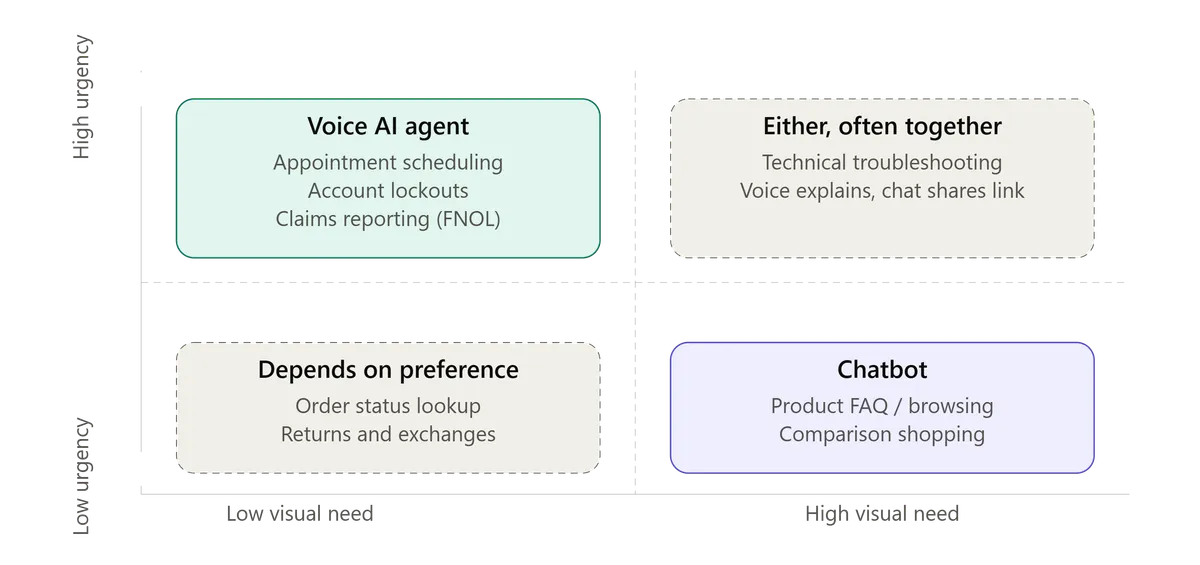
| Use Case | Better Fit | Why |
|---|---|---|
| Appointment Scheduling | Voice AI Agent | Often urgent, benefits from real-time confirmation |
| Product FAQ / Browsing Support | Chatbot | Low urgency, visual content helps |
| Account Lockout / Urgent Access Issue | Voice AI Agent | High urgency, needs immediate resolution |
| Order Status Lookup | Either | Works well in both, depends on customer preference |
| Insurance Claim Reporting (FNOL) | Voice AI Agent | Often urgent, emotionally charged, benefits from spoken reassurance |
| Comparing Product Specs | Chatbot | Visual comparison, no urgency |
| Appointment Reminders (Outbound) | Voice AI Agent | Requires proactive outreach; chat can't initiate |
| Returns and Exchanges | Chatbot | Structured process, often involves links and forms |
| Technical Troubleshooting (Complex) | Both, Often Together | Voice for explanation, chat for sharing links and steps |
| Elderly or Low-Literacy Customer Base | Voice AI Agent | Removes typing barrier entirely |
A useful exercise: map every common contact reason your business handles to one of these categories. The pattern that emerges usually makes the right channel obvious for each one.
The Real Answer for Most Businesses: Both, Working Together
Treating this as an either-or decision is usually the wrong framing entirely. The businesses getting the most value from conversational AI typically deploy both channels, each handling the interactions it's naturally suited for.
A common effective pattern: Chat handles pre-purchase questions, browsing support, and low-urgency lookups on the website. Voice handles the phone line for existing customers, urgent issues, appointment-related interactions, and any use case requiring proactive outbound contact. Both channels can share the same underlying knowledge base and business logic, just delivered through the channel that fits the moment.
For a healthcare provider, this might look like: a chatbot on the website answering "what insurance do you accept" and "what are your hours," while a voice AI agent handles the phone line for actual appointment booking, rescheduling, and triage-adjacent calls where tone and urgency matter.
For an insurance company: a chatbot handling policy document lookups and general coverage questions on the customer portal, while a voice AI agent handles the phone line for claims reporting, where the emotional context of "my car was just in an accident" genuinely benefits from a spoken, reassuring interaction rather than a text exchange.
The decision isn't "voice or chat." It's "which interactions on our channel map deserve voice, and which deserve chat."
Common Mistakes in This Decision
Deploying chat for genuinely urgent issues. If a customer's primary reason for contacting you is often time-sensitive (service outages, account access, anything where "waiting for a reply" causes real harm), routing that exclusively through chat creates frustration regardless of how good the chatbot is. Urgency favours voice.
Deploying voice for simple, high-volume informational queries. Building an elaborate voice AI agent to answer "what time do you close" when a simple chat widget or even a static FAQ page would serve the same purpose just as well is over-engineering. Match the investment to the actual need.
Assuming one channel preference fits all customers. Younger, digitally native customers often prefer chat by default. Older customers, or those calling about something emotionally significant, often strongly prefer voice. A business serving a broad demographic benefits from offering both rather than picking one and hoping it fits everyone.
Ignoring existing customer behaviour. If your customers have called your business for years and your phone number is the primary contact point people already know and use, deploying a brilliant chatbot while leaving the phone line as basic IVR misses where your actual call volume lives.
How VoiceInfra Fits This Decision
VoiceInfra is built as a genuine omnichannel AI agent platform, not a single-channel voice tool with everything else bolted on. The same agent, the same knowledge base, and the same business logic can power a phone call, a web chat widget, an in-app chat experience, or a direct API integration, depending on what a given interaction actually needs.
For the voice channel specifically, the platform is architected around the constraints that make real-time phone conversation different from text: streaming speech recognition, an LLM reasoning layer designed for sub-second response latency, natural-sounding text-to-speech, and real-time function calling so the agent can actually book, look up, and update business systems while the caller is still on the line. For chat and web, the same underlying agent delivers an experience suited to asynchronous, visual interactions, links, structured content, and the slower pace customers expect from typing rather than talking. For teams that want to build their own interface entirely, the API gives direct access to the same agent logic without being locked into a specific channel at all.
For businesses where the phone is, or should be, a primary channel, healthcare, insurance, logistics, real estate, and contact centres handling urgent or appointment-related interactions, VoiceInfra handles the voice side of the equation properly rather than treating it as an afterthought to a chat product. And because call, chat, web, and API all run on the same platform, there's no need to stitch together separate vendors for each channel or maintain inconsistent logic across them.
The right architecture treats voice and chat as two channels serving different moments in the same customer relationship, not two separate products that happen to share a brand name. VoiceInfra is built to be that single platform underneath both.
Final Thought
Voice AI agents and chatbots aren't competing for the same job. They're suited to different moments, different urgency levels, and different customer behaviours.
The question worth asking isn't "which one is better." It's "what is each interaction on my contact channel actually like, and which format genuinely serves it best."
For most businesses, the honest answer involves both, deployed deliberately rather than defaulting to whichever one a vendor pitched first.
Want to see how voice AI agents handle the urgent, real-time side of your customer interactions? Schedule a demo with VoiceInfra and we'll walk through which of your call types are the best fit.
Related reading:
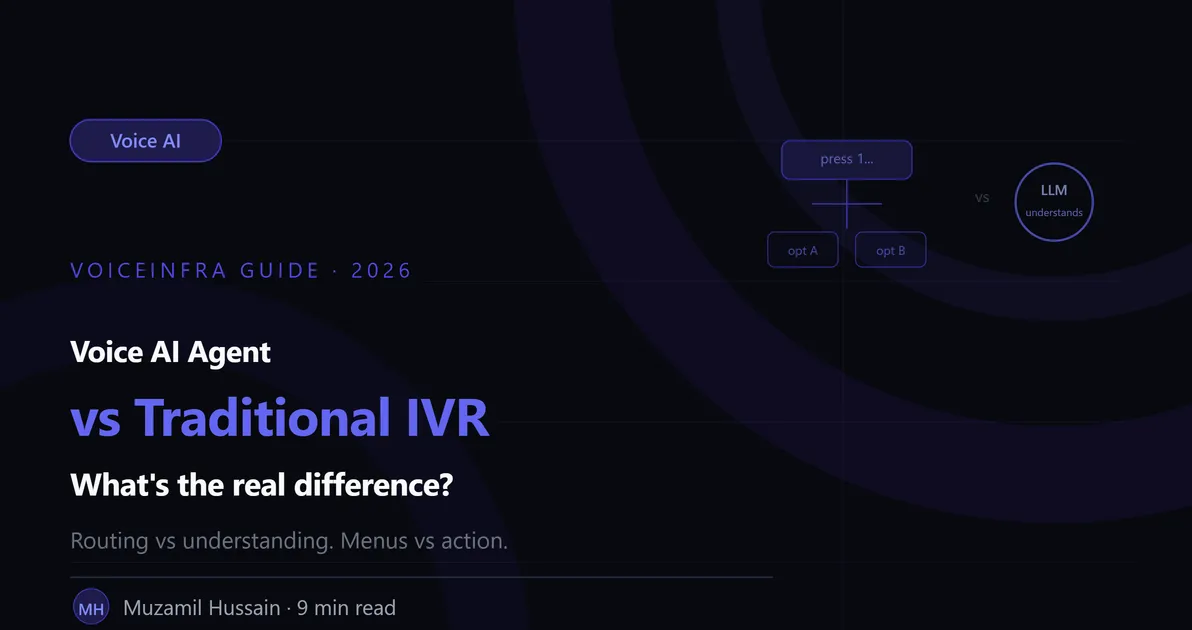
Voice AI Agent vs Traditional IVR: What's the Real Difference?
What is a Voice AI Agent? How It Works, Components & Real Examples
Real-Time Function Calling in Voice AI: How Agents Take Action During a Call