"Press 1 for billing. Press 2 for support. Press 3 to repeat this menu."
Everyone has been stuck in that loop. Pressing through four layers of options to reach a fifth one that doesn't exist, then getting routed back to the main menu, then giving up and calling a different number to find a human.
That experience has trained an entire generation of callers to associate phone automation with frustration. So when businesses talk about deploying "AI" on their phone lines, a lot of customers brace for the same thing with a slightly fancier voice.
It's a reasonable assumption. It's also wrong, if the system in question is an actual voice AI agent rather than a relabelled IVR.
The difference between these two systems isn't cosmetic. It's architectural, and it shows up immediately the moment a caller says something that doesn't fit a predefined menu option. This guide breaks down exactly what separates a voice AI agent from traditional IVR, why the distinction matters, and how to tell which one you're actually evaluating when a vendor uses the word "AI."
What Traditional IVR Actually Is
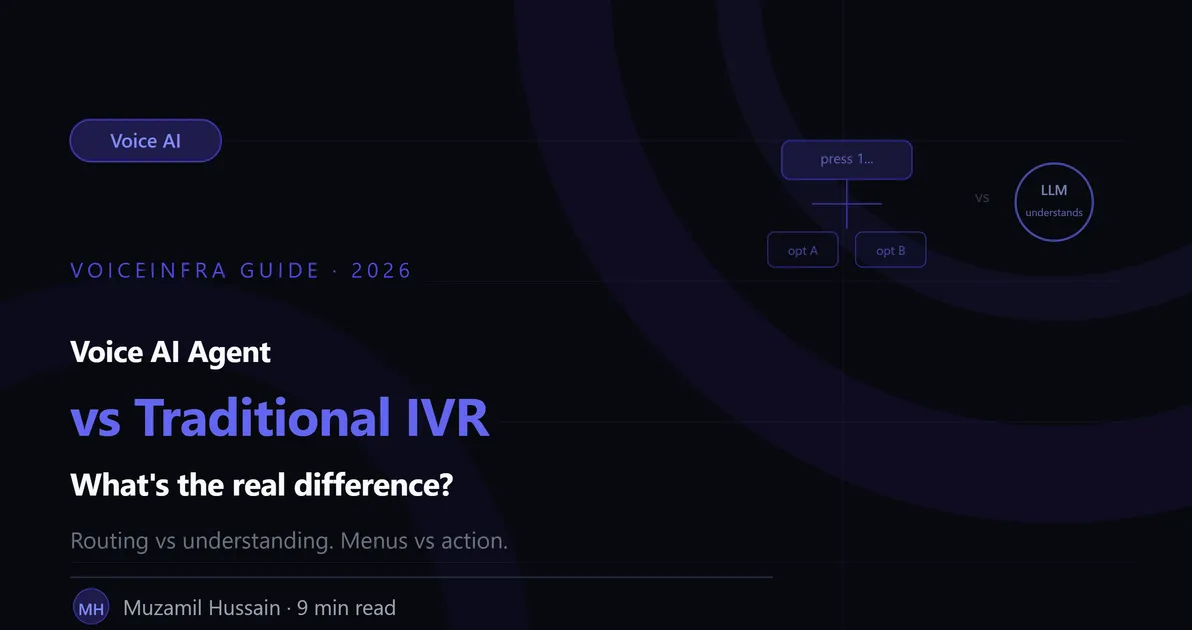
Interactive Voice Response (IVR) is decades-old technology. At its core, it's a decision tree navigated by keypress or basic voice command, with each branch leading to a different recorded message, department, or sub-menu.
"For billing, press 1" routes the caller down the billing branch. "For technical support, press 2" routes down a different branch. The system has no understanding of what the caller actually needs, it's matching an input (a keypress or a simple matched phrase like "billing") against a fixed set of predefined paths.
The fundamental limitation: IVR systems operate on pattern matching against a finite, predetermined set of options. They cannot interpret a sentence. They cannot understand intent that wasn't explicitly anticipated by whoever designed the menu tree. If a caller says "I need to talk to someone about a charge on my account that I don't recognise," a basic IVR either fails to match any option or routes based on a single keyword it happened to catch ("account" maybe routes to general account services, regardless of what the caller actually needs).
This is why IVR menus tend to expand over time into increasingly granular sub-menus, designers are trying to anticipate every possible reason someone might call and give it a dedicated branch. It never fully works, because real conversation doesn't decompose into a finite decision tree.
What a Voice AI Agent Actually Is
A voice AI agent uses a large language model to understand what the caller says as natural language, not as a pattern to match against predefined options.
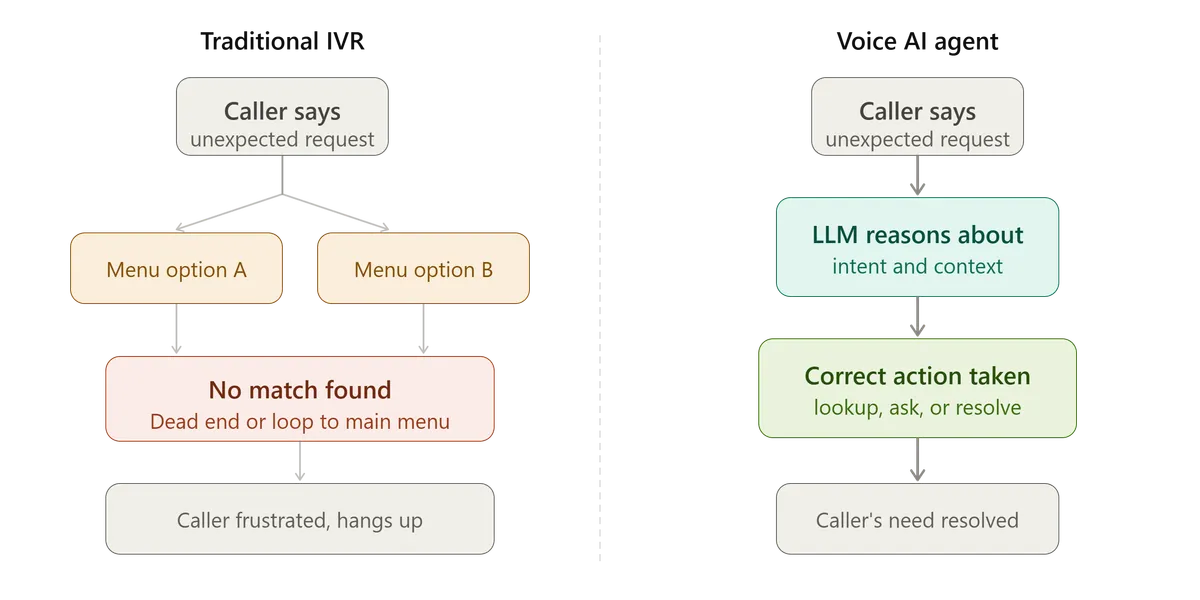
When a caller says "I need to talk to someone about a charge on my account that I don't recognise," a voice AI agent processes the actual meaning of that sentence. It understands this is a billing dispute, that the caller doesn't have specifics about the charge yet, and that the appropriate next step might be looking up recent transactions or asking a clarifying question, not routing blindly to a fixed branch.
The agent isn't matching against a menu. It's reasoning about what the caller needs, based on genuine language understanding, and then deciding what to do, whether that's asking a follow-up question, looking up information through a real-time function call, or transferring to the right specialist with context already attached.
This is the core architectural difference. IVR routes. Voice AI agents understand and act.
Side-by-Side: The Real Differences
| Capability | Traditional IVR | Voice AI Agent |
|---|---|---|
| Input Method | Keypress or simple matched phrase | Full natural sentences |
| Understanding | Pattern matching against fixed menu | Genuine language comprehension via LLM |
| Handles Unexpected Input | No, routes to error or default menu | Yes, adapts and reasons about intent |
| Multi-step Conversations | No, each interaction is isolated | Yes, maintains context across turns |
| Takes Real Action | Limited (route call, play recording) | Yes, books, updates, performs lookups during the call |
| Personalisation | None, same menu for every caller | Context-aware, uses caller history if available |
| Handles Ambiguity | No, requires exact match | Yes, can ask clarifying questions |
| Escalation to Human | Blind transfer, no context passed | Warm transfer with full conversation context |
| Setup Complexity for New Flows | Requires rebuilding menu structure | Requires updating prompts or workflow logic |
| Caller Effort Required | High, navigate menus to find the right option | Low, just say what you need |
Each row in this table represents a real, measurable difference in caller experience, not a marketing distinction.
Why "Press 1" Feels Bad: The Psychology
It's worth being specific about why IVR frustrates callers, because understanding the mechanism explains why voice AI agents feel different even before they prove themselves on actual task completion.
Cognitive load. Every menu layer requires the caller to remember a list of options, decide which one applies, and execute a keypress, all while trying to recall why they called in the first place. Three or four layers deep, most callers have forgotten the original menu entirely.
Forced categorisation. IVR requires the caller to fit their actual problem into one of a small number of predefined categories, even when their situation doesn't cleanly belong to any of them. This creates a mismatch between what the caller needs and what the system can route them to.
No recovery from a bad guess. If a caller picks the wrong option, most IVR systems offer no graceful way back except returning to the main menu and starting over, often forfeiting any progress already made (like having entered an account number).
Total lack of acknowledgement. IVR never confirms understanding. It just routes. The caller has no way of knowing whether the system understood their situation at all until they reach a human, possibly an entirely wrong human.
A voice AI agent eliminates all four of these friction points by design. The caller states their need in their own words, the agent confirms understanding conversationally, and incorrect initial routing can be corrected mid-conversation rather than requiring a full restart.
What Voice AI Agents Still Share With IVR
It's worth being honest about where the line is less absolute than marketing material sometimes suggests.
Both rely on telephony infrastructure. SIP trunks, call routing, PSTN connectivity, these foundational pieces are shared. A voice AI agent isn't replacing the phone network, it's replacing what happens on top of it.
Both can fail on truly novel situations. A voice AI agent handles unanticipated phrasing far better than IVR, but it isn't infinite. A genuinely unprecedented situation, one the system has no training or instruction to handle, can still produce a poor outcome. The difference is the failure mode: a well-designed voice AI agent recognises uncertainty and escalates gracefully, where IVR simply has no path forward at all.
Both need good design to work well. A poorly designed voice AI agent with a vague system prompt, no clear workflow logic, and no defined escalation paths can still produce a frustrating experience, just a different flavour of frustrating. The architecture is superior, but execution still matters enormously.
This last point matters for anyone evaluating vendors. The label "voice AI" doesn't guarantee a good experience any more than the label "IVR" guarantees a bad one (a genuinely well-designed IVR with sensible menu depth and fast escalation paths can still beat a badly built voice AI agent). The architecture creates the ceiling; design and execution determine how close to that ceiling the deployment actually gets.
The Cost and Outcome Difference
Beyond caller experience, the business metrics diverge significantly between the two approaches.
| Metric | Traditional IVR | Voice AI Agent |
|---|---|---|
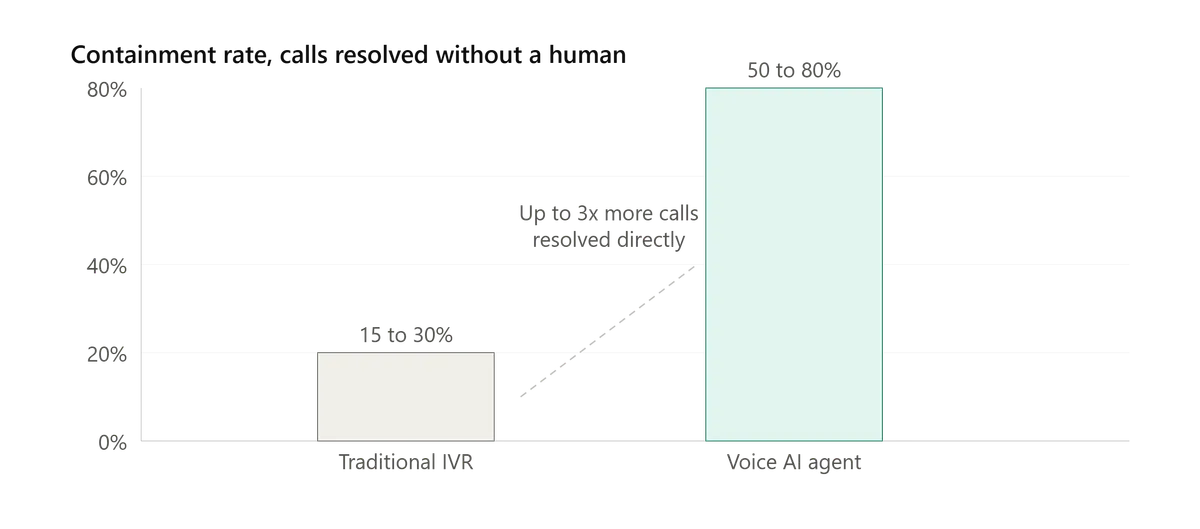
| Containment Rate (Typical) | 15–30% | 50–80% |
| Average Handling Time When Escalated | Higher (caller repeats information) | Lower (context already passed) |
| Caller Satisfaction with Automation | Generally low | Significantly higher when well designed |
| Setup Time for New Use Case | Days to weeks (menu redesign) | Hours to days (prompt/workflow update) |
| Scalability to New Languages | Requires new recordings and menu trees | Often just a configuration change |
The containment rate difference is the most commercially significant figure. IVR's low containment rate exists precisely because it can only resolve the narrow set of issues that map cleanly onto a menu option, anything outside that set routes to a human regardless of how simple the actual request was. Voice AI agents resolve a much wider range of requests directly because they aren't constrained to a finite decision tree.
When IVR Still Makes Sense
This isn't a case for ripping out every IVR system immediately. There are scenarios where simple IVR remains a reasonable choice.
Extremely simple, single-purpose lines. A line that exists purely to route between two departments with no ambiguity ("press 1 for sales, press 2 for support") doesn't need the sophistication of a voice AI agent. The complexity isn't there to justify it.
Very low call volume. If a line receives a handful of calls per week, the operational cost of deploying and maintaining a voice AI agent may not be justified relative to simply answering the few calls that come in.
Pure routing with no information need. If the entire job of the system is "get this call to the right department" with no information gathering, no task completion, and no decision-making required, basic call routing accomplishes that adequately.
What doesn't make sense is using IVR for anything beyond simple routing, multi-step information gathering, account-specific tasks, anything requiring the system to understand what the caller actually needs. That's where IVR's architecture runs out of road and a voice AI agent becomes the right tool.
How to Tell What You're Actually Being Sold
Given how loosely "AI" gets used in vendor marketing, it's worth knowing the specific questions that reveal whether a system is a genuine voice AI agent or a relabelled IVR with a speech-recognition layer bolted on.
Ask: can it handle a request phrased in an unexpected way? Describe a real customer scenario using natural, slightly indirect language (not the exact phrasing a menu option would expect) and see if the system understands it correctly.
Ask: does it remember what I said three turns ago? A genuine voice AI agent maintains context across the conversation. If you mention your account number early and the system asks for it again later, that's a sign of weak or absent context management, IVR-like behaviour wearing an AI label.
Ask: can it actually do something, not just route? Request an action that requires real-time lookup or update (checking an appointment, verifying an order status) and see whether the system genuinely retrieves real information or just transfers you to someone who will.
Ask: what happens when it's wrong? Deliberately give an ambiguous or unusual request and observe the recovery behaviour. A real voice AI agent asks a clarifying question or escalates with context. A disguised IVR loops back to a generic menu or fails silently.
If a vendor's system fails these tests, it's IVR with a voice interface, regardless of what the pitch deck calls it.
How VoiceInfra Handles This
VoiceInfra is built as a genuine voice AI agent platform, not a speech layer on top of decision-tree routing. The architecture reflects every difference outlined above.
Callers speak naturally and the agent, powered by LLM reasoning, understands intent rather than matching keywords. Conversations maintain full context across every turn, so callers never repeat information they've already given. Real-time function calling means the agent actually books, looks up, and updates, rather than just routing to someone who will. And when escalation is genuinely needed, the handoff to a human carries the full conversation context, so the caller never has to start over.
That said, VoiceInfra doesn't force every flow into pure conversation. For businesses that still want a traditional press 1, press 2 style menu, either for specific legacy workflows or as a fallback option, the platform supports DTMF (keypress) input alongside natural language. You can configure an agent to behave like a classic IVR where that's genuinely the right fit, or blend the two, letting the caller either speak naturally or press a key, and route accordingly. The point isn't that IVR-style menus are never useful, it's that a voice AI agent gives you the option to use them only where they make sense, instead of forcing every caller through one regardless of what they're calling about.
The result is a system that resolves the majority of calls directly rather than routing the majority of calls onward, which is the entire point of deploying voice automation in the first place.
Final Thought
The difference between a voice AI agent and traditional IVR isn't a matter of degree, it's a different category of system entirely.
IVR routes calls based on fixed pattern matching. Voice AI agents understand language and take real action. One asks the caller to navigate a menu. The other lets the caller just say what they need.
If your business is still running IVR for anything beyond the simplest routing tasks, the gap between what callers experience and what's now possible has become significant enough to matter, both for caller satisfaction and for the percentage of calls that get resolved without ever reaching a human.
Curious what a real voice AI agent sounds like compared to your current IVR? Schedule a demo with VoiceInfra and hear the difference on a live call in your industry.
Related reading:
What is a Voice AI Agent? How It Works, Components & Real Examples