Most people still picture a robotic phone menu when they hear "AI voice agent." You press 1 for billing, 2 for support, and by the time you've pressed 4 options deep, you've forgotten why you called in the first place.
That's not a voice AI agent. That's a twenty-year-old IVR with a fresh coat of paint.
A real voice AI agent listens to what you say, understands what you mean, and actually does something about it, in real time, without a script, without a phone tree, and without a human on the other end.
In this guide, we're breaking down exactly what a voice AI agent is, how the technology works under the hood, what components make it run, and where businesses are already deploying them at scale in 2026.
What Is a Voice AI Agent?
A voice AI agent is a software system that can hold a full, natural phone conversation with a human caller, understanding their intent, responding intelligently, and taking real actions during the call.
Not routing them. Not reading from a script. Actually resolving the reason they called.
When a patient calls a clinic to reschedule an appointment, a voice AI agent can check availability in the scheduling system, confirm the new slot, update the record, and send a confirmation, all while the caller is still on the phone. No hold music. No "let me transfer you." No human agent required.
That's the difference. A voice AI agent isn't just answering. It's doing.
Here's a simple way to think about it:
| System | How it works | Understands full sentences? | Can it take action? |
|---|---|---|---|
| IVR | Press 1 for billing, 2 for support | No | No |
| Voice Bot | Understands simple commands | Limited | No |
| Voice AI Agent | Full natural conversation | ✅ Yes | ✅ Yes, in real time |
The shift feels subtle until you're on the receiving end. Then it's obvious.
How Does a Voice AI Agent Actually Work?
Every time someone picks up the phone and talks to a voice AI agent, five things happen in sequence, and they happen fast. Usually, within 500 to 800 milliseconds from the moment the caller stops speaking.
Here's what's happening behind the scenes:
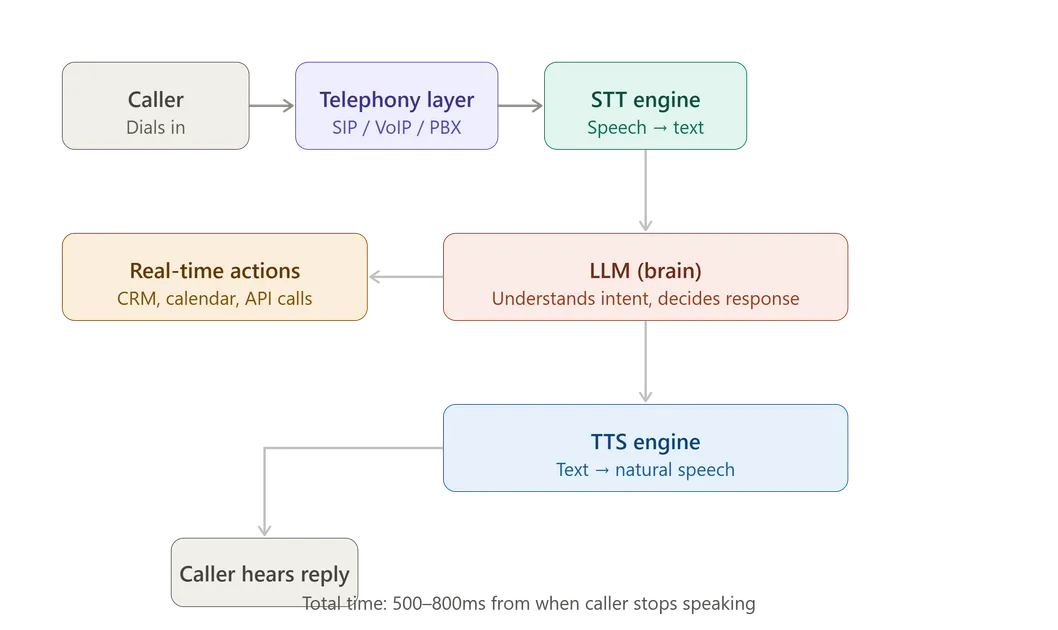
How a voice AI agent processes every call: five steps happening in under 800ms from the moment the caller stops speaking.
Step 1: The Call Comes In
The call arrives through a telephony layer, either a SIP trunk connected to an existing phone system, a direct number from a provider like Twilio or Telnyx, or a VoIP extension registered on a PBX like 3CX or Yeastar.
This layer handles the actual phone infrastructure: connecting the call, managing audio streams, handling drops, and ensuring the conversation stays stable. It's the foundation that everything else runs on.
Step 2: Speech-to-Text (STT) Converts Audio to Words
The moment the caller speaks, an automatic speech recognition (ASR) engine converts the audio stream into text in real time.
Modern STT models, think Deepgram, Cartesia, ElevenLab, are remarkably accurate, even with background noise, accents, or people talking quickly. They're not transcribing a recording. They're processing a live audio stream word by word as the caller speaks.
Step 3: The LLM Understands Intent and Decides What to Do
The transcribed text goes into a large language model (LLM), GPT, Claude, Gemini, or others, which is where the actual intelligence lives.
This is the brain of the operation. The LLM reads the caller's words, understands what they actually want (not just what they said), and decides how to respond. It does this by following a set of instructions, the system prompt, that defines the agent's role, its knowledge, its tone, and the actions it's allowed to take.
If the caller says, "I need to move my appointment from Thursday to sometime next week," the LLM understands that as a reschedule request, not a cancellation. It knows how to check availability. It knows how to ask which day works better. It knows not to ask for the caller's name again if it has already collected it.
Step 4: Real-Time Actions Get Executed
Here's where voice AI agents go beyond just talking. During the conversation, while the caller is still on the line, the agent can execute actions through API calls and integrations.
Checking a CRM for customer history. Querying a database for an account balance. Booking an appointment in a scheduling tool. Creating a support ticket. Sending an SMS confirmation. Transferring the call to a human agent with full context already attached.
These actions happen in the background, mid-conversation, without the caller waiting or being placed on hold.
Step 5: Text-to-Speech (TTS) Speaks the Response
Once the LLM generates a response, a text-to-speech engine converts it back into audio and plays it to the caller.
The quality of this voice is what determines whether the caller feels like they're talking to a machine. Bad TTS sounds robotic and monotone, callers notice immediately, and trust drops. Modern TTS engines from providers like ElevenLabs, PlayHT, or OpenAI produce voices that are genuinely difficult to distinguish from a human at normal conversational speed.
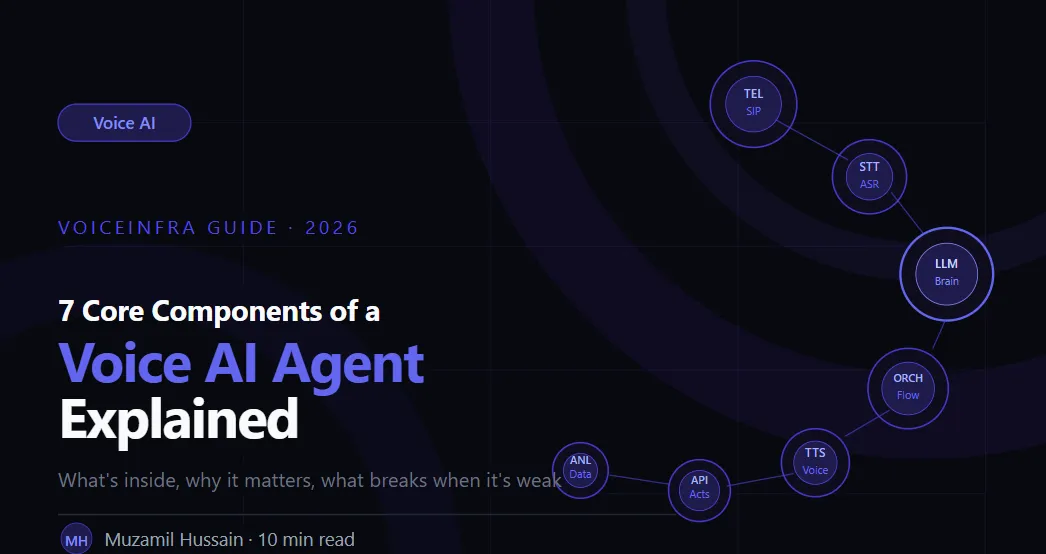
The 6 Core Components of a Voice AI Agent
Understanding the full picture means knowing what's actually inside these systems. Here are the six components that every production voice AI agent needs to function properly.
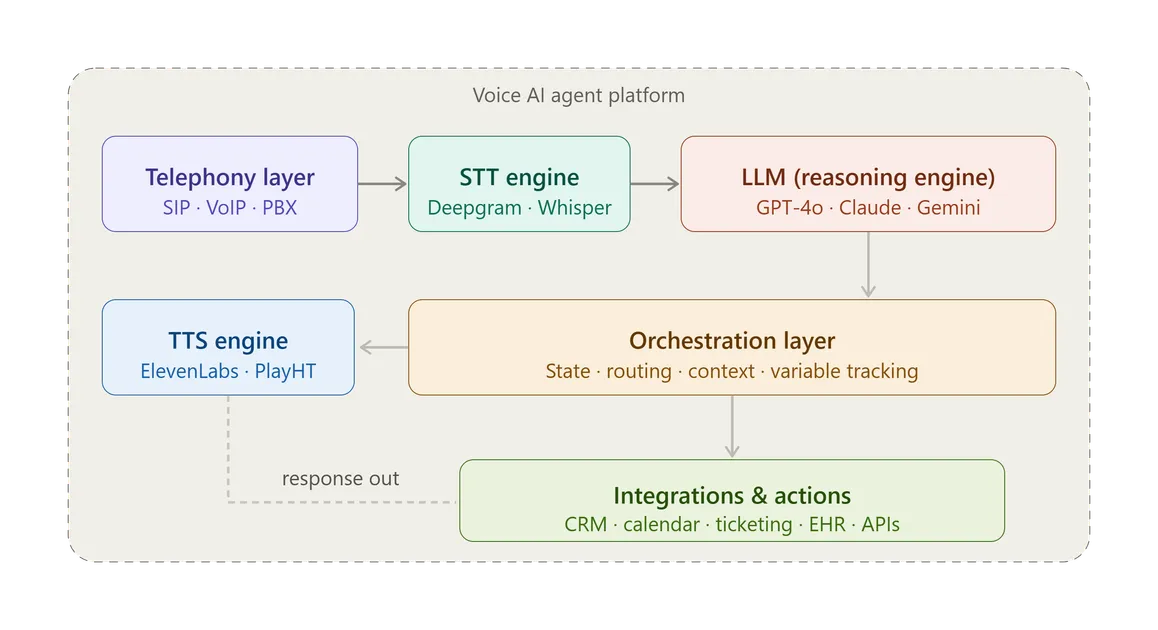
The six components that every production voice AI agent needs. Remove any one of them and the system either doesn't work or falls apart under real-world conditions.
1. Telephony Layer
This is the bridge between the phone network and the AI system. It handles SIP trunks, phone number provisioning, call routing, PSTN connections, and audio streaming. Without a solid telephony layer, you don't have a phone agent; you have a chatbot with an identity crisis.
The telephony layer also determines how easily the AI agent integrates with existing phone infrastructure. Enterprise deployments often need to plug into an existing PBX (3CX, Yeastar, FreePBX) as an extension, no new hardware, no ripping out the old system.
2. Speech Recognition (STT Engine)
The STT engine does one job: turn spoken words into text accurately and fast. Latency here matters enormously. A 2-second delay between when the caller finishes speaking and when the agent starts responding feels unnatural and erodes trust.
The best production STT engines stream transcription in real time, and the LLM can start processing before the caller has even finished their sentence, which shaves critical milliseconds off the response time.
3. Large Language Model (LLM)
The LLM is the reasoning engine. It reads the transcribed text, understands context, follows instructions, and generates a response. It's also responsible for deciding when to trigger a tool call, when to transfer a call, and when to ask a clarifying question.
Choosing the right LLM and switching between them intelligently based on the task has a significant impact on both cost and quality. Routing simple queries to a lighter, cheaper model and reserving GPT-4o for complex conversations can reduce inference costs by 60–70% without any drop in call quality that callers would notice.
4. Orchestration Layer
This is the least glamorous component and the most important one. The orchestration layer coordinates everything else; it manages the conversation state, tracks extracted variables, decides which node of the workflow is active, routes between tools and knowledge bases, and handles edge cases gracefully.
Without a well-designed orchestration layer, voice AI agents fall apart in production. They work perfectly for five scenarios and break on the sixth. They lose context after three turns. They fail silently when a tool call doesn't return the expected format.
Most platform failures that get blamed on the LLM are actually orchestration failures. We covered this in detail in our post on why conversational AI agents fail.
5. Text-to-Speech (TTS Engine)
The TTS engine converts the LLM's text response into audio. Voice quality is not a cosmetic concern; it directly affects whether callers stay on the line or hang up.
Research from our deployments and across the industry consistently shows that robotic-sounding agents have significantly higher abandonment rates than natural-sounding ones. Callers don't consciously think "this TTS is poor quality." They just feel something is off, lose patience faster, and ask to speak to a human sooner.
6. Integrations & Actions
A voice AI agent that can only talk but can't do anything is a very expensive FAQ page. The integrations layer connects the agent to the systems that actually run the business, CRMs like Salesforce or Zoho, scheduling tools like Calendly, ticketing systems, EHRs in healthcare, and policy management systems in insurance.
Real-time function calling lets the agent execute these integrations mid-conversation, not after. The caller experiences a natural conversation. The system experiences a series of API calls. The outcome is a completed task, not a promise to follow up.
What Makes a Voice AI Agent Sound Human?
This question comes up in almost every conversation we have with businesses evaluating voice AI. The honest answer is that four specific things separate agents that sound human from agents that obviously don't.
Interruption handling. Real conversations have interruptions. Someone cuts in. Someone says "wait, no" mid-sentence. A voice AI agent that plows through its response without acknowledging the interruption sounds like a broken tape recording. Good agents detect interruptions and respond to them naturally, stopping, resetting, and acknowledging what just changed.
Filler words and natural pacing. "Give me just a moment to check that for you" sounds human. A 1.5-second silence sounds like the call dropped. Good voice AI uses natural bridging language during the fraction of a second it takes to process a response or execute a tool call.
Context retention across the conversation. If a caller mentioned their account number in the first minute, the agent should never ask for it again. This sounds obvious, but it requires proper variable extraction and state management throughout the conversation, not just clever prompting.
Graceful fallback. When something goes wrong, the caller asks something outside the agent's scope, a tool call fails, the intent is genuinely ambiguous, a good agent doesn't freeze or give a nonsensical answer. It acknowledges the situation naturally, and either asks for clarification or transfers to a human with context already attached.
Real Examples: Where Voice AI Agents Are Deployed in 2026
The range of real-world deployments in 2026 is broader than most people realize. These aren't experiments or pilots. These are production systems handling hundreds of thousands of calls.
Industries actively running voice AI agents in production in 2026, with the most common use cases for each.
Healthcare. Patient scheduling is the clearest use case. Clinics receive hundreds of inbound calls daily for appointment booking, rescheduling, prescription refill routing, and insurance verification. Voice AI agents handle the routine calls, and they're faster and more consistent than a front-desk team fielding the same questions repeatedly.
Insurance. The first notice of loss (FNOL) call, when a policyholder reports a claim, is a high-volume, time-sensitive interaction that follows a fairly consistent structure. Voice AI agents are handling FNOL intake, collecting the required information, creating the claim record, and routing complex cases to adjusters.
Logistics & Freight. Trucking and freight brokerage operations deal with enormous call volumes, dispatch confirmations, load status updates, driver check-ins, and delivery coordination. Freight brokers are deploying outbound AI agents to cover lanes, confirm loads, and qualify carriers at a scale that would require dozens of additional headcount to replicate manually.
Real Estate. Voice AI agents handle the initial outbound call to a new inquiry, collecting qualifying information, gauging interest level, answering common questions about a property, and either scheduling a viewing or flagging the lead for follow-up.
Contact Centers. Inbound customer service at scale, 24/7, across multiple languages, with intelligent routing to human agents for escalations. In AI-to-human handoffs with full conversation context attached, the human agent picks up, knowing exactly what was already discussed, without asking the caller to repeat themselves.
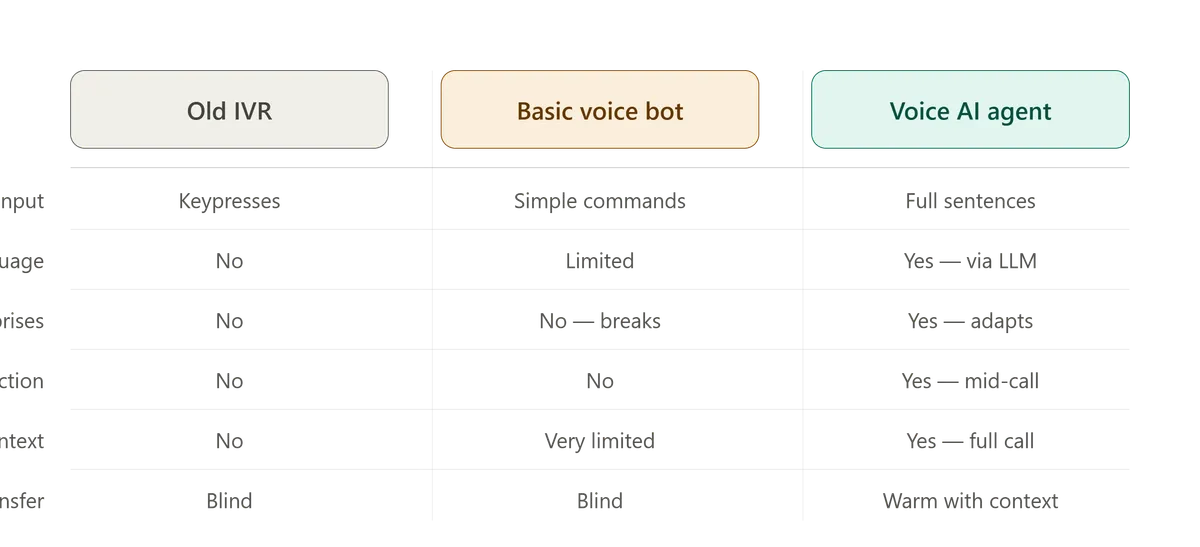
How Is This Different from What Came Before?
It's worth being specific about this, because "AI" gets attached to a lot of products that are nowhere near what we're describing.
| Old IVR | Basic voice bot | Voice AI agent (2026) | |
|---|---|---|---|
| Input method | Keypress or simple command | Simple spoken commands | Full natural sentences |
| Understanding | Fixed decision tree | Narrow predefined intents | Full language understanding via LLM |
| Handles unexpected input | No, routes to error message | No, breaks immediately | Yes, adapts naturally |
| Takes real action | No | No | Yes, mid-conversation |
| Retains context | No | Very limited | Yes, full conversation memory |
| Escalation | Blind transfer | Blind transfer | Context-aware warm transfer |
The gap between a 2019 voice bot and a 2026 voice AI agent is roughly the gap between a calculator and a laptop.
Key Metrics to Evaluate Voice AI Agent Performance
If you're evaluating a voice AI deployment, whether you're building one or buying one, these are the numbers that actually matter.
Containment Rate: What percentage of calls get fully resolved without needing a human? For well-defined use cases (scheduling, basic support), 60–80% containment is achievable. Anything below 40% usually points to a workflow design problem, not a fundamental technology limit.
Response Latency: The time between when the caller stops speaking and when the agent starts responding. Anything above 1.5 seconds feels like a lag. Under 700ms feels natural. This is heavily influenced by which STT and TTS providers are used and how the LLM routing is structured.
Transfer Rate and Reasons: How often does the agent hand off to a human, and why? Tracking transfer reasons tells you which parts of the conversation the agent can't handle yet, which becomes your product roadmap for improving the agent.
Caller Satisfaction (CSAT) and Abandonment: Callers vote with their behavior. High abandonment rates or repeated requests to "speak to a human" early in the call signal that something is wrong, usually voice quality, response latency, or a failure to resolve the actual intent quickly enough.
Building vs. Buying: What You Actually Need to Think About
There are two ways to deploy a voice AI agent: build the infrastructure yourself by assembling STT providers, LLM APIs, TTS services, and telephony layers, or use a platform that has already assembled and integrated all of those components.
| Build yourself | Use a platform (VoiceInfra) | |
|---|---|---|
| Time to production | 3–6 months | Days to weeks |
| Engineering required | High (multiple vendor APIs) | Low (configure, don't build) |
| Ongoing maintenance | You own every vendor update | Platform handles it |
| Customization | Maximum | High, within platform constraints |
| Best for | Large teams with specific infra needs | Most businesses moving fast |
Building gives you maximum control and flexibility. It also requires significant engineering resources, ongoing maintenance across multiple vendor APIs, and time you may not have if the competitive pressure is already present.
Using a platform like VoiceInfra means you get all six components, telephony, STT, LLM routing, orchestration, TTS, and integrations, already integrated and production-tested. You configure the agent for your use case. The infrastructure is already there.
What's Coming Next
Voice AI agents in 2026 are genuinely capable. But the technology is still improving fast. A few things to watch:
Latency is getting lower. Sub-300ms response times are becoming achievable for simpler interactions, which will further close the gap between AI and human conversation feel.
Multilingual support is maturing. Agents handling Spanish, Arabic, Hindi, and Mandarin at quality levels comparable to English are already in production. For businesses operating across regions, this opens significant deployment opportunities.
Proactive outreach is growing. Inbound is already mature. Outbound AI, batch calling campaigns, automated follow-ups, and reactivation sequences are scaling rapidly, with some operations running 500+ AI calls per day in multiple languages.
Human-AI collaboration is getting smarter. The handoff from AI to humans is improving. Real-time summaries, sentiment flags, and mid-call escalations with full context are becoming standard, not just a nice-to-have.
Final Thought
A voice AI agent isn't a feature. It's infrastructure.
The businesses getting the most out of this technology aren't treating it as a cost-cutting experiment. They're treating it as a new channel, one that operates 24/7, handles volume that would require significant headcount to replicate, and improves over time as the workflows are refined.
If you're evaluating where to start, pick the highest-volume, most repetitive phone interaction your team handles today. The one where your agents are answering the same five questions in the same order, fifty times a day. That's your first deployment candidate.
The technology is ready. The question is whether your workflows are designed well enough to use them.
Want to see a voice AI agent handling real calls? Schedule a demo with the VoiceInfra team, and we'll show you a live deployment in your industry.
Related reading:
Why Your Conversational AI Agent Fails (And How to Fix It)