When you talk to an AI voice assistant, it somehow knows exactly when you've finished speaking before responding. It doesn't interrupt you mid-sentence, and it doesn't wait too long after you've stopped talking.
The technology that makes this possible is called Voice Activity Detection (VAD).
Voice Activity Detection is one of the most important components of modern Voice AI systems. It helps distinguish between speech and silence, allowing AI voice agents to respond naturally and efficiently.
Whether you're building an AI receptionist, an AI call center, or a real-time voice assistant, VAD plays a critical role in delivering a smooth user experience.
What Is Voice Activity Detection?
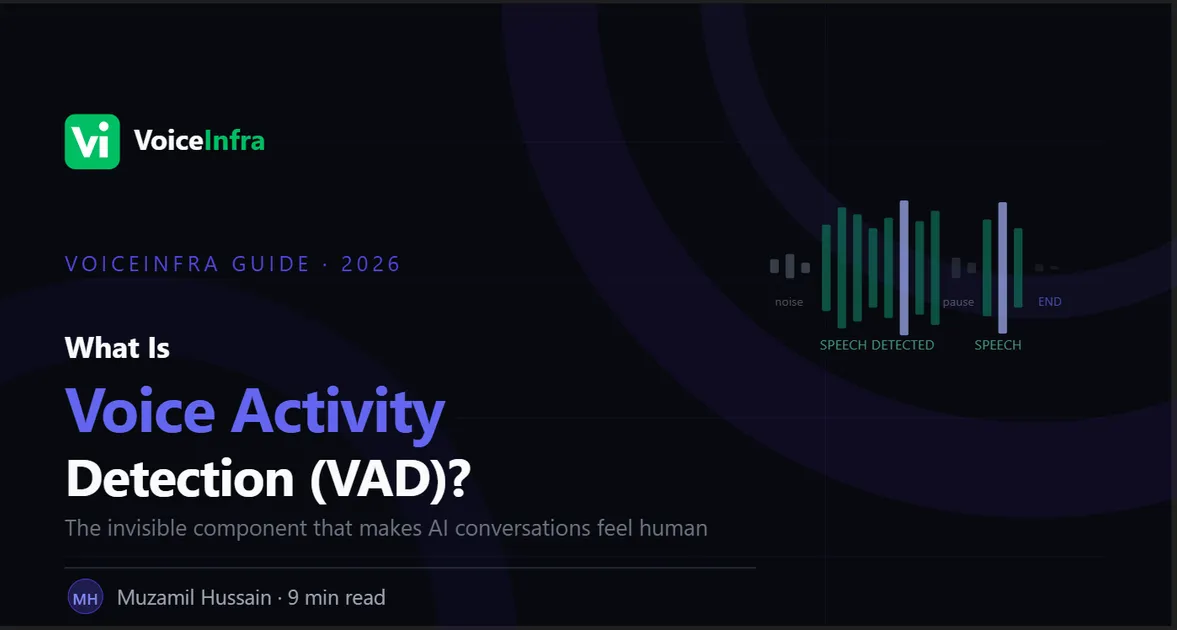
Voice Activity Detection, commonly known as VAD, is a technology that detects whether an incoming audio signal contains human speech or not.
Instead of processing every sound continuously, VAD identifies when someone starts speaking and when they stop.
This allows Voice AI systems to:
Detect the beginning of speech
Detect the end of speech
Ignore silence
Ignore background noise
Trigger speech recognition only when someone is actually talking
Without VAD, Voice AI systems would waste computing resources processing silence and unwanted sounds.
Why Is Voice Activity Detection Important?
Imagine calling an AI-powered customer support agent.
You ask:
"I'd like to upgrade my internet plan."
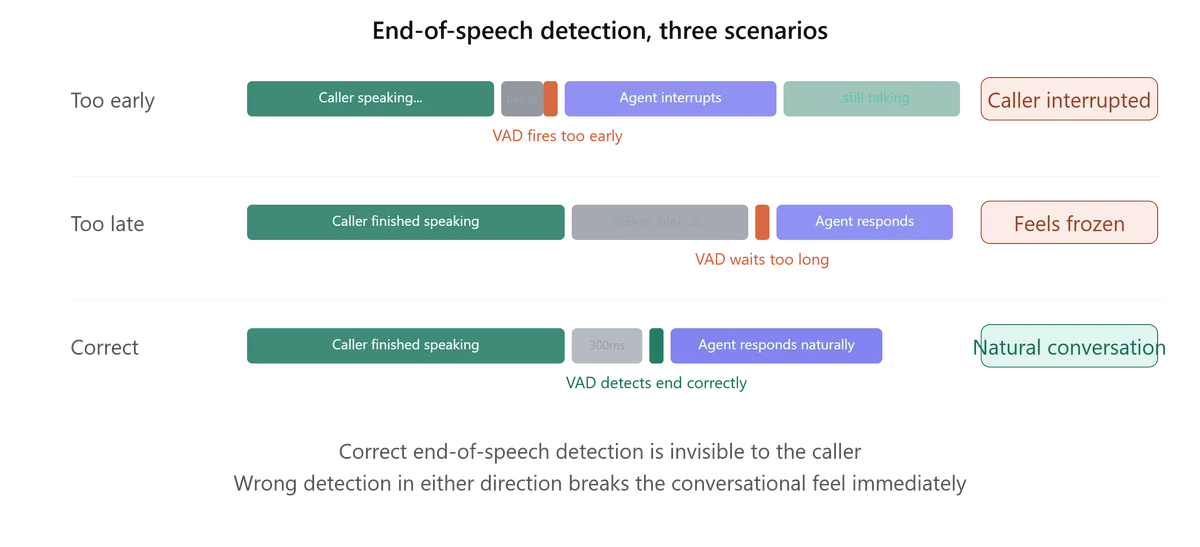
The AI needs to determine exactly when you've finished speaking before generating a response.
If it responds too early, it interrupts you.
If it responds too late, the conversation feels slow and unnatural.
VAD helps find the right balance by accurately identifying when speech starts and ends.
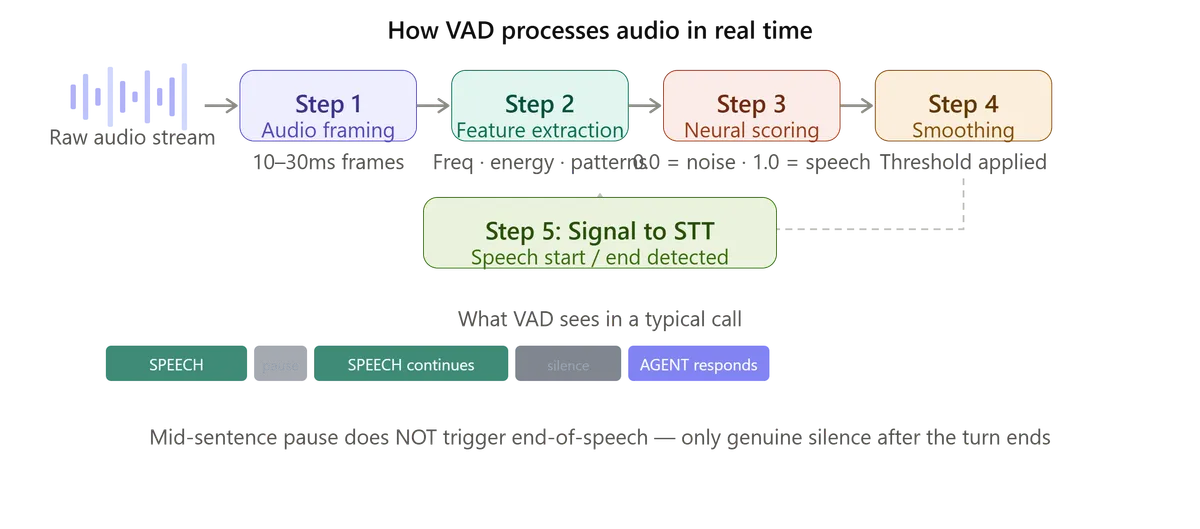
How Does Voice Activity Detection Work?
Although different systems use different algorithms, the overall process is similar.
Step 1: Capture Audio
The microphone continuously receives audio from the caller.
This audio contains:
Human speech
Background noise
Silence
Keyboard clicks
Music
Environmental sounds
Step 2: Analyze the Audio Signal
The VAD engine analyzes small chunks of audio, often just a few milliseconds long.
It looks for characteristics commonly found in human speech, including:
Energy levels
Frequency patterns
Voice characteristics
Signal changes over time
Modern AI systems may also use machine learning models to improve detection accuracy in noisy environments.
Step 3: Classify Speech or Silence
The algorithm decides whether each audio segment contains:
Speech
Non-speech
If speech is detected, the system continues listening.
If silence is detected for a configured duration, the AI assumes the speaker has finished talking.
Step 4: Trigger the Next AI Component
Once speech ends, the audio is passed to the Automatic Speech Recognition (ASR) system.
The workflow typically looks like this:
Microphone → Voice Activity Detection → Speech Recognition (ASR) → Large Language Model (LLM) → Text-to-Speech (TTS)This pipeline enables fast and natural conversations.
Benefits of Voice Activity Detection
Faster AI Responses
The AI knows exactly when to begin processing your request, reducing unnecessary delays.
Lower Latency
Since only speech is processed, the system spends less time handling silence and background noise.
For real-time Voice AI applications, reducing latency is essential because even small delays can make conversations feel unnatural.
Reduced Computing Costs
Processing continuous audio consumes more computing resources.
VAD limits processing to speech segments only, helping reduce infrastructure costs.
Improved Speech Recognition
Background noise and silent audio can reduce transcription accuracy.
By filtering out unnecessary audio, VAD improves the performance of speech recognition systems.
Better User Experience
Natural conversation depends heavily on timing.
Accurate VAD helps AI avoid interrupting users while also preventing awkward pauses.
Where Is Voice Activity Detection Used?
VAD is widely used across modern voice applications.
Common examples include:
AI Receptionists
AI Call Centers
Virtual Assistants
Smart Speakers
Voice Chat Applications
Video Conferencing Platforms
Customer Support Automation
Healthcare Voice Systems
Banking Voice Assistants
Automotive Voice Assistants
Anywhere real-time speech is involved, VAD is usually working behind the scenes.
Types of Voice Activity Detection
There isn't just one type of VAD.
Different applications require different approaches.
Energy-Based VAD
This is the simplest method.
If the audio signal exceeds a predefined energy threshold, it is classified as speech.
Advantages:
Very fast
Low computational cost
Disadvantages:
Performs poorly in noisy environments
Statistical VAD
These systems analyze additional characteristics of the audio signal beyond volume alone.
They are generally more reliable than simple energy-based approaches.
AI-Based Voice Activity Detection
Modern Voice AI platforms increasingly use machine learning and deep learning models for VAD.
These models can distinguish speech from challenging background noise much more accurately.
They are especially useful in contact centers where callers may be speaking from busy environments.
Voice Activity Detection vs Noise Suppression
These technologies often work together, but they solve different problems.
| Voice Activity Detection | Noise Suppression |
|---|---|
| Detects when someone is speaking | Removes unwanted background noise |
| Identifies speech boundaries | Cleans the audio signal |
| Determines when AI should listen | Improves audio quality |
| Controls conversation timing | Improves transcription accuracy |
Both technologies are essential for building high-quality Voice AI systems.
Voice Activity Detection vs Endpoint Detection
These terms are sometimes used interchangeably, but they are not exactly the same.
Voice Activity Detection determines whether speech is present.
Endpoint Detection determines when an entire utterance has finished so the AI can begin responding.
Many modern Voice AI platforms combine both technologies to achieve natural conversation timing.
Best Practices for Voice Activity Detection
To build responsive Voice AI applications, consider these best practices:
Use AI-based VAD for noisy environments.
Tune silence thresholds carefully to avoid interruptions.
Combine VAD with noise suppression.
Test with real customer conversations rather than studio recordings.
Continuously monitor latency and conversation quality.
How VoiceInfra Uses Voice Activity Detection
VoiceInfra uses Voice Activity Detection as part of its real-time Voice AI pipeline to create fast and natural customer conversations.
Working alongside speech recognition, language models, and text-to-speech systems, VAD helps VoiceInfra:
Detect when callers begin speaking
Identify when they've finished speaking
Reduce unnecessary processing
Improve response speed
Deliver more natural conversational experiences
Support enterprise-scale AI voice applications
Rather than treating every audio stream the same, VoiceInfra intelligently processes only active speech, helping businesses deliver faster, more accurate, and more reliable AI-powered phone interactions.
Try VoiceInfra for Free
Want to see Voice Activity Detection in action?
Create your free VoiceInfra account and explore the platform yourself. You can build AI voice agents, test real-time conversations, and experience how Voice Activity Detection improves response speed and conversation quality.
👉 Sign up for free: https://portal.voiceinfra.ai/
You can also explore the VoiceInfra Portal to see the available features and start building your first AI voice agent in just a few minutes.
Final Thoughts
Voice Activity Detection may not be visible to users, but it is one of the most important technologies behind modern Voice AI.
By accurately identifying when people are speaking and when they have stopped, VAD enables faster responses, lower latency, improved speech recognition, and more natural conversations.
Whether you're building an AI receptionist, a virtual assistant, or an enterprise contact center, choosing the right Voice Activity Detection approach can significantly improve both user experience and system performance.
Frequently Asked Questions
What does Voice Activity Detection do?
Voice Activity Detection identifies whether an audio signal contains human speech or silence. It helps Voice AI systems know when to listen and when to respond.
Is Voice Activity Detection the same as speech recognition?
No. VAD detects the presence of speech, while speech recognition converts spoken words into text.
Does Voice Activity Detection reduce latency?
Yes. By processing only speech instead of continuous audio, VAD helps reduce response time and improves the overall speed of Voice AI applications.
Can Voice Activity Detection work in noisy environments?
Yes. Modern AI-based VAD models are designed to distinguish human speech from background noise, making them much more reliable than traditional energy-based methods.
Why is VAD important for AI voice agents?
Without VAD, AI voice agents may interrupt users, respond too late, or waste computing resources processing silence. Accurate VAD makes conversations feel faster and more natural.
Related reading:
How Speech-to-Text (STT) Works in Voice AI Agents
What is LLM Latency in Voice AI & How to Reduce It Below 500ms