Every business has a phone number. Most of them treat it like a liability.
Calls go unanswered after 5pm. Customers sit on hold while the one person who knows the answer is with another customer. The same five questions get answered fifty times a day by staff who have more important things to do. New leads call, no one picks up, and they move on to a competitor who did.
None of this is new. What's new in 2026 is that there's no longer a reasonable excuse for it.
AI phone agents have crossed the threshold from interesting technology to practical business infrastructure. The voice quality is there. The accuracy is there. The integrations are there. The cost is within reach of businesses that aren't enterprise. And the gap between businesses that have deployed them and businesses that haven't is starting to show up in customer satisfaction scores, in lead conversion rates, and in the operational costs of running a support team.
This isn't a guide about what AI phone agents are. It's a guide about why 2026 is the year your business specifically needs one, and what happens if you keep waiting.
The Phone Channel Is Not Going Away
Before anything else, it's worth addressing the assumption that the phone is a dying channel being replaced by chat, email, and messaging apps.
The data doesn't support this. Phone remains the preferred contact channel for urgent issues, older demographics, high-value transactions, and any situation where the customer needs an answer right now rather than a response sometime later. Healthcare appointments get booked by phone. Insurance claims get reported by phone. Complex orders, service disputes, and account changes get handled by phone, because people instinctively reach for a call when something important needs to go right.
What has changed is caller expectations. A customer who gets a fast, accurate response from a website chatbot now has a reference point for what automation should feel like. When they call a business and get a four-minute hold time followed by a menu tree followed by being transferred, that experience now feels comparatively worse than it did five years ago.
The phone channel isn't dying. It's just overdue for the same quality upgrade that online chat got a few years ago.
What's Actually Different in 2026
The honest answer to "why now" is that the technology has improved enough to stop being the limiting factor.
Three years ago, voice AI was a demo that worked on pre-scripted queries and broke the moment a caller said anything unexpected. The STT accuracy wasn't good enough for real-world conditions. The LLMs weren't fast enough to hit sub-second response times on a live call. The TTS voices were robotic enough that callers noticed and lost trust immediately.
All three of those constraints have materially changed.
STT accuracy on leading providers is now above 95% word accuracy even on compressed 8kHz phone audio with accents and background noise. The gap between "what the caller said" and "what the system heard" is narrow enough to stop being the primary source of failure.
LLM latency with streaming token output and intelligent model routing is now consistently under 500ms for most queries, which is within the range that feels like normal conversational timing rather than a noticeable delay.
TTS voice quality from providers like ElevenLabs and Cartesia has reached the point where callers in production deployments frequently don't know they're talking to an AI until the end of the call, if at all.
The technology was always going to get here. It got here in 2025 and 2026. The businesses that moved early are now a year into learning what actually works in their environment. The businesses still waiting are a year behind.
The Real Cost of Not Having One
The case for an AI phone agent is usually framed as cost reduction. That's accurate but incomplete. The fuller picture includes costs that don't appear on a staffing budget but show up in outcomes.
Missed calls are missed revenue. A study of small and mid-size businesses consistently finds that 30 to 40% of inbound calls go unanswered, primarily outside business hours. Each missed call is a potential customer who called once and didn't call back. For a business where the average customer is worth $500 or $5,000, the math on missed calls compounds quickly.
Hold time affects conversion. Callers who reach a queue and wait longer than 90 seconds abandon at a rate of 35 to 40%. The customers most likely to abandon are often the highest-intent ones, they called instead of using the website because they were ready to move forward, not because they were browsing. Losing them to hold time is losing an active buyer.
Staff time has an invisible cost. When a human agent answers "what are your hours" for the fifteenth time today, the cost is real even if it doesn't show up as a line item. That answer took 90 seconds. Across 20 such calls, it's 30 minutes of time that could have been spent on something that actually requires human judgment. Multiply that across a team and a month, and the hidden labor cost of routine calls is significant.
After-hours is an undefended gap. Healthcare providers lose appointment bookings to clinics that offer online scheduling because their phone line goes to voicemail at 5pm. Service businesses lose emergency requests to competitors who answer. The after-hours gap isn't a niche problem, it's a structural weakness in any business whose customers don't operate on office hours.
What an AI Phone Agent Actually Handles
The most common misconception about AI phone agents is that they're IVR with a better voice. That framing limits what businesses look for and what they deploy.
A production AI phone agent in 2026 can handle full conversations across a range of intent types, not just route calls. Here's what that looks like across different business categories:
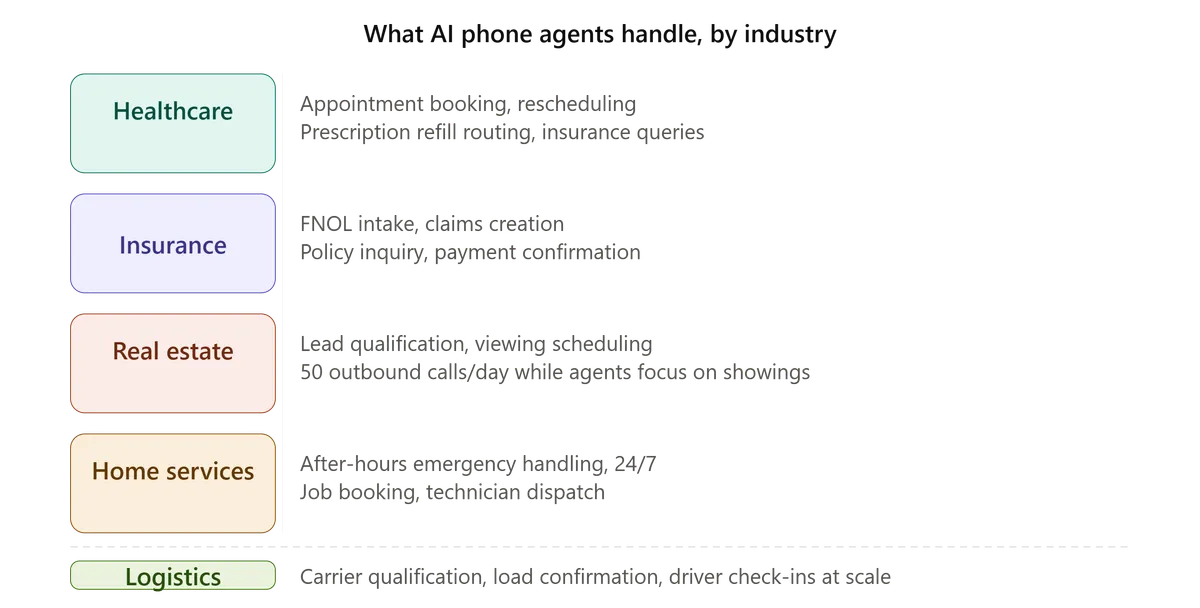
Healthcare. Inbound scheduling calls, appointment reminders, prescription refill routing, insurance verification queries, after-hours triage. The agent books, reschedules, and cancels in the practice management system in real time. A patient who calls at 7pm to reschedule for next Tuesday gets it done on that call.
Insurance. First notice of loss intake, policy inquiry, premium payment confirmation, claims status checks. The agent collects the required information, creates the record, and routes the case to the right adjuster, all on the initial call. The adjuster picks it up with full context already attached.
Real estate. Lead qualification from new inquiry calls, property information delivery, viewing scheduling, follow-up on existing leads who haven't responded to emails. Agents make 50 outbound qualification calls a day while the human team focuses on the showings.
Home services and trades. After-hours emergency call handling, job booking, technician dispatch coordination, estimate scheduling. The agent answers at 11pm when a pipe bursts and books the emergency call while the human crew is asleep.
Logistics and freight. Carrier qualification, load confirmation, driver check-ins, delivery status updates. An outbound campaign calls 200 carriers in a morning to cover a lane, at a scale that would require four full-time dispatchers to replicate manually.
The Business Case in Numbers
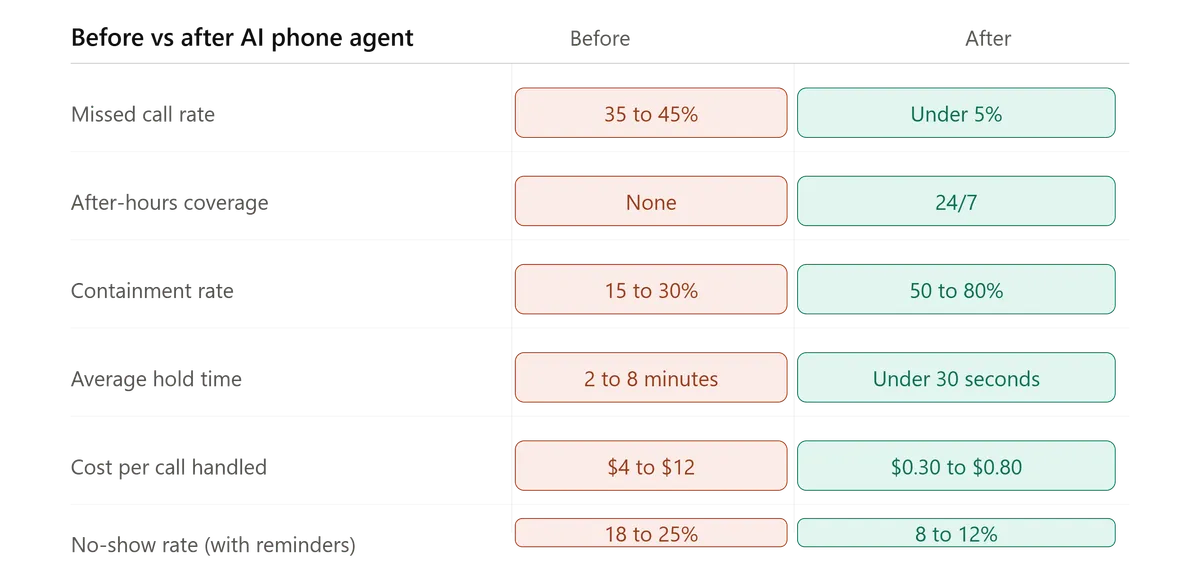
These are real-world numbers drawn from production deployments, not projections:
| Metric | Before AI Phone Agent | After AI Phone Agent |
|---|---|---|
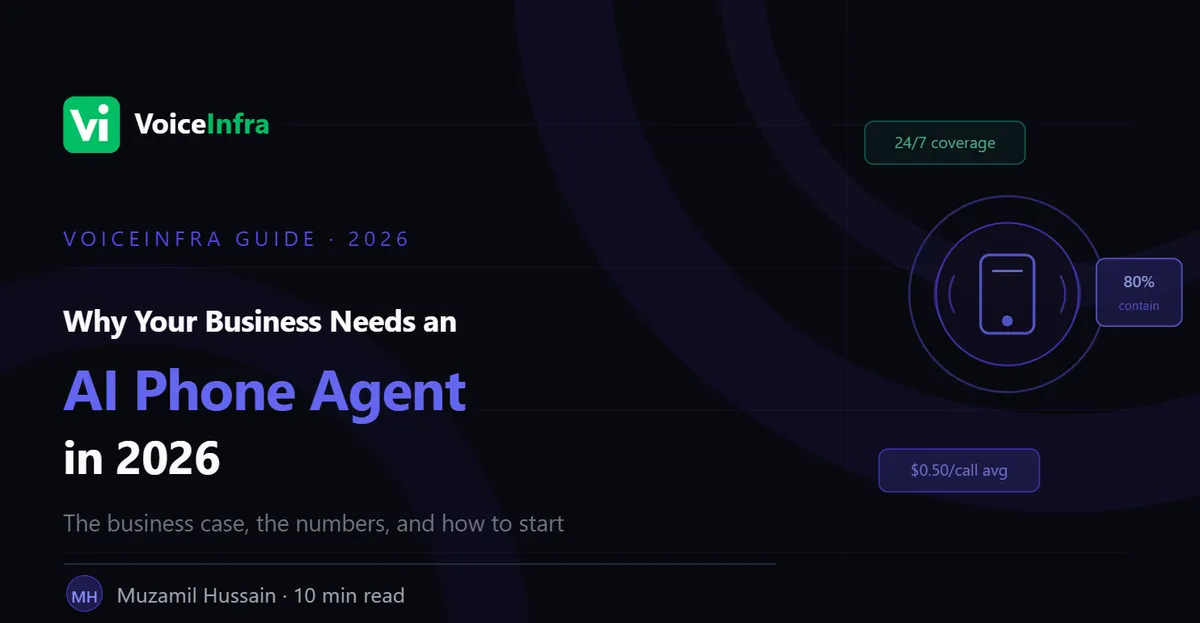
| Missed Call Rate | 35–45% | Under 5% |
| After-hours Coverage | None | 24/7 |
| Calls Resolved Without Human | 15–30% (with basic IVR) | 50–80% |
| Average Hold Time | 2–8 minutes | Under 30 seconds |
| Cost per Call Handled | $4–$12 (human agent blended) | $0.30–$0.80 (AI handled) |
| Appointment No-show Rate (with reminders) | 18–25% | 8–12% |
The containment rate improvement is the number that drives most of the ROI. Moving from 20% containment (basic IVR) to 65% containment (well-configured AI agent) means 45% fewer calls reaching a human agent, across whatever volume your business handles. At 1,000 calls per month with a $6 blended cost per human-handled call, that's a $2,700 monthly saving on that metric alone, before factoring in missed call recovery or after-hours revenue.
Common Objections, Addressed Honestly
"Our customers prefer talking to a human." Some do, particularly for complex or sensitive interactions. A well-designed AI phone agent doesn't try to replace those interactions, it identifies them and escalates with full context attached so the human conversation that follows is better, not worse. The preference for a human on simple, repetitive queries is usually lower than businesses assume, customers prefer resolution, and they'll accept automation when it resolves their issue quickly.
"Our use case is too complex." This is almost always true for some percentage of calls and almost never true for all of them. A realistic deployment starts with the calls that are genuinely automatable, the appointment bookings, the status checks, the FAQ queries, and adds complexity over time as the agent proves itself. Most businesses find that 50 to 70% of their call volume is within scope for automation in the first deployment, even in industries they assumed were "too complex."
"We tried a chatbot and it didn't work." Chatbots and voice AI agents are different categories of product with different architectures, different latency requirements, and different conversation design principles. A chatbot that failed on your website is evidence that that particular chatbot wasn't right for that channel, not evidence that AI-powered conversation doesn't work over the phone.
"The timing isn't right." Every year of delay is a year of missed call revenue, a year of staff spending time on repetitive queries, and a year of competitors who moved earlier building operational advantages that compound. The technology isn't experimental anymore. The timing question has an increasingly clear answer.
How to Start: Picking the First Use Case
The fastest path to value is not deploying an AI agent that handles everything. It's deploying one that handles one well-defined use case, proving it, and expanding from there.
The right first use case has three characteristics: high volume (so the impact is visible quickly), low variance (the calls follow a predictable pattern), and clear resolution (there's a defined outcome the agent can deliver, not just a handoff).
For most businesses, this looks like one of the following:
Appointment scheduling. High volume, structured conversation, clear outcome (slot booked, confirmation sent). Works across healthcare, services, real estate, and any business where a calendar is involved.
After-hours answering. The agent handles calls during the hours when no human is available. Even a basic deployment that collects caller information and schedules callbacks is dramatically better than voicemail, and it starts generating ROI on the first night it's live.
Outbound reminders. Appointment reminders, payment reminders, follow-up calls on open leads. High volume, structured, measurable outcome (confirmation received, payment made, meeting booked).
Pick one. Configure it well. Measure the containment rate and the call outcome. Then expand.
Final Thought
The question "should we get an AI phone agent" is being replaced, slowly but visibly, by "why haven't we deployed one yet."
Not because it's a trend to follow, but because the business case has become straightforward: the technology works, the cost is justified, the gap between businesses that have deployed and businesses that haven't is growing, and the phone channel isn't disappearing.
For most businesses, the limiting factor is no longer the technology. It's the decision to start, and the selection of the first use case to prove the concept on.
Both of those are smaller hurdles than they were two years ago.
Ready to build your own AI phone agent?
Create your free VoiceInfra account and start building AI phone agents in minutes. Test real inbound and outbound calls, connect your knowledge base, and see how VoiceInfra works with your own business workflows.
Sign Up For Free Now and start building today
Related reading:
What is a Voice AI Agent? How It Works, Components & Real Examples
Voice AI Agent vs Traditional IVR: What's the Real Difference?
Inbound vs Outbound Voice AI Agents: Use Cases, Setup & Cost