Understanding the Technology Behind Modern Business Calling
For decades, businesses relied on traditional telephone systems such as analog phone lines and PRI circuits to handle customer communication.
These systems worked, but they had limitations:
Expensive hardware requirements
Limited scalability
Difficult maintenance
High calling costs
Slow deployment
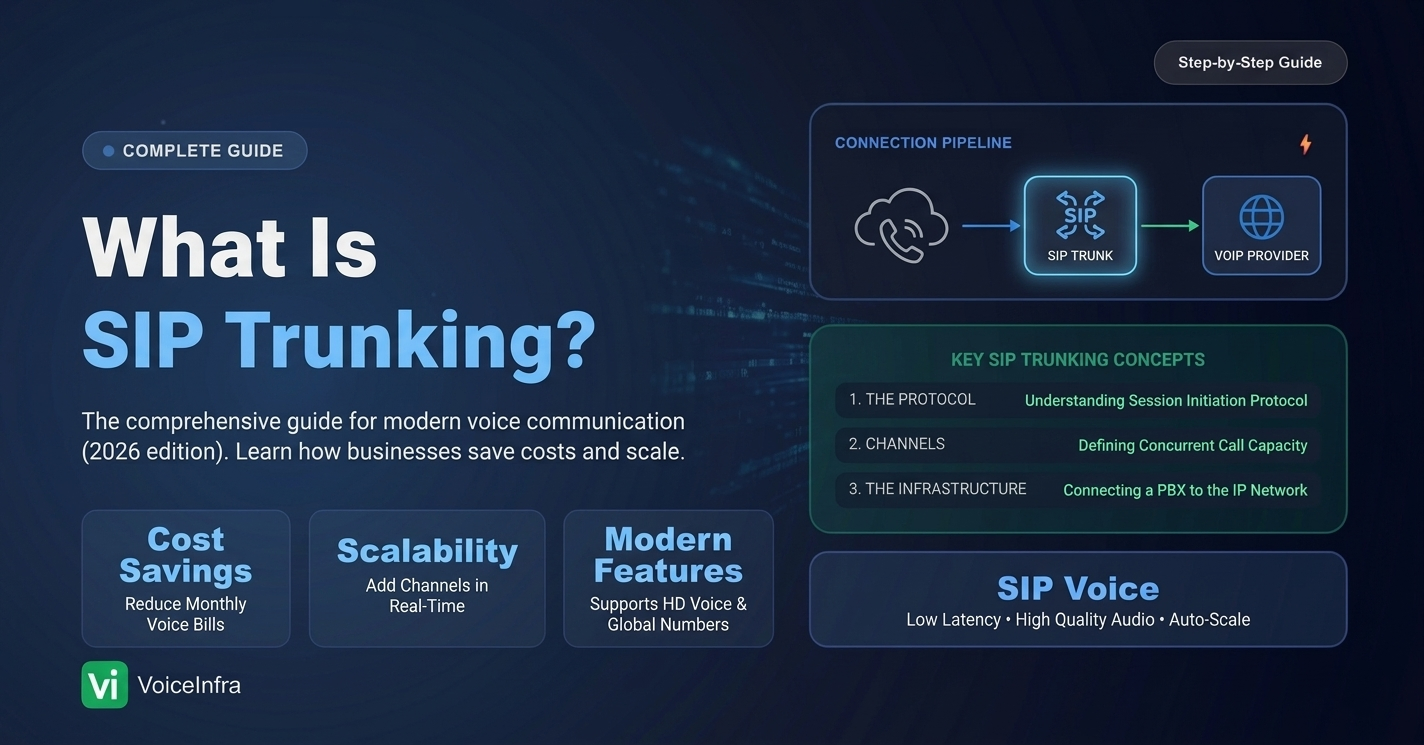
SIP Trunking changed how businesses connect their phone systems to the outside world.
Session Initiation Protocol (SIP) Trunking is a technology that allows businesses to make and receive voice calls over an internet connection instead of traditional telephone lines.
Instead of using physical phone circuits, SIP trunks use IP networks to connect a company's Private Branch Exchange (PBX) to the Public Switched Telephone Network (PSTN).
Simply put:
SIP Trunking replaces traditional phone lines with internet-based voice communication.
How SIP Trunking Works
A SIP trunk acts as a virtual connection between your business phone system and telephone networks.
A simplified call flow looks like this:
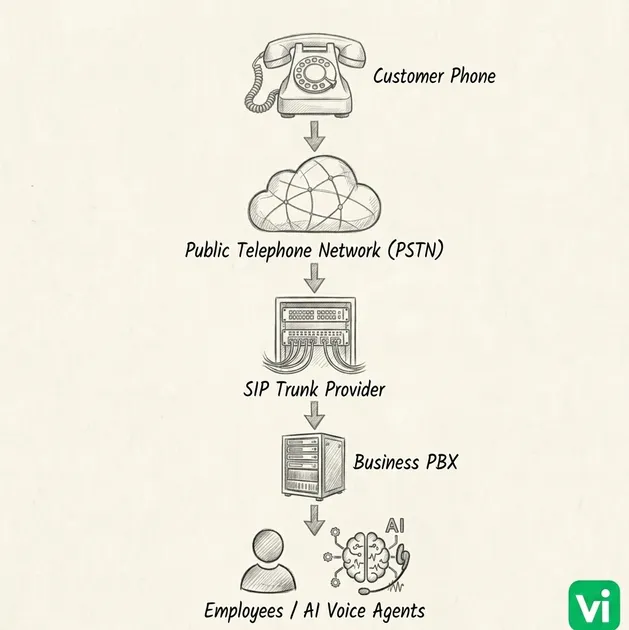
When someone calls your business:
The call reaches the SIP trunk provider.
The provider routes the call through the SIP trunk.
The PBX receives the call.
The PBX sends it to the correct extension, department, or AI voice agent.
For outbound calls, the process works in reverse.
What Is a SIP Trunk?
A SIP trunk is a virtual communication channel that uses SIP signaling to connect a business phone system to external telephone networks.
Unlike traditional phone lines, a SIP trunk does not require a physical connection for every phone number.
A single SIP trunk can support:
Multiple phone numbers
Multiple simultaneous calls
International calling
Call routing
Disaster recovery
AI-powered call automation
SIP Trunking Architecture
Traditional Phone System
Before SIP Trunking:
Phone Line
    │
    │
Telephone Carrier
    │
    │
PBX
    │
    │
Employees
Each phone line required dedicated physical infrastructure.
Modern SIP Trunk Architecture
With SIP Trunking:
Customer
    │
    │
PSTN
    │
    │
SIP Trunk Provider
    │
    │
Internet Connection
    │
    │
PBX / Cloud PBX
    │
    │
Employees
This architecture provides more flexibility and easier scaling.
Why Businesses Use SIP Trunking
Businesses adopt SIP Trunking because it improves flexibility, reduces infrastructure costs, and enables modern communication features.
Major advantages include:
1. Lower Communication Costs
Traditional phone systems often require:
Physical phone lines
Carrier circuits
Expensive hardware
Maintenance contracts
SIP Trunking reduces these requirements by using existing IP infrastructure.
Businesses can often reduce:
Monthly phone bills
Long-distance charges
Hardware costs
Maintenance expenses
2. Easy Scalability
With traditional phone systems, adding more users often requires installing additional physical lines.
SIP Trunking makes expansion easier.
Businesses can increase capacity by adjusting their SIP trunk configuration.
This is especially useful for:
Growing companies
Contact centers
Seasonal businesses
Enterprise organizations
3. Support for Remote Work
Modern companies need communication systems that work from anywhere.
SIP Trunking enables:
Remote extensions
Cloud PBX deployments
Distributed teams
Multi-location offices
Employees can stay connected without being tied to a physical office phone.
SIP Trunking and Voice AI
SIP Trunking has become a critical technology for modern AI voice applications.
AI voice platforms use SIP connectivity to communicate with traditional phone networks.
A typical AI voice architecture:
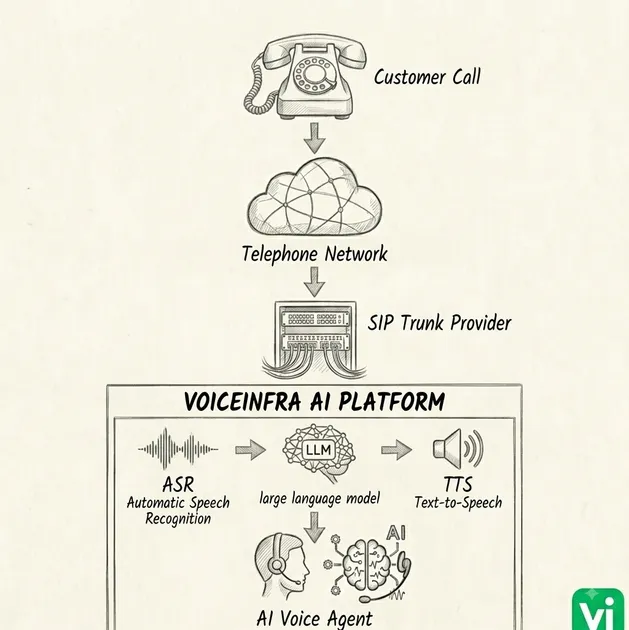
In this setup:
SIP connects the phone network.
ASR converts speech into text.
LLM understands customer intent.
TTS generates the AI response.
This allows businesses to deploy AI receptionists and AI call agents without replacing their existing phone infrastructure.
SIP Trunking vs Traditional Phone Lines (Quick Comparison)
| Feature | Traditional Phone Lines | SIP Trunking |
|---|---|---|
| Connection Type | Physical circuits | Internet-based |
| Scalability | Limited | Highly scalable |
| Hardware | More hardware required | Less hardware |
| Deployment Speed | Slow | Fast |
| Remote Work | Limited | Excellent |
| AI Integration | Difficult | Easy |
| Multiple Locations | Complex | Simple |
Real-World SIP Trunking Use Cases
SIP Trunking is widely used across industries.
Contact Centers
Businesses use SIP trunks to handle thousands of customer calls with flexible capacity.
Healthcare
Hospitals and clinics use SIP communication for:
Patient support
Appointment systems
Call routing
Financial Services
Banks use SIP-based communication for:
Customer support
Secure calling systems
Automated services
Telecom Operators
Telecom companies use SIP trunking to connect networks and deliver voice services.
AI Voice Agents
Modern AI platforms use SIP trunks to connect AI agents with real telephone numbers and existing business phone systems.
Did You Know?
SIP Trunking does not replace the entire phone system.
Instead, it replaces the connection between your phone system and the outside world.
Your PBX, extensions, and internal call routing can remain the same while SIP replaces old telephone circuits.
Key Takeaways
SIP Trunking replaces traditional phone lines with internet-based communication.
It connects business PBXs to the PSTN using SIP technology.
It improves scalability, flexibility, and cost efficiency.
SIP Trunks are a foundation for modern VoIP and Voice AI systems.
Businesses can adopt AI calling solutions without completely replacing existing phone infrastructure.
SIP Trunking Technical Architecture Explained
Understanding the internal architecture of SIP Trunking helps businesses design reliable, secure, and scalable communication systems.
A SIP Trunk environment usually contains multiple components working together:
SIP Provider
Session Border Controller (SBC)
PBX / Cloud PBX
SIP Endpoints
Media Servers
Voice AI Platforms
Each component has a specific role in establishing and managing voice communication.
Components of a SIP Trunking System
1. SIP Trunk Provider
The SIP provider connects the business communication system to the Public Switched Telephone Network (PSTN).
The provider manages:
Phone numbers (DIDs)
Call routing
Carrier connections
International termination
Voice traffic management
Examples of SIP trunk providers include telecom carriers and cloud communication platforms.
2. Private Branch Exchange (PBX)
A PBX is the internal phone system that manages communication inside an organization.
A PBX handles:
Extensions
Call transfers
IVR menus
Call queues
Voicemail
Internal calling
Modern businesses often use:
Cloud PBX
IP PBX
Software-based PBX systems
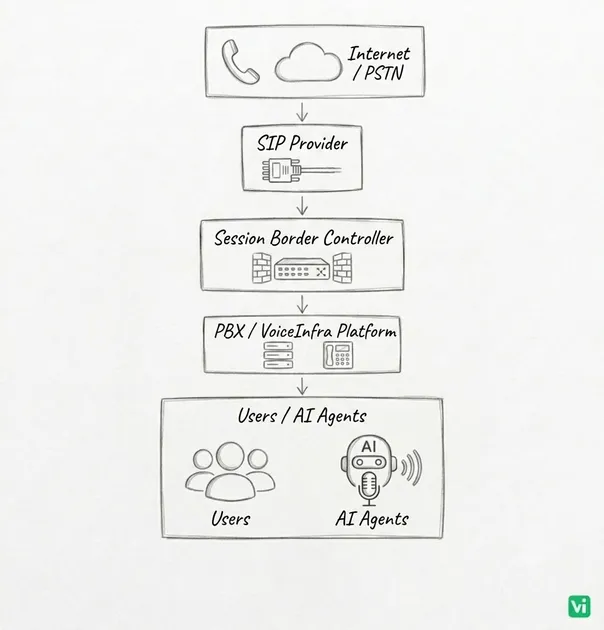
3. Session Border Controller (SBC)
An SBC acts as a security gateway between the business network and external SIP networks.
It provides:
Security protection
Protocol conversion
NAT traversal
Call admission control
Media handling
A simplified architecture:
SIP Trunk Call Flow Explained
Let's understand what happens when a customer calls a business.
Incoming Call Flow
Customer
   │
   │  INVITE
   ▼
SIP Provider
   │
   ▼
SBC
   │
   ▼
PBX
   │
   ▼
Employee / AI Voice Agent
Steps:
Customer dials the business number.
The carrier receives the call.
SIP signaling creates the session.
The SIP trunk routes the call to the business PBX.
The PBX sends the call to the correct destination.
Outbound Call Flow
For outbound calls:
Employee / AI Agent
        │
        ▼
       PBX
        │
        ▼
       SBC
        │
        ▼
 SIP Trunk Provider
        │
        ▼
     Customer
The SIP trunk provider authenticates the request and connects the call to the destination network.
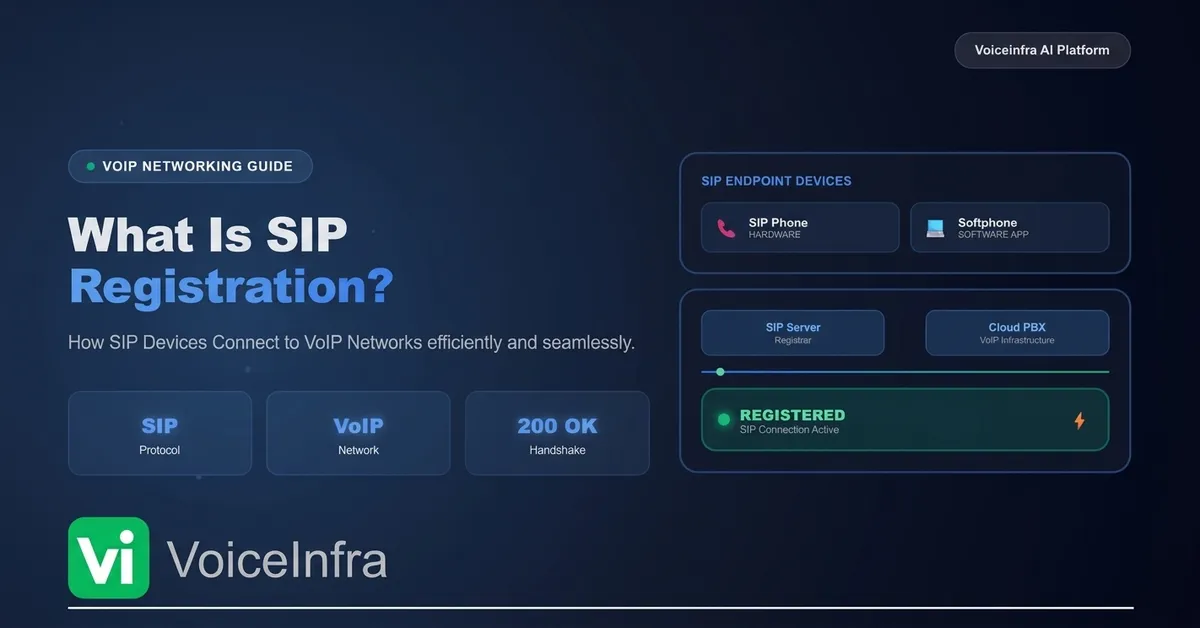
SIP Trunk vs SIP Registration
Many people confuse SIP Trunking with SIP Registration.
They are related but completely different.
| SIP Trunking | SIP Registration |
|---|---|
| Connects PBX to telephone networks | Connects devices to SIP server |
| Used for external calls | Used for endpoint availability |
| Handles carrier connectivity | Handles user/device location |
| Used by businesses and carriers | Used by phones and extensions |
Example:
A company may have:
Employees' phones registered to the PBX
PBX connected to the PSTN through SIP Trunking
Both work together.
SIP Trunk vs VoIP
These terms are often used together but they are not identical.
| SIP Trunking | VoIP |
|---|---|
| A specific technology for connecting phone systems | General term for voice communication over IP networks |
| Uses SIP protocol | Can use multiple protocols |
| Usually connects businesses to carriers | Includes many internet calling solutions |
| Enterprise-focused | Consumer and enterprise use |
A simple explanation:
VoIP is the overall concept.
SIP Trunking is one method used to implement business VoIP.
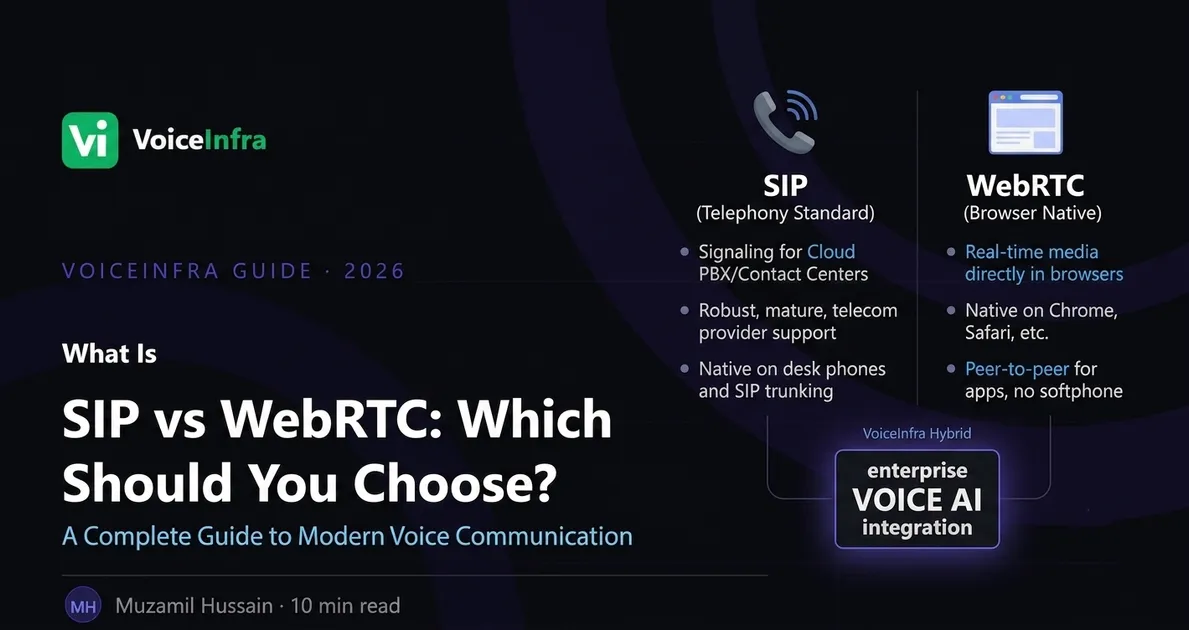
SIP Trunk vs WebRTC
SIP Trunking and WebRTC serve different purposes.
| SIP Trunking | WebRTC |
|---|---|
| Connects phone systems to PSTN | Enables browser communication |
| Designed for telecom networks | Designed for web applications |
| Uses SIP signaling | Uses browser APIs |
| Common in enterprises | Common in browser apps |
| Great for phone numbers | Great for web calling |
Modern Voice AI platforms often combine both:
Phone Network
      │
 SIP Trunk
      │
VoiceInfra AI
      │
WebRTC Dashboard
      │
Browser Monitoring
Understanding Concurrent Calls
One important SIP Trunking concept is concurrent call capacity.
A SIP trunk does not usually depend on the number of phone numbers.
Instead, it depends on how many calls can happen simultaneously.
Example:
A business has:
10 phone numbers
50 employees
20 concurrent call channels
This means:
20 calls can happen at the same time.
SIP Channels Explained
A SIP channel represents one simultaneous call session.
For example:
| SIP Channels | Suitable For |
|---|---|
| 5 Channels | Small businesses |
| 20 Channels | Growing companies |
| 100+ Channels | Contact centers |
| 1,000+ Channels | Large enterprises |
The required number depends on:
Call volume
Average call duration
Peak calling hours
Business requirements
Voice Codecs in SIP Trunking
Codecs determine how voice audio is compressed and transmitted.
Common SIP codecs include:
G.711
Characteristics:
High voice quality
Uses more bandwidth
Common in enterprise networks
G.729
Characteristics:
Lower bandwidth usage
Reduced audio quality
Used where bandwidth is limited
Opus
Characteristics:
Modern high-quality codec
Adaptive bitrate
Popular in WebRTC and AI voice applications
SIP Trunk Security
Security is critical because SIP trunks connect directly to public communication networks.
Common security technologies include:
TLS Encryption
Protects SIP signaling messages.
SRTP Encryption
Protects voice media streams.
Session Border Controllers
Protect against:
SIP attacks
Toll fraud
Unauthorized access
Network threats
Enterprise SIP Trunk Architecture with Voice AI
Modern businesses increasingly combine SIP Trunking with AI systems.
Example architecture:
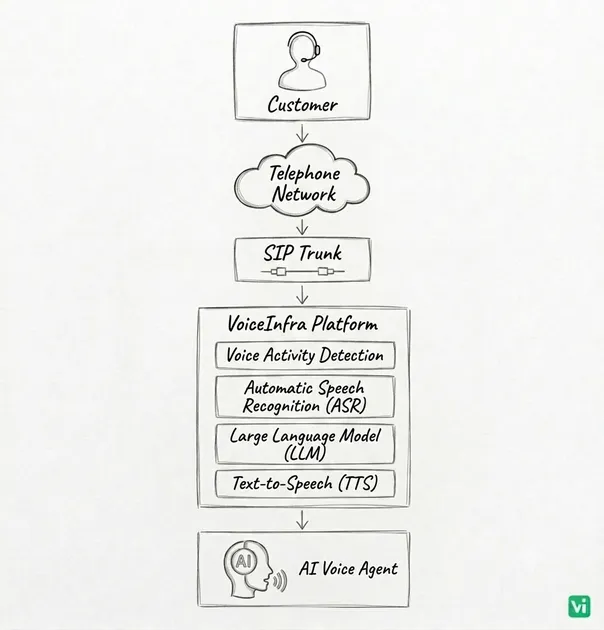
This architecture allows businesses to automate:
Customer support calls
Appointment booking
Sales calls
Technical support
After-hours reception
Benefits of SIP Trunking for Businesses
SIP Trunking is not only a replacement for traditional phone lines. It is a foundation for modern business communication.
Organizations adopt SIP Trunking because it provides better flexibility, scalability, reliability, and integration capabilities.
1. Cost Savings
One of the biggest reasons businesses move to SIP Trunking is reducing communication expenses.
Traditional telephone systems often require:
Physical phone circuits
Separate voice lines
Expensive hardware
Carrier maintenance
On-site infrastructure
SIP Trunking reduces many of these requirements by using existing IP networks.
Businesses can save through:
Lower monthly line rental costs
Reduced long-distance calling charges
Less hardware dependency
Easier management
However, the actual savings depend on:
Current telecom setup
Call volume
SIP provider pricing
Number of channels required
Geographic locations
When publishing pricing examples, always reference the provider's official pricing pages so customers can verify current rates.
2. Better Scalability
Traditional phone systems require additional physical lines when a company grows.
This creates problems:
Installation delays
Hardware limitations
Higher costs
With SIP Trunking, businesses can increase capacity by adding more concurrent call channels.
Example:
A company starts with:
10 concurrent calls
Later grows to:
100 concurrent calls
The SIP trunk capacity can be increased without replacing the entire communication system.
This makes SIP Trunking ideal for:
Growing companies
Call centers
Seasonal businesses
Enterprise organizations
3. Support for Multiple Locations
Global businesses often operate across different offices.
Traditional phone systems require separate infrastructure for every location.
SIP Trunking enables:
Centralized communication
Unified phone numbers
Shared PBX systems
Remote extensions
Example:
Office A
   │
Office B ─── SIP Trunk ─── Cloud PBX
   │
Office C
Employees across different locations can communicate through one unified system.
4. Improved Reliability and Disaster Recovery
Modern SIP solutions provide better business continuity options.
Features include:
Call routing flexibility
Backup destinations
Geographic redundancy
Failover routing
Example:
If an office internet connection fails:
Normal:

Customer
   │
SIP Trunk
   │
Office PBX


Failure:

Customer
   │
SIP Trunk
   │
Backup Location / Cloud Platform
Calls can automatically redirect to another destination.
5. Enables Voice AI Integration
One of the biggest advantages of SIP Trunking today is its ability to connect traditional phone networks with Artificial Intelligence.
Businesses can connect SIP trunks with Voice AI platforms to build:
AI receptionists
AI customer support agents
Automated appointment systems
Outbound sales agents
Call analytics systems
Example:
Customer Call

      ↓

SIP Trunk

      ↓

VoiceInfra AI Platform

      ↓

ASR → LLM → TTS

      ↓

AI Voice Agent
SIP Trunking provides the communication layer, while AI provides intelligence.
SIP Trunking Deployment Options
Businesses usually choose between two deployment models.
Cloud SIP Trunking
In cloud-based SIP Trunking:
The SIP provider manages most infrastructure.
Architecture:
Business Network

       │

Internet

       │

Cloud SIP Provider

       │

PSTN
Advantages:
Faster deployment
Lower hardware requirements
Easier scaling
Remote management
Best for:
Small businesses
Distributed teams
Companies adopting cloud communication
On-Premise SIP Trunking
In an on-premise deployment:
The business manages its own PBX infrastructure.
Architecture:
PSTN

 │

SIP Provider

 │

SBC

 │

Company PBX

 │

Employees
Advantages:
More control
Custom configurations
Existing PBX investment protection
Best for:
Large enterprises
Telecom environments
Organizations with IT teams
Common SIP Trunking Problems
Although SIP Trunking is reliable, configuration problems can cause issues.
1. Registration Failures
Symptoms:
Calls cannot connect
Trunk appears offline
Authentication errors
Possible causes:
Wrong credentials
Incorrect SIP server address
Expired configuration
Solutions:
Verify SIP credentials
Check provider settings
Review PBX logs
2. One-Way Audio
A common SIP issue.
Example:
Caller can hear the business, but the business cannot hear the caller.
Common causes:
NAT problems
Firewall blocking RTP traffic
Incorrect media routing
Solutions:
Configure NAT correctly
Use SBC
Verify RTP ports
3. Call Quality Issues
Symptoms:
Echo
Delay
Audio distortion
Possible causes:
Network congestion
Packet loss
High latency
Solutions:
Monitor network quality
Prioritize voice traffic
Use QoS settings
4. Failed Call Routing
Symptoms:
Calls reach wrong destination
Calls fail immediately
Possible causes:
Incorrect dial plans
PBX configuration errors
SIP header problems
Solutions:
Review routing rules
Test SIP signaling
Check provider configuration
Migrating From Traditional Phone Lines to SIP Trunking
A typical migration process looks like this:
Step 1: Analyze Current System
Review:
Existing PBX
Phone numbers
Call volume
Required channels
Step 2: Select SIP Provider
Evaluate:
Geographic coverage
Reliability
Security features
Support quality
Pricing model
Step 3: Configure SIP Trunk
Setup includes:
Authentication
SIP endpoints
Dial plans
Routing rules
Step 4: Testing
Test:
Incoming calls
Outgoing calls
Call quality
Failover scenarios
Step 5: Number Migration
Transfer existing business numbers to the SIP provider.
This process is known as number porting.
Why SIP Trunking Matters for VoiceInfra
VoiceInfra is designed for modern voice communication environments where businesses need both telecom connectivity and AI intelligence.
SIP Trunking allows VoiceInfra to connect directly with existing communication infrastructure.
Businesses can:
Keep existing phone numbers
Connect current PBX systems
Deploy AI voice agents
Automate customer conversations
Transfer calls between AI and humans
Analyze conversations in real time
Instead of replacing traditional telecom systems, VoiceInfra works alongside them.
SIP Trunking + AI Voice Future
The future of business communication is not only about making calls.
It is about making calls intelligent.
The combination of:
SIP Trunking
Voice AI
Large Language Models
Speech Recognition
Text-to-Speech
creates communication systems that can understand, respond, and automate customer interactions.
Businesses can move from simple phone systems to intelligent communication platforms.
Technical Best Practices
For reliable SIP Trunk deployments:
✅ Use Session Border Controllers
✅ Enable TLS and SRTP encryption
✅ Monitor call quality metrics
✅ Configure QoS for voice traffic
✅ Maintain updated PBX software
✅ Implement backup routing
✅ Monitor SIP logs regularly
✅ Use strong authentication methods
Final Thoughts
SIP Trunking has transformed the way businesses communicate by replacing traditional telephone infrastructure with flexible, internet-based voice connectivity.
Instead of relying on physical phone circuits, businesses can now connect their PBX systems to the global telephone network using SIP technology.
The benefits go beyond cost savings.
SIP Trunking provides:
Greater scalability
Better reliability
Remote work support
Easier management
Advanced integration capabilities
For modern organizations, SIP Trunking is also becoming a foundation for AI-powered communication.
By connecting SIP infrastructure with Voice AI platforms, businesses can create intelligent voice systems capable of handling customer conversations, automating workflows, and improving customer experiences.
The future of business communication is not just about connecting calls it is about making every conversation smarter.
With technologies like SIP Trunking, Automatic Speech Recognition (ASR), Large Language Models (LLMs), and Text-to-Speech (TTS), companies can build next-generation communication systems.
VoiceInfra helps businesses bridge the gap between traditional telecom infrastructure and modern AI voice solutions.
Frequently Asked Questions (FAQ)
What is SIP Trunking?
SIP Trunking is a technology that allows businesses to make and receive phone calls over an internet connection instead of traditional telephone lines.
It connects a company's PBX system to the Public Switched Telephone Network (PSTN) using SIP protocol.
How does SIP Trunking work?
SIP Trunking works by creating a virtual connection between a business phone system and a SIP provider.
The SIP provider routes voice calls between the company's PBX and external phone networks.
What is the difference between SIP Trunking and VoIP?
VoIP is a broad term for transmitting voice over internet networks.
SIP Trunking is a specific method used by businesses to connect their phone systems to telephone networks using SIP.
What is the difference between SIP Trunking and SIP Registration?
SIP Trunking connects a PBX to external telephone networks.
SIP Registration connects individual SIP devices such as phones and softphones to a SIP server.
Does SIP Trunking replace a PBX?
No.
SIP Trunking replaces traditional phone lines, while the PBX continues managing internal calls, extensions, routing, and features.
Is SIP Trunking secure?
Yes, when properly configured.
Enterprise SIP deployments commonly use:
TLS encryption for signaling
SRTP encryption for media
Session Border Controllers (SBCs)
Authentication controls
How many calls can a SIP trunk handle?
The number of simultaneous calls depends on the number of channels purchased from the SIP provider and the organization's requirements.
For example:
Small business: 5–20 concurrent calls
Medium business: 20–100 concurrent calls
Contact center: Hundreds or thousands of concurrent calls
Can SIP Trunking work with AI voice agents?
Yes.
Modern AI voice platforms use SIP Trunking to connect AI agents with real telephone networks.
This enables:
AI receptionists
Automated customer support
Appointment scheduling
Sales automation
Call analytics
Is SIP Trunking cheaper than traditional phone lines?
In many cases, SIP Trunking can reduce communication costs because it eliminates many physical infrastructure requirements.
Actual savings depend on:
Provider pricing
Call volume
Existing telecom setup
Required features
What industries use SIP Trunking?
Common industries include:
Telecom
Healthcare
Banking
Retail
Education
Logistics
Hospitality
Contact centers
Enterprise organizations
Modernize Your Communication With SIP + Voice AI
Your existing phone infrastructure does not need to limit your future.
VoiceInfra helps businesses combine SIP connectivity with intelligent AI voice solutions.
With VoiceInfra you can:
✓ Connect SIP trunks
✓ Deploy AI voice agents
✓ Automate customer calls
✓ Integrate business workflows
✓ Analyze conversations in real time
✓ Scale communication globally
Related Reading
Cold Transfer vs Warm Transfer vs Attended Warm Transfer: What's the Difference?
How to Connect a Phone Number to Your AI Voice Agent on VoiceInfra
Typical Monthly AI Voice Agent Minutes for Small Business After-Hours Receptionists
What is SIP Protocol & Why Every Telephony Voice AI Agent Needs It