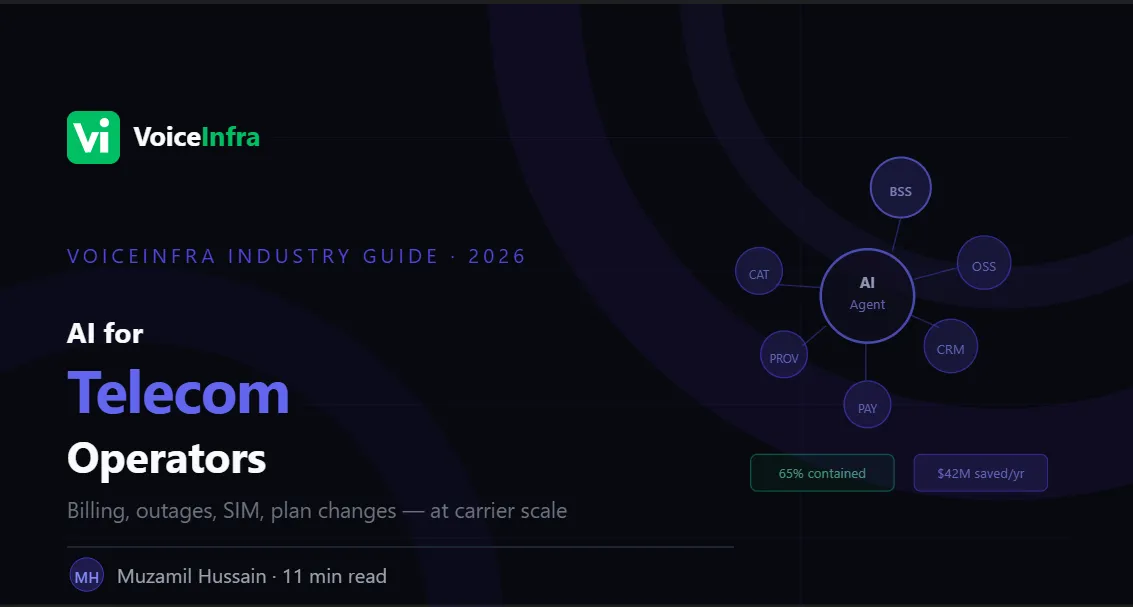
The telecom industry has changed dramatically over the past decade. Customers expect instant support, faster issue resolution, and 24/7 availability across every communication channel. At the same time, telecom operators face rising operational costs, increasing call volumes, and growing competition.
Traditional call centers struggle to keep up with these expectations. Long wait times, repetitive customer inquiries, and staffing challenges continue to affect both customer satisfaction and business profitability.
Artificial Intelligence is helping telecom operators solve these challenges. More specifically, Voice AI is becoming one of the most valuable technologies for improving customer support while reducing operational costs.
In this guide, we'll explore how AI is transforming telecom operations, where it delivers the biggest business value, and how platforms like VoiceInfra help operators deploy enterprise-grade AI voice agents.
Why Telecom Operators Are Investing in AI
Telecom companies process millions of customer interactions every month. Most of these conversations involve repetitive tasks such as:
Billing questions
Balance inquiries
SIM activation
Data package information
Network outage updates
Plan upgrades
Roaming support
Device troubleshooting
These requests usually don't require human expertise, yet they consume a significant portion of support resources.
According to recent McKinsey research, telecom operators are increasingly investing in AI to improve customer service, automate network operations, and create new revenue opportunities. The firm also notes that AI has become a strategic priority across the telecom industry rather than an experimental technology.
Common Challenges Faced by Telecom Operators
Before implementing AI, many telecom providers deal with several operational problems.
High Customer Support Costs
Running large customer support teams requires significant investment in hiring, training, infrastructure, and quality assurance.
Long Wait Times
During peak hours, customers often wait several minutes before speaking with an agent, leading to frustration and lower satisfaction scores.
Repetitive Support Requests
A large percentage of inbound calls involve routine questions that follow predictable workflows.
Limited 24/7 Coverage
Providing round-the-clock human support across multiple regions is expensive and difficult to scale.
Inconsistent Customer Experience
Different agents may provide different answers, creating inconsistent customer experiences.
How AI Helps Telecom Operators
AI doesn't replace every support agent. Instead, it automates repetitive conversations while allowing human teams to focus on complex issues.
Here are the most impactful use cases.
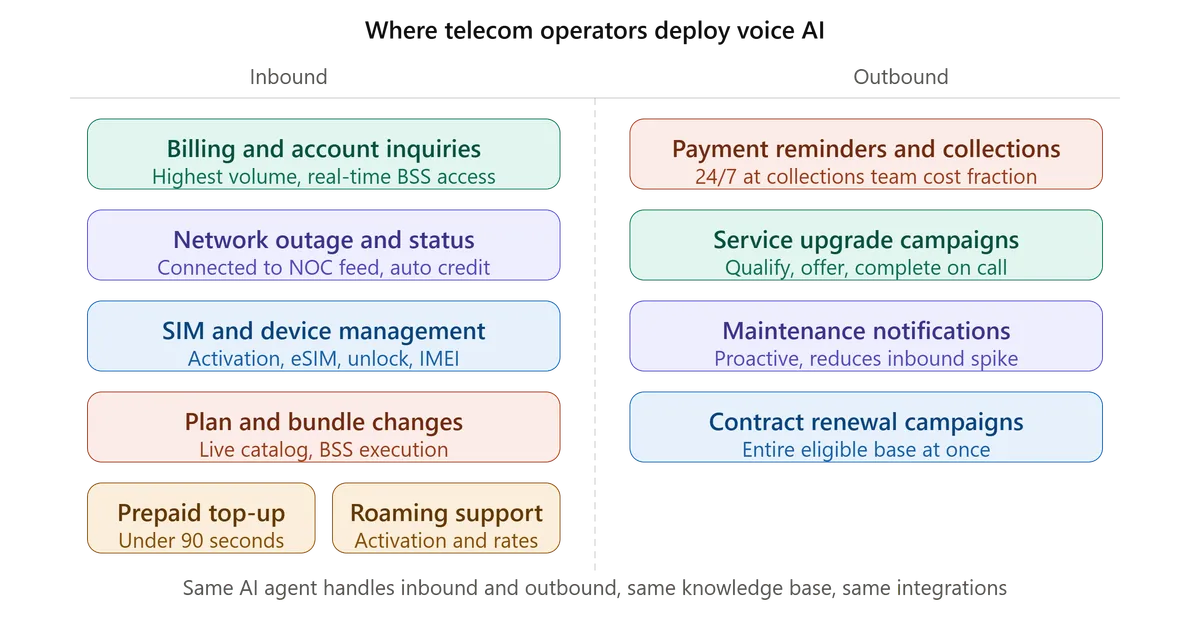
1. AI Voice Agents for Customer Support
Voice AI agents can answer calls automatically and handle common customer requests such as:
Account verification
Balance checks
Bill payment assistance
Package information
Service activation
Troubleshooting guidance
Complaint registration
Appointment scheduling
Customers receive immediate assistance without waiting in a queue.
2. Intelligent Call Routing
Instead of navigating complicated IVR menus, customers simply explain their issue in natural language.
The AI understands their intent and routes the call to the correct department or specialist.
This reduces transfer rates and improves first-call resolution.
3. Automated Billing Support
Billing remains one of the most common reasons customers contact telecom providers.
Voice AI can instantly answer questions related to:
Outstanding balances
Payment status
Billing cycles
Invoice explanations
Auto-pay enrollment
This reduces pressure on human support teams.
4. Network Outage Notifications
When outages occur, thousands of customers may call simultaneously.
AI voice agents can instantly provide location-specific outage updates and estimated restoration times without overwhelming the call center.
5. Sales and Plan Recommendations
AI can recommend better mobile plans based on customer usage patterns.
For example:
"Based on your monthly usage, switching to our Unlimited Plus plan could reduce your monthly bill while increasing your available data."
This creates new upselling opportunities while improving customer satisfaction.
Business Benefits of AI for Telecom Operators
Implementing Voice AI delivers measurable improvements across the business.
Lower Operational Costs
Automating repetitive conversations allows telecom providers to serve more customers without expanding support teams.
Faster Response Times
Customers receive answers within seconds instead of waiting in long queues.
Better Customer Experience
Natural conversations create a smoother experience than traditional IVR systems.
24/7 Availability
AI voice agents never require breaks, shifts, or holidays.
Consistent Support Quality
Every customer receives accurate, standardized responses based on approved knowledge sources.
Why Voice AI Is Better Than Traditional IVR
Traditional IVR systems force customers through endless menus.
"Press 1 for billing."
"Press 2 for technical support."
"Press 3 for roaming."
Modern Voice AI removes these frustrating experiences.
Customers simply speak naturally.
"I want to upgrade my mobile plan."
The AI understands the request and immediately starts helping.
This creates a faster and more human customer experience.
Real Business Impact
McKinsey's latest telecom research suggests that leading telecom operators using AI effectively could improve both return on invested capital (ROIC) and EBITDA margins by as much as 10 percentage points within five years, depending on their starting point and implementation scope.
Earlier McKinsey research also found examples of telecom companies using AI to optimize network investments by around 10% and improve personalized upselling, increasing average revenue per user (ARPU) by 5% to 15% in some customer segments.
How VoiceInfra Helps Telecom Operators
VoiceInfra provides enterprise-grade Voice AI infrastructure designed for telecom environments.
With VoiceInfra, telecom operators can:
Deploy AI voice agents in minutes
Handle inbound and outbound calls
Integrate with SIP infrastructure
Connect CRM and billing platforms
Transfer calls to human agents when needed
Monitor conversations with analytics
Support multilingual customer interactions
Scale across thousands of concurrent calls
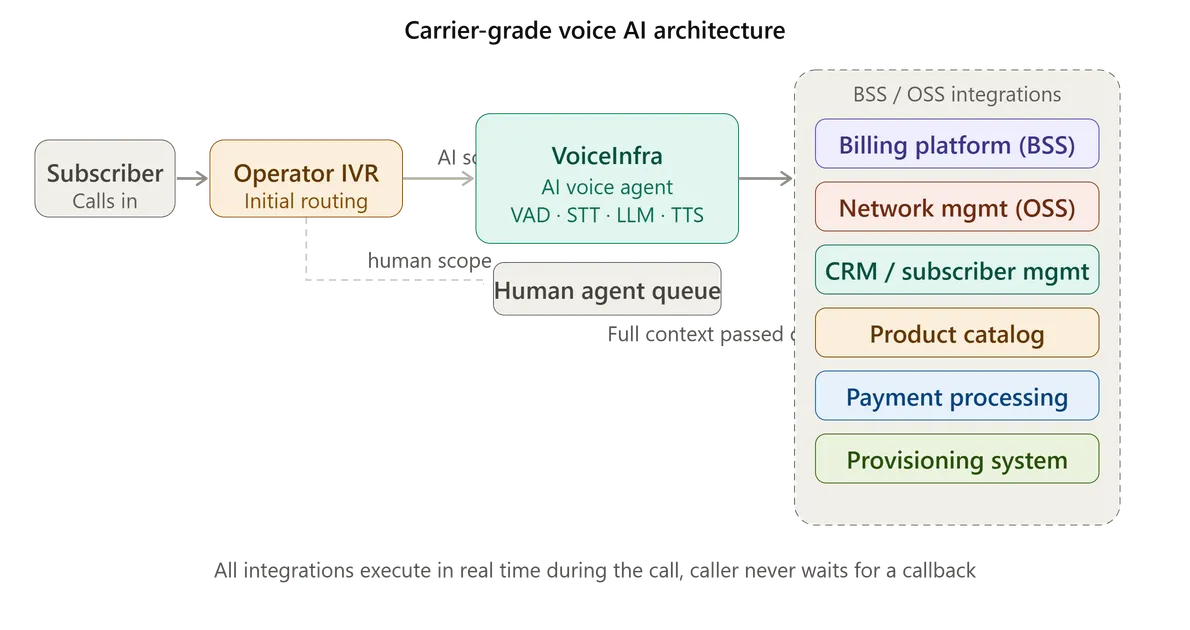
Instead of replacing your existing telecom infrastructure, VoiceInfra works alongside it to automate repetitive conversations while keeping human agents available for high-value interactions.
Get Started for Free: You can sign up to the portal completely for free to explore the platform and see how it works firsthand. and create your account today!
Is AI Replacing Telecom Support Agents?
No.
The most successful telecom operators use AI to automate repetitive conversations while human agents handle complex technical issues, escalations, and sensitive customer cases.
This combination delivers better customer experiences and higher operational efficiency.
Final Thoughts
Telecom operators are under constant pressure to deliver better customer service while controlling operational costs.
Voice AI offers a practical way to meet both goals.
By automating repetitive customer conversations, reducing wait times, and improving support availability, telecom companies can create a better experience for customers while allowing support teams to focus on work that truly requires human expertise.
For operators planning their next phase of digital transformation, AI is no longer a future investment. It is becoming an essential part of delivering faster, smarter, and more scalable customer support.
Frequently Asked Questions
How is AI used in telecom?
AI helps telecom operators automate customer support, optimize network operations, detect fraud, improve call routing, and personalize customer experiences.
Can AI replace traditional IVR systems?
Yes. Modern Voice AI allows customers to speak naturally instead of navigating menu-based IVR systems, creating faster and more intuitive support experiences.
Is Voice AI suitable for large telecom operators?
Yes. Enterprise Voice AI platforms are designed to handle thousands of simultaneous calls while integrating with existing telecom infrastructure.
Can Voice AI integrate with CRM and billing systems?
Yes. Most enterprise Voice AI platforms, including VoiceInfra, can integrate with CRM, billing, ticketing, and telephony systems to provide real-time customer support.
Related reading:
What Is Voice Activity Detection (VAD) in Voice AI? Complete Guide
Inbound vs Outbound Voice AI Agents: Use Cases, Setup & Cost
Voice AI Agent vs Traditional IVR: What's the Real Difference?