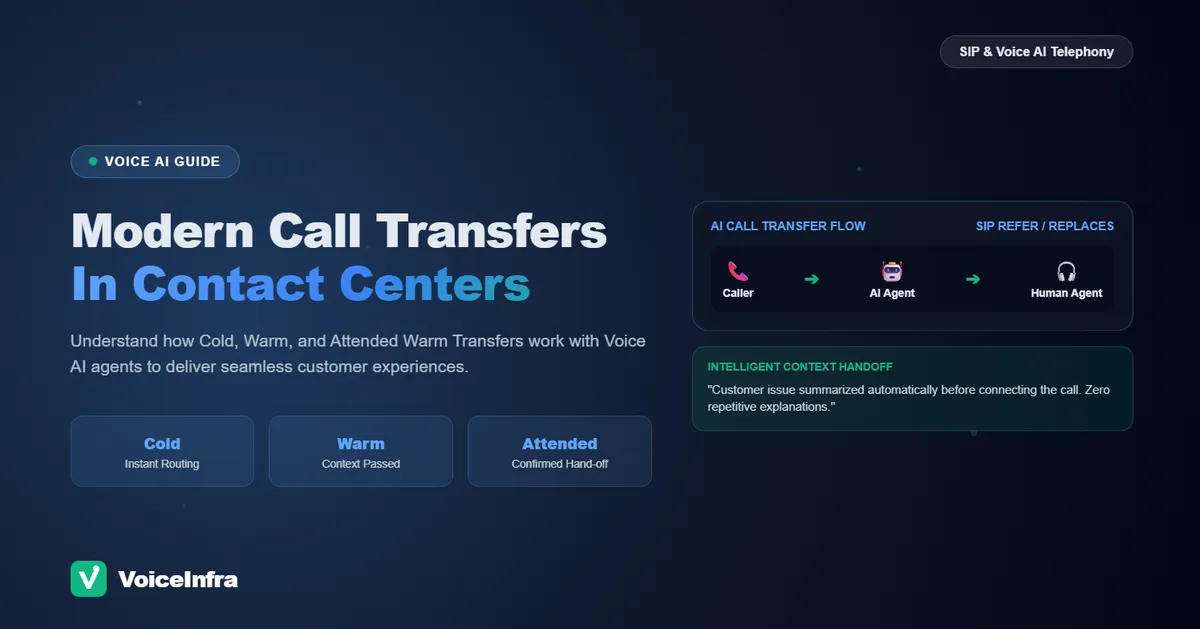
Understanding Modern Call Transfers in Voice AI and Contact Centers
Imagine calling a business for technical support.
An AI receptionist answers your call.
After understanding your issue, the AI needs to transfer you to a human support agent.
There are several ways this transfer can happen.
The AI can immediately send your call to another agent without any introduction.
Or it can first speak to the agent, explain why you're calling, and then connect both of you.
Or it can wait until the receiving agent accepts the call before completing the transfer.
These approaches are known as:
Cold Transfer
Warm Transfer
Attended Warm Transfer
Although they may sound similar, they create very different customer experiences.
Choosing the right transfer method can improve customer satisfaction, reduce frustration, and help agents resolve issues more efficiently.
In this guide, you'll learn how each transfer type works, when to use it, and how VoiceInfra enables intelligent AI-powered call transfers.
What Is Call Transfer?
A call transfer is the process of moving an active phone call from one person, department, extension, or AI voice agent to another.
Call transfers are common in:
Customer support
Sales teams
Healthcare clinics
Financial institutions
Government services
Contact centers
AI receptionists
The goal is simple:
Get the caller to the right person as quickly and efficiently as possible.
Modern Voice AI platforms can automatically determine when a transfer is needed based on customer intent, business rules, or agent availability.
Why Call Transfers Matter
An effective transfer process helps businesses:
Reduce customer wait times
Improve first-call resolution
Minimize repeated explanations
Route callers to the right department
Increase customer satisfaction
Improve agent productivity
Poor transfers, on the other hand, often lead to dropped calls, frustrated customers, and longer handling times.
What Is a Cold Transfer?
A Cold Transfer (also called a Blind Transfer) sends the caller directly to another extension or agent without first speaking to the receiving person.
The transferring agent or AI voice assistant does not confirm whether someone is available to answer the call.
The transfer happens immediately.
For example:
A customer calls an AI receptionist and says:
"I need help with billing."
The AI identifies the Billing department and transfers the call instantly.
The billing agent receives the call without any prior context or conversation.
How Cold Transfer Works
A typical Cold Transfer follows these steps:
The customer calls the business.
The AI receptionist or agent identifies the destination.
The call is transferred immediately.
The receiving agent answers the call directly.
Cold Transfer Workflow
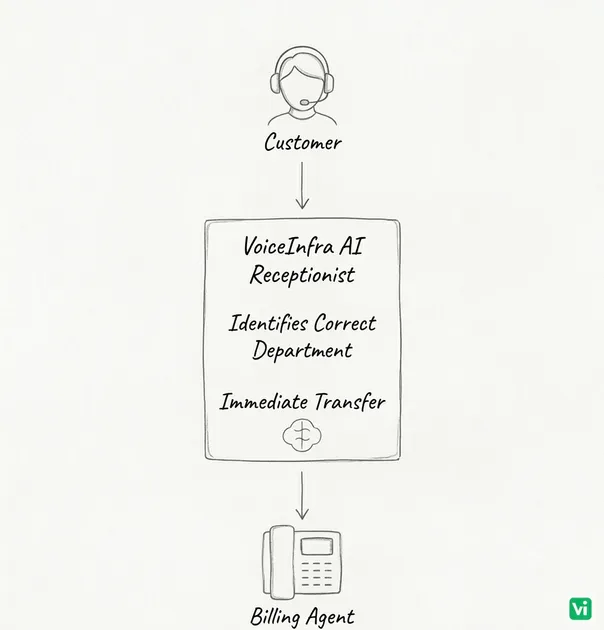
No conversation takes place between the AI (or transferring agent) and the receiving agent before the caller is transferred.
Advantages of Cold Transfer
Cold transfers are useful because they:
Connect callers quickly.
Reduce transfer time.
Require minimal agent involvement.
Work well for simple routing scenarios.
Improve efficiency for high-volume contact centers.
Examples include:
General inquiries
Directory assistance
Basic customer routing
Automated IVR systems
AI receptionists
Disadvantages of Cold Transfer
Because the receiving agent receives no background information, they often need to ask the customer to repeat details.
This can lead to:
Longer conversations
Reduced customer satisfaction
Repeated explanations
Increased average handling time
For complex issues, a cold transfer may not provide the best customer experience.
When Should You Use a Cold Transfer?
Cold transfers work best when:
The destination is obvious.
The issue is straightforward.
Customers only need basic assistance.
Call volume is high.
Speed is more important than context.
Common examples include:
Sales inquiries
Store locations
Business hours
Appointment confirmations
Department routing
Cold Transfer in VoiceInfra
VoiceInfra allows AI voice agents to perform intelligent cold transfers based on predefined routing rules.
For example, if a customer says:
"I want to speak with Sales."
The AI can immediately transfer the caller to the Sales team without requiring human intervention.
This helps businesses reduce response times while ensuring customers reach the correct department quickly.
What Is a Warm Transfer?
A Warm Transfer is a call transfer where the system checks if the receiving agent is available before connecting the customer.
This is the opposite of a Cold Transfer, where the call is blindly pushed to a third party without checking if they are available or ready to answer.
Key Principle:
In VoiceInfra, a Warm Transfer does NOT share conversation context, summaries, or customer details with the receiving agent.
The only difference between Cold and Warm transfer is the availability check.
Warm Transfer Workflow
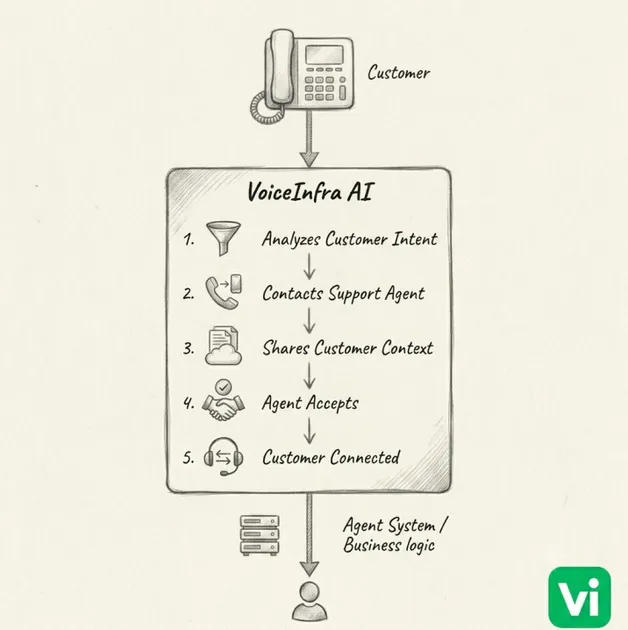
Customer calls the business.
VoiceInfra AI understands the request.
AI identifies the correct department or specialist.
AI checks agent availability (busy or not busy).
If the agent is available → the call is transferred.
If the agent is busy → the transfer is stopped. The customer is informed or queued.
If the customer is placed on hold during the transfer process, hold music may be played until the transfer is completed.
That is the entire process. No context is passed. No summary is shared. It is purely a connection check.
SIP-Based Warm Transfer (Important)
In SIP-based systems, the Warm Transfer ensures the receiving endpoint is ready before the call connects.
If the agent is available, the transfer proceeds.
If the agent is busy, the system does not force the call through. The customer is either informed, placed in a queue, or offered a callback.
Hold music may be played during short waiting periods to avoid silence.
Cold Transfer vs. Warm Transfer
| Feature | Cold Transfer | Warm Transfer |
|---|---|---|
| Checks agent availability | No | Yes |
| Shares call context/summary | No | No |
| Customer may reach a busy agent | Yes | No (system prevents this) |
| Hold music while caller is on hold | If applicable | Yes |
Important Clarification (What This Is NOT)
This is NOT an "Attended Transfer."
No conversation history, customer name, or issue details are sent to the agent.
The agent simply receives the call as if it were a new inbound call, but only when they are free to take it.
Summary
In VoiceInfra:
Warm Transfer = AI checks if the agent is available before transferring.
If available → call connects.
If busy → call is not transferred.
No context, summaries, or customer data are ever passed during a Warm Transfer.
This makes the handoff smarter and prevents customers from being sent to busy agents, without overcomplicating the agent's workflow.
What Is an Attended Warm Transfer?
An Attended Warm Transfer is a more advanced version of a Warm Transfer.
It works exactly like a Warm Transfer (the system checks if the agent is available before transferring), but with one key addition:
The agent is informed about the caller before the call is connected.
How It Works
Customer calls in.
AI understands the request.
AI checks if the correct agent is available.
If busy → the transfer does not happen. Customer is informed, queued, or offered a callback.
If available → the process continues.
The customer is placed on hold (hold music may play).
The AI contacts the agent privately and informs them about the caller.
If needed, the AI may ask the customer for additional information while they are on hold.
The AI relays that information to the agent.
If all set, the agent confirms readiness.
The customer is connected to the agent.
Key Principles (What This Is)
Availability is checked first just like Warm Transfer.
The agent is told about the caller before the call lands.
The caller is placed on hold while this happens. Hold music may be played whenever the caller is on hold.
Additional info can be gathered from the caller and passed to the agent.
The transfer only happens when the agent is ready and confirms.
What This Is NOT
This is not a Cold Transfer — availability is always checked.
This is not just a Warm Transfer — the agent is actively informed and prepared.
No lengthy conversation summaries or full history are shared unless explicitly asked for by the agent.
Cold vs. Warm vs. Attended (Summary)
| Feature | Cold Transfer | Warm Transfer | Attended Warm Transfer |
|---|---|---|---|
| Checks agent availability | No | Yes | Yes |
| Agent informed about caller | No | No | Yes |
| Caller placed on hold | No | No (unless waiting is required) | Yes |
| Hold music while caller is on hold | If applicable | Yes | Yes |
| Gathers info from caller before transfer | No | No | Yes (if needed) |
| Agent confirms readiness before connection | No | No | Yes |
Real-World Example
A customer calls with a billing issue.
Cold Transfer → Call is thrown to billing. Agent may be busy. No context given.
Warm Transfer → AI checks if billing agent is free. If free, call is transferred. Agent knows nothing about the caller.
Attended Warm Transfer → AI checks if billing agent is free. If free, customer is put on hold. AI tells the agent: "Customer calling about an invoice discrepancy." If the agent needs more info, AI asks the customer and relays it. Once the agent says "ready," the call is connected.
Summary (Plain and Simple)
In VoiceInfra:
Warm Transfer = Check if agent is available. If yes, transfer. No context. No info.
Attended Warm Transfer = Check availability. Put caller on hold. Inform the agent about the caller. Gather extra info if needed. Transfer only when the agent says "ready."
AI-Powered Call Transfer Workflow
A modern Voice AI transfer typically follows this sequence:
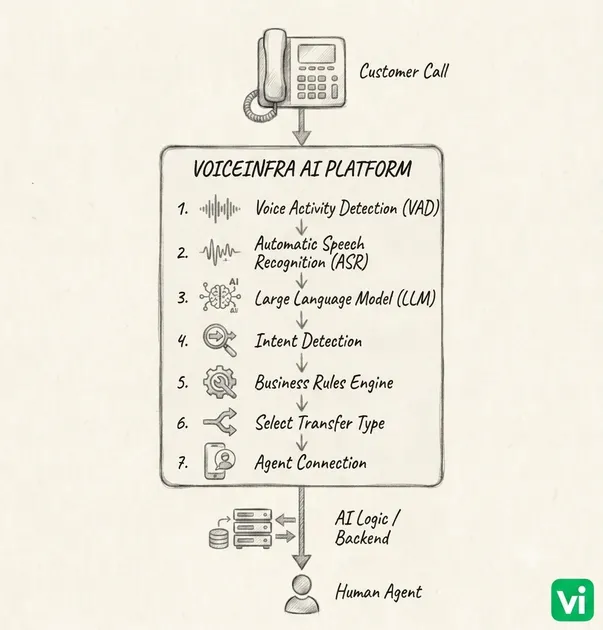
Instead of relying only on IVR menus, AI understands natural language and routes callers intelligently.
Intelligent Transfer Decisions
VoiceInfra can automatically determine which transfer type is most appropriate.
Example 1: Cold Transfer
Customer:
"Can you connect me to Sales?"
The AI identifies the Sales department and immediately transfers the call.
Example 2: Warm Transfer
Customer:
"My SIP trunk stopped working after changing our firewall."
The AI recognizes the technical issue and checks whether a support engineer is available. If the engineer is available, the call is transferred. If not, the caller is informed, placed in a queue, or offered a callback.The AI recognizes a technical issue, summarizes the problem, and briefs the support engineer before connecting the customer.
Example 3: Attended Warm Transfer
Customer:
"Our emergency support line is completely down."
The AI contacts an available senior engineer, confirms availability, provides the incident summary, and only then transfers the caller.
SIP Call Transfer Methods
Behind the scenes, SIP-based phone systems use standardized methods to transfer calls.
Although end users only experience a simple handoff, the SIP infrastructure coordinates the transfer process.
Common SIP transfer mechanisms include:
SIP REFER
The REFER method tells another endpoint to initiate a new call and transfer the current conversation.
This approach is widely used for standard call transfers in PBX systems.
Typical use cases include:
Blind (Cold) Transfers
Basic department routing
Internal call forwarding
Replaces Header (Attended Transfer)
For attended transfers, many SIP implementations use the Replaces mechanism.
This allows an existing call to be replaced with another active call after the receiving agent accepts it.
It enables:
Smooth attended transfers
Reduced call interruption
Better customer experience
Why SIP Standards Matter
Using standardized SIP methods improves compatibility between different systems.
Benefits include:
Easier PBX integration
Better interoperability
Reliable call signaling
Consistent transfer behavior
This is especially important for businesses using multiple telecom providers or cloud communication platforms.
Industry Use Cases
Customer Support
Support teams commonly use Attended Warm Transfers because technical issues often require the receiving agent to understand the customer's issue before the call is connected. Standard Warm Transfers are useful when businesses simply want to ensure the agent is available before transferring the caller.
Example:
The AI summarizes the customer's problem before connecting them to a support specialist.
Healthcare
Healthcare organizations frequently use Attended Warm Transfers.
Examples include:
Appointment scheduling
Nurse triage
Specialist referrals
Emergency escalation
Providing context before the transfer reduces the need for patients to repeat sensitive information.
Banking and Financial Services
Financial institutions prioritize security and customer verification.
Warm transfers help agents receive authentication status and customer history before continuing the conversation.
Sales Teams
Sales departments often combine AI qualification with human expertise.
Example workflow:
Customer
     │
VoiceInfra AI
     │
Lead Qualification
     │
Sales Representative
     │
Closed Opportunity
The sales representative already knows:
• Customer name
• Company
• Product interest
• Budget range
• Conversation summary (if available)
Telecom Providers
Telecom operators use intelligent transfers for:
Network support
Number porting
Billing
Enterprise provisioning
Technical escalations
AI helps reduce unnecessary transfers while directing callers to the correct specialist.
Best Practices for Call Transfers
To create a better customer experience, follow these best practices:
Match the Transfer Type to the Situation
Cold Transfer for simple requests
Warm Transfer for moderate complexity
Attended Warm Transfer for sensitive or high-value interactions
Capture Context Before the Transfer
AI should gather:
Customer name
Account details
Reason for calling
Priority level
Previous conversation summary
Providing this information helps the receiving agent continue the conversation naturally.
Keep Wait Times Short
Customers should not remain on hold longer than necessary.
If no suitable agent is available, businesses should consider:
Scheduling a callback
Offering voicemail
Continuing with AI assistance until an agent is available
Define Clear Routing Rules
Businesses should configure routing based on factors such as:
Department
Language
Business hours
Customer tier
Skill requirements
Agent availability
Well-designed routing reduces unnecessary transfers.
Common Call Transfer Mistakes
Many organizations reduce customer satisfaction by making avoidable mistakes.
Common issues include:
Sending Calls to the Wrong Department
Incorrect routing increases handling time and frustrates customers.
Requiring Customers to Repeat Information
Without conversation context, customers often need to explain the same issue multiple times.
Attended Warm Transfers significantly reduce the need for customers to repeat information because the AI can brief the receiving agent before connecting the call.
Transferring Without Checking Availability
Sending callers to unavailable agents can lead to unanswered calls and poor experiences.
Attended Warm Transfers reduce this risk.
Overusing Cold Transfers
Cold Transfers are efficient for simple requests but may not be appropriate for technical support, healthcare, or enterprise account management.
Choosing the correct transfer type improves customer outcomes.
How VoiceInfra Improves Call Transfers
VoiceInfra combines AI with enterprise telephony to automate intelligent call routing and seamless handoffs.
Businesses can:
Automatically understand customer intent.
Route calls to the right department.
Generate conversation summaries for Attended Warm Transfers when required.
Perform Cold, Warm, or Attended Warm Transfers.
Connect AI and human agents seamlessly.
Reduce customer effort.
Improve first-call resolution.
Scale customer support without sacrificing quality.
Rather than replacing human agents, VoiceInfra helps them start every conversation with the context they need to resolve issues faster.
Final Thoughts
Call transfers may seem like a simple feature, but they play a major role in the overall customer experience.
The difference between a customer having to repeat their issue three times and reaching the right person immediately often comes down to choosing the correct transfer method.
Cold Transfers are best when speed is the priority.
Warm Transfers ensure the receiving agent is available before the customer is connected, preventing unnecessary transfers to busy agents.
Attended Warm Transfers deliver the best customer experience by ensuring the receiving agent is available and fully prepared.
Modern Voice AI platforms like VoiceInfra make these transfer methods even smarter by combining AI-powered intent detection with SIP telephony and intelligent routing.
Instead of simply moving calls between departments, businesses can deliver faster resolutions, reduce customer frustration, and improve overall service quality.
As organizations continue adopting AI receptionists and AI customer support agents, intelligent call transfers will become an essential part of every modern communication system.
Frequently Asked Questions (FAQ)
What is a Cold Transfer?
A Cold Transfer (also called a Blind Transfer) sends a caller directly to another extension or department without speaking to the receiving agent first.
What is a Warm Transfer?
A Warm Transfer checks whether the receiving agent is available before transferring the customer. Unlike an Attended Warm Transfer, no conversation context, summaries, or customer details are shared with the receiving agent.
What is an Attended Warm Transfer?
An Attended Warm Transfer is an advanced form of Warm Transfer where the transferring party waits until the receiving agent confirms availability before completing the transfer.
What is the difference between Cold and Warm Transfer?
The primary difference is availability checking. A Cold Transfer immediately sends the call without checking whether the receiving agent is available, while a Warm Transfer first verifies the agent's availability before completing the transfer.
Which transfer type provides the best customer experience?
Attended Warm Transfer generally offers the best experience because the receiving agent is informed and ready before the caller is connected.
Can AI Voice Agents perform Warm Transfers?
Yes.
Modern AI voice platforms like VoiceInfra can:
Detect customer intent
Check agent availability
Perform Cold, Warm, or Attended Warm Transfers
Generate summaries and share context during Attended Warm Transfers when required
Do SIP phone systems support call transfers?
Yes.
Most SIP-based PBX systems support multiple transfer methods using standardized SIP mechanisms such as REFER and Replaces.
Which industries benefit the most from intelligent call transfers?
Industries that frequently use intelligent call transfers include:
Healthcare
Telecom
Banking
Insurance
Retail
Customer Support
SaaS
Hospitality
Government Services
Related Articles