Every time you ask Siri a question, talk to Google Assistant, call an AI receptionist, or speak with an AI-powered support agent, there is one technology doing the heavy lifting behind the scenes.
That technology is Automatic Speech Recognition (ASR).
ASR is one of the core parts of modern Voice AI. It takes spoken language and turns it into text so that artificial intelligence systems can understand what a person is saying and respond in a useful way.
Without Automatic Speech Recognition, an AI voice agent would hear sound, but it would not understand the words. And without that understanding, there would be no real conversation.
Today, ASR is used in all kinds of enterprise applications, from AI receptionists and call centers to virtual assistants, healthcare workflows, banking support, telecom service, and voice-enabled software.
As more businesses adopt conversational AI, ASR has become a key part of delivering faster support, lowering operational costs, and making phone interactions feel more natural.
In this guide, we will explain how Automatic Speech Recognition works, why it matters for Voice AI, how businesses use it today, and how VoiceInfra brings ASR into enterprise Voice AI infrastructure to automate customer conversations at scale.
What Is Automatic Speech Recognition?
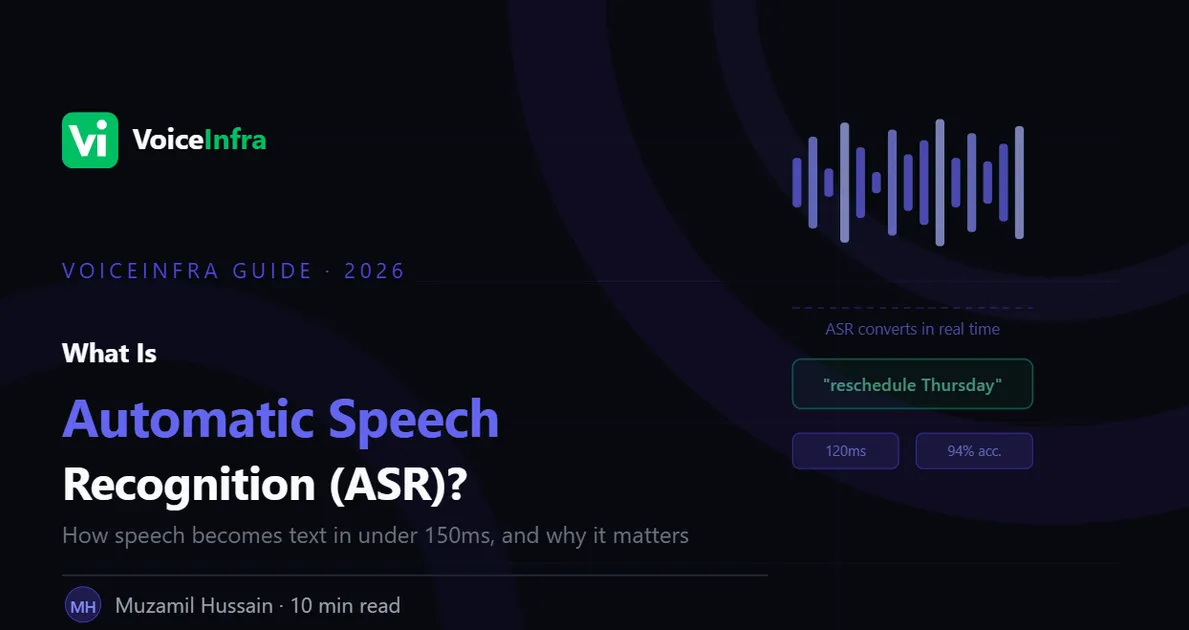
Automatic Speech Recognition (ASR) is an artificial intelligence technology that converts spoken language into written text automatically.
Instead of asking users to type commands or move through old-style phone menus, ASR lets computers listen to spoken words and turn them into machine-readable text in real time.
For example, imagine a customer calls your business and says:
"I'd like to change my appointment to next Tuesday."
The ASR engine listens to that speech and converts it into text.
"I'd like to change my appointment to next Tuesday."That text is then passed to an AI language model, which figures out what the customer wants and generates a response.
Without ASR, this whole flow would fall apart.
A simple way to think about it is this:
ASR hears what the customer says.
The AI understands what the customer means.
Text-to-Speech (TTS) speaks the reply back to the customer.
That is the basic pattern behind almost every modern Voice AI application.
Why Is Automatic Speech Recognition Important?
People speak naturally. We do not stop after every sentence to press buttons or choose from a menu.
Traditional IVR systems often force customers into rigid paths:
Press 1 for Sales
Press 2 for Billing
Press 3 for Technical Support
Modern Voice AI removes that friction.
Instead of navigating menus, customers can just say what they need.
For example:
"I need help paying my internet bill."
ASR turns that spoken request into text in a fraction of a second.
The AI then understands the intent, pulls the right information, and gives a response that feels much closer to a real conversation.
That is one of the biggest reasons businesses are moving away from legacy IVR systems and toward AI voice agents.
Why Businesses Are Investing in ASR
Automatic Speech Recognition does more than improve customer experience. It also helps businesses work faster and more efficiently.
Organizations use ASR to:
Automate repetitive customer conversations
Reduce average handling time (AHT)
Improve first-call resolution
Offer 24/7 customer support
Lower contact center costs
Improve customer satisfaction
Scale support without adding more staff
As Voice AI continues to grow, ASR has become an important part of automation strategies across industries like healthcare, banking, telecommunications, insurance, retail, logistics, and hospitality.
How Does Automatic Speech Recognition Work?
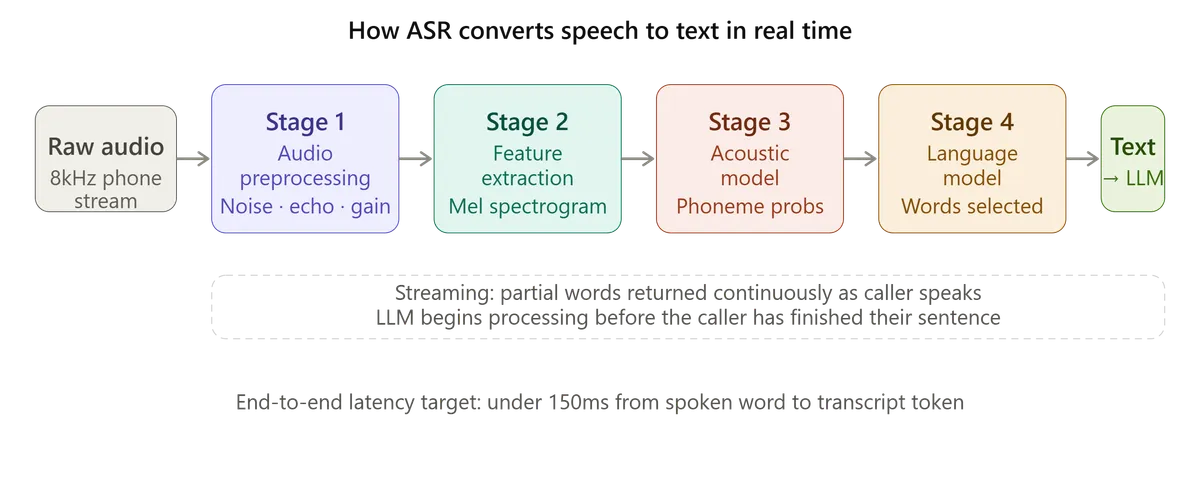
Modern ASR systems use advanced deep learning models, but the overall process still follows a clear sequence.
Once you understand the flow, it becomes easier to see how Voice AI systems deliver fast and accurate conversations.
Step 1: Capturing the Audio
Every conversation starts with an audio signal.
That audio may come from:
A telephone call
A mobile app
A web browser
A smart speaker
A conferencing platform
A microphone connected to an AI assistant
At this point, the audio usually contains more than just speech.
It may also include:
Background conversations
Traffic noise
Keyboard clicks
Echo
Silence
Wind
Office sounds
Music
Before speech recognition can begin, the system needs to figure out which parts of the audio actually contain human speech.
Step 2: Voice Activity Detection (VAD)
The next step is Voice Activity Detection (VAD).
Instead of processing every second of audio, VAD identifies when someone starts speaking and when they stop.
That helps the system avoid wasting time on silence or background noise, and it also improves response speed.
Without Voice Activity Detection, AI systems would spend a lot of unnecessary computing power analyzing audio that does not matter.
Related Reading: What Is Voice Activity Detection (VAD)?
Step 3: Noise Suppression and Audio Enhancement
Once speech has been detected, the audio is cleaned before it reaches the ASR engine.
This may include:
Noise Suppression
Echo Cancellation
Acoustic Echo Control
Automatic Gain Control (AGC)
These tools help make the audio clearer and improve transcription accuracy.
For example, if a customer is calling from a busy airport or a crowded café, audio enhancement helps separate the speaker’s voice from the surrounding noise.
That gives the ASR engine a much better chance of producing an accurate transcript.
Step 4: Converting Audio into Features
Computers do not understand raw sound waves in the same way humans do.
So the ASR engine first turns the audio into mathematical representations called acoustic features.
These features capture important parts of speech, such as frequency patterns, timing, and phonetic details.
Modern neural networks then analyze those features to identify the words being spoken.
This all happens in real time and is designed to balance speed with accuracy.
Step 5: Speech Recognition
This is the main job of Automatic Speech Recognition.
Using deep learning models trained on millions of hours of spoken language, the system predicts the sequence of words spoken by the user.
For example:
Caller Says
"I'd like to upgrade my business internet plan."
↓
ASR Output
"I'd like to upgrade my business internet plan."
That text is then passed to the next stage of the Voice AI pipeline.
Step 6: Understanding the User's Intent
Once the speech has been converted into text, the Large Language Model (LLM) steps in and analyzes the request.
The model tries to understand:
What the customer wants
Which workflow should run
Whether another system needs to be checked
What information should be returned
Whether the conversation should be handed off to a human agent
This is where the conversation starts to feel intelligent.
Step 7: Generating a Natural Voice Response
After the AI creates a response, a Text-to-Speech (TTS) engine turns that response back into natural-sounding speech.
The customer hears a smooth, human-like reply, and the conversation continues.
The full Voice AI pipeline looks like this:
Customer → Microphone → Voice Activity Detection → Noise Suppression → Automatic Speech Recognition → Large Language Model → Business Logic → Text-to-Speech → Customer
This entire process usually happens within seconds, which is what makes Voice AI feel fast and responsive.
Key Takeaway
Automatic Speech Recognition is much more than a speech-to-text tool.
It is the bridge between human speech and artificial intelligence, allowing AI voice agents to understand spoken language and respond naturally.
Without ASR, modern Voice AI platforms, including AI receptionists, AI call centers, and enterprise voice assistants, would not be possible.
Benefits of Automatic Speech Recognition
Automatic Speech Recognition is much more than a convenience feature. For businesses, it improves customer experience, reduces operational costs, and enables scalable Voice AI applications.
Here are some of the biggest advantages of ASR.
1. Faster Customer Support
Customers no longer have to navigate complex IVR menus or wait for an available agent before explaining their issue.
Instead, they simply speak naturally.
ASR converts their speech into text within milliseconds, allowing the AI to understand the request and respond almost immediately.
The result is:
Faster response times
Shorter queues
Better customer satisfaction
2. Natural Conversations
Traditional IVR systems require customers to follow predefined menus.
Modern Voice AI removes those restrictions.
Instead of saying:
"Press 1 for Billing."
Customers can simply say:
"I want to pay my bill."
ASR captures the request, while the AI understands the intent and responds naturally.
This creates conversations that feel far more human.
3. Lower Operational Costs
Many customer support calls involve repetitive tasks such as:
Checking account balances
Booking appointments
Resetting passwords
Tracking orders
Updating customer information
With ASR, these conversations can be automated using AI voice agents.
This allows businesses to handle more calls without increasing support staff.
4. 24/7 Availability
Unlike human agents, AI voice assistants never sleep.
ASR enables businesses to provide customer support around the clock, ensuring callers receive immediate assistance regardless of the time or day.
This is especially valuable for global businesses operating across multiple time zones.
5. Improved Accessibility
Not every customer prefers typing.
Voice interfaces make digital services more accessible for people who:
Have limited mobility
Find typing difficult
Are driving
Need hands-free interactions
ASR makes these experiences possible by allowing users to communicate naturally through speech.
6. Better Business Insights
Every conversation processed by ASR can also be analyzed.
Businesses can discover:
Frequently asked questions
Customer pain points
Product feedback
Service issues
Trending topics
These insights help improve customer support and business decision-making.
Common Use Cases of Automatic Speech Recognition
Today, ASR is used across almost every industry that relies on voice communication.
Some of the most common applications include:
AI Receptionists
AI receptionists answer incoming calls, greet customers, understand requests, and either provide answers or transfer calls to the correct department.
AI Call Centers
Enterprise contact centers use ASR to automate repetitive conversations while allowing human agents to focus on more complex issues.
Healthcare
Hospitals and clinics use ASR for:
Appointment scheduling
Patient support
Prescription reminders
Medical transcription
Banking and Financial Services
Banks use ASR to help customers:
Check account balances
Verify identity
Report lost cards
Make payments
Receive account information
Telecom Operators
Telecom providers use ASR to automate:
SIM activation
Billing inquiries
Plan upgrades
Network support
Technical troubleshooting
E-commerce
Online retailers use Voice AI powered by ASR to:
Track orders
Process returns
Check delivery status
Update shipping information
Hospitality
Hotels use AI voice assistants to:
Handle reservations
Answer guest questions
Recommend services
Process room requests
Automatic Speech Recognition vs Speech-to-Text
Many people use these terms interchangeably.
While they are closely related, there is a slight difference.
| Automatic Speech Recognition (ASR) | Speech-to-Text (STT) |
|---|---|
| AI technology that recognizes spoken language | The process of converting speech into text |
| Includes speech recognition models | Focuses on the transcription result |
| Often includes language modeling | Usually refers to the final output |
In everyday conversations, both terms generally refer to the same technology.
ASR vs Voice Activity Detection (VAD)
These technologies work together, but they solve different problems.
| Automatic Speech Recognition (ASR) | Voice Activity Detection (VAD) |
|---|---|
| Converts speech into text | Detects whether someone is speaking |
| Understands spoken words | Detects speech boundaries |
| Produces transcripts | Decides when ASR should start and stop listening |
Think of it this way:
VAD decides when to listen.
ASR understands what was said.
ASR vs Natural Language Processing (NLP)
Another common point of confusion is the difference between ASR and NLP.
| Automatic Speech Recognition (ASR) | Natural Language Processing (NLP) |
|---|---|
| Converts speech into text | Understands the meaning of text |
| Processes audio | Processes language |
| Recognizes spoken words | Understands user intent |
A simple way to remember it:
ASR hears.
NLP understands.
Challenges of Automatic Speech Recognition
Although ASR has improved dramatically over the past decade, it is not perfect.
Several factors can affect recognition accuracy.
Background Noise
Busy offices, traffic, or public places make speech recognition more difficult.
Strong Accents
Different accents and pronunciations can increase transcription errors if models are not properly trained.
Multiple Speakers
When two people speak at the same time, ASR systems may struggle to identify individual voices.
Poor Audio Quality
Low-quality microphones, packet loss, and poor phone connections reduce transcription accuracy.
Industry-Specific Vocabulary
Medical, legal, and technical terminology often requires custom vocabularies to achieve high accuracy.
Measuring ASR Accuracy
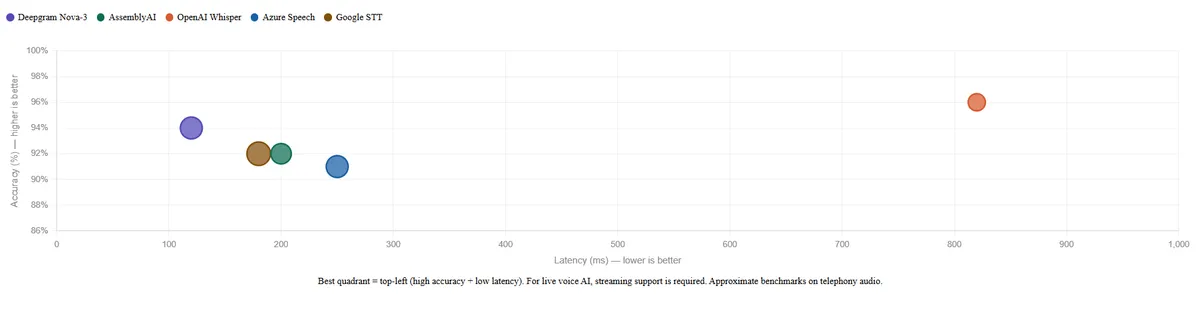
One of the most common ways to evaluate speech recognition systems is Word Error Rate (WER).
WER measures how many words are incorrectly recognized during transcription.
A lower WER generally indicates better performance.
Factors that influence WER include:
Background noise
Audio quality
Speaker accent
Speaking speed
Language
Domain-specific terminology
Improving these factors helps businesses deliver more accurate Voice AI experiences.
Best Practices for Enterprise Voice AI
If you're building AI voice applications, follow these best practices.
Use high-quality microphones whenever possible.
Combine ASR with Voice Activity Detection (VAD).
Apply Noise Suppression before transcription.
Continuously monitor transcription accuracy.
Fine-tune language models for your industry.
Test with real customer conversations instead of studio recordings.
Monitor Word Error Rate (WER) over time.
These practices help improve both customer experience and AI performance.
How VoiceInfra Uses Automatic Speech Recognition
VoiceInfra combines enterprise-grade Automatic Speech Recognition with a complete Voice AI infrastructure.
Instead of using ASR in isolation, VoiceInfra integrates it with:
Voice Activity Detection (VAD)
Noise Suppression
This allows businesses to build AI voice agents that understand customer conversations, retrieve information instantly, execute workflows, and respond naturally over the phone.
Whether you're deploying an AI receptionist, automating customer support, or modernizing a contact center, VoiceInfra provides the building blocks needed to deliver enterprise-grade Voice AI experiences.
💡 Did You Know?
Automatic Speech Recognition is only one component of a modern Voice AI system.
To create natural conversations, Voice AI platforms combine multiple technologies, including Voice Activity Detection (VAD), Noise Suppression, Large Language Models (LLMs), and Text-to-Speech (TTS), all working together in real time.
Final Thoughts
Automatic Speech Recognition (ASR) has become one of the most important technologies behind modern Voice AI.
Every AI receptionist, intelligent call center, virtual assistant, and conversational phone system depends on ASR to accurately understand what customers are saying before generating a response.
As speech recognition models continue to improve, businesses can automate more conversations, deliver faster customer support, and provide experiences that feel increasingly natural.
However, ASR alone is not enough.
Enterprise Voice AI requires multiple technologies working together, including Voice Activity Detection (VAD), Noise Suppression, Large Language Models (LLMs), and Text-to-Speech (TTS), to create seamless, real-time conversations.
VoiceInfra brings all of these technologies together in a single enterprise Voice AI platform.
Whether you're building an AI receptionist, automating customer support, or deploying AI voice agents across your organization, VoiceInfra provides the infrastructure needed to build reliable, scalable, and intelligent voice experiences.
If you're planning to modernize your customer communication, understanding ASR is the first step toward building faster, smarter, and more human-like Voice AI applications.
Ready to Build AI Voice Agents?
VoiceInfra helps businesses build enterprise-grade AI voice agents that understand customers, automate conversations, and integrate with existing business systems.
With VoiceInfra you can:
Build AI Receptionists without writing complex code
Automate inbound and outbound phone calls
Connect with SIP providers and PBX systems
Integrate CRMs, calendars, and business tools
Use enterprise-grade Automatic Speech Recognition
Deploy multilingual AI voice agents
Monitor conversations with real-time analytics
Seamlessly transfer calls to human agents when needed
Whether you're a startup or an enterprise, VoiceInfra gives you everything you need to deploy Voice AI at scale.
Related Articles
Continue learning about Voice AI with these guides:
Frequently Asked Questions
What is Automatic Speech Recognition (ASR)?
Automatic Speech Recognition (ASR) is an AI technology that converts spoken language into text, allowing computers and Voice AI systems to understand human speech.
Is ASR the same as Speech-to-Text?
They are closely related. Speech-to-Text describes the conversion process, while ASR refers to the broader AI technology that recognizes spoken language and generates text.
How does Automatic Speech Recognition work?
ASR captures audio, filters unnecessary noise, converts speech into acoustic features, predicts spoken words using AI models, and sends the resulting text to language models for understanding.
Why is ASR important for Voice AI?
ASR enables AI voice agents to understand customer requests, making natural phone conversations, automated support, and voice-based applications possible.
What is the difference between ASR and Voice Activity Detection?
Voice Activity Detection (VAD) identifies when someone is speaking, while ASR converts those spoken words into text.
What is the difference between ASR and NLP?
ASR converts speech into text. Natural Language Processing (NLP) interprets the meaning of that text so the AI can decide how to respond.
Can ASR recognize multiple languages?
Yes. Modern enterprise ASR engines support dozens of languages and dialects, making them suitable for global customer support.
What industries use Automatic Speech Recognition?
ASR is widely used in healthcare, banking, telecommunications, insurance, retail, logistics, hospitality, education, government services, and customer support.
How accurate is modern ASR?
Modern AI-powered ASR systems can achieve very high accuracy under good audio conditions. Performance depends on factors such as microphone quality, background noise, accents, and domain-specific vocabulary.
How does VoiceInfra use ASR?
VoiceInfra combines enterprise-grade ASR with Voice Activity Detection (VAD), Large Language Models (LLMs), Text-to-Speech (TTS), SIP calling, workflow automation, and business integrations to deliver natural, real-time AI phone conversations.