Understanding the Future of Real-Time Voice Communication
Whether you're building an AI receptionist, a cloud contact center, a video conferencing platform, or a browser-based calling application, you'll eventually face one important question:
Should you use SIP or WebRTC?
At first glance, they may seem like competing technologies.
In reality, they solve different problems and are often used together.
Many businesses assume that WebRTC replaces SIP, while others believe SIP is outdated.
Neither assumption is correct.
Modern communication platforms, including AI voice agents, cloud PBXs, customer support platforms, and unified communication systems, often combine both technologies to deliver secure, low-latency voice experiences.
Understanding how they work together can help you build more scalable and future-proof communication systems.
In this guide, we'll explain:
What SIP is
What WebRTC is
How each technology works
Key differences
Advantages and disadvantages
Business use cases
Security considerations
Performance comparisons
How VoiceInfra combines SIP and WebRTC for enterprise Voice AI
What Is SIP?
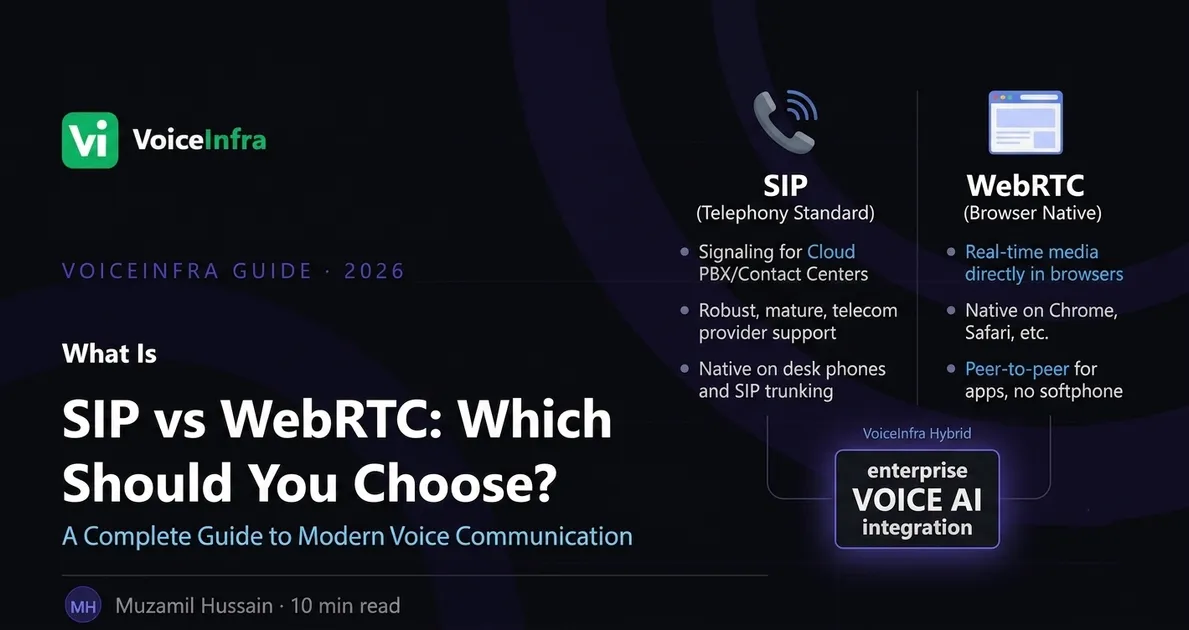
Session Initiation Protocol (SIP) is a signaling protocol used to establish, manage, and terminate real-time communication sessions.
It has been the foundation of the modern enterprise telephony for more than two decades.
SIP doesn't carry audio itself.
Instead, it handles the signaling required to:
Start calls
End calls
Transfer calls
Hold calls
Register endpoints
Authenticate users
Route calls
Think of SIP as the traffic controller of a phone call.
It tells devices:
Who is calling
Where to connect
When to start
When to end
Once the call is established, the actual voice usually travels using RTP (Real-time Transport Protocol).
Common SIP Use Cases
Businesses use SIP for:
Cloud PBXs
Enterprise phone systems
Contact centers
SIP trunking
VoIP services
AI phone agents
Telecom infrastructure
Call routing
Interactive Voice Response (IVR)
Today, most enterprise phone systems rely on SIP because it is mature, reliable, and supported by nearly every telecom provider.
How SIP Works
A simplified SIP call flow looks like this:
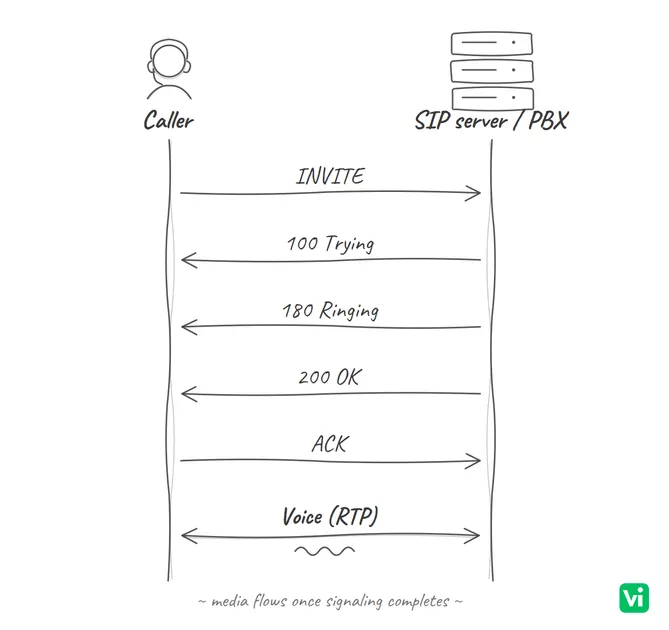
Once the signaling process is complete, audio begins flowing between the participants.
What Is WebRTC?
WebRTC (Web Real-Time Communication) is an open-source technology that enables real-time voice, video, and data communication directly inside web browsers and mobile applications.
Unlike SIP, WebRTC is built for the modern web.
Users don't need to install softphones or additional software.
They simply open a browser and start communicating.
This makes WebRTC ideal for:
Browser calling
Video meetings
Live customer support via Browsers
AI voice assistants for Web Applications
Telehealth
Online education
Screen sharing, File Sharing
Collaboration platforms
Why Was WebRTC Created?
Before WebRTC, developers needed third-party plugins like Flash or Java applets to enable voice and video communication in browsers.
These solutions introduced security risks, compatibility issues, and poor user experiences.
WebRTC solved this problem by adding real-time communication capabilities directly into modern browsers.
Today, major browsers such as Chrome, Firefox, Edge, and Safari support WebRTC natively.
How WebRTC Works
A typical WebRTC communication flow looks like this:
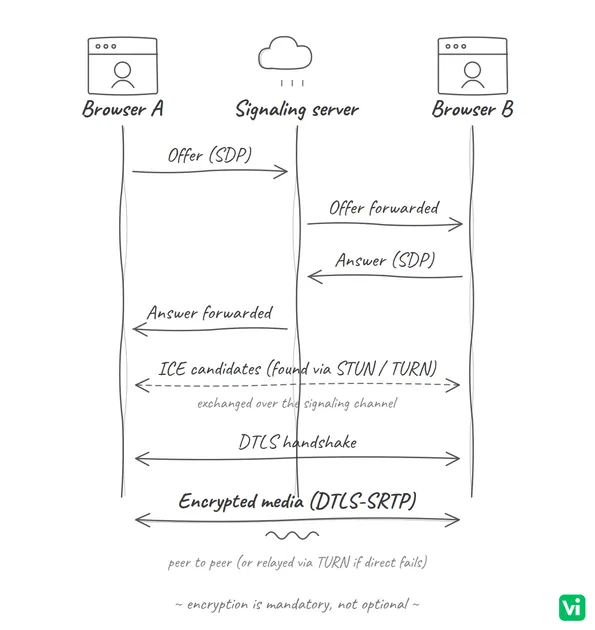
Unlike SIP, WebRTC requires additional technologies such as ICE, STUN, and TURN to establish peer-to-peer connections, especially when users are behind NATs or firewalls.
SIP vs WebRTC: Quick Comparison
| Feature | SIP | WebRTC |
|---|---|---|
| Primary Purpose | Session signaling | Browser-based real-time media & data |
| Installation | Softphone or SIP device | Works directly in modern browsers |
| Voice | ✅ | ✅ |
| Video | ✅ (widely used in enterprise video/telepresence) | ✅ Native in browsers |
| Data Channels | Messaging via MESSAGE/MSRP; no browser-style data channel | ✅ SCTP data channels |
| Browser Support | Requires gateway or softphone | Native |
| PBX Integration | Excellent | Requires gateway in many deployments |
| AI Voice Applications | Excellent | Excellent |
| Enterprise Telephony | Industry standard | Growing rapidly |
💡 Did You Know?
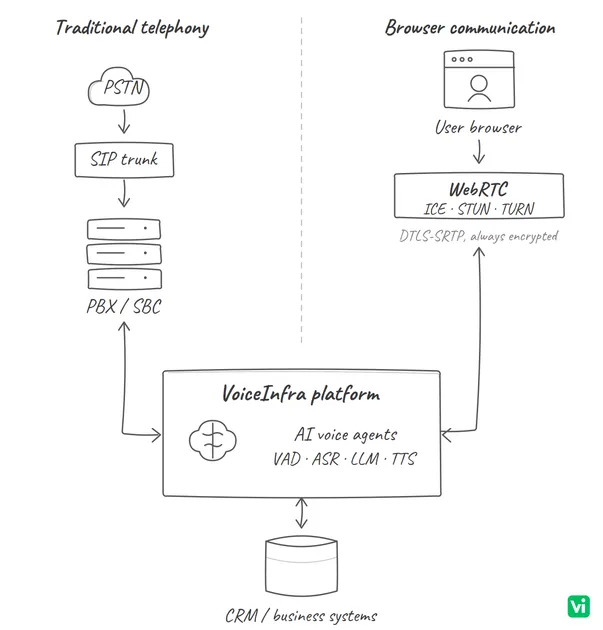
Many modern Voice AI platforms don't choose SIP or WebRTC they use both.
For example:
A customer calls a business through a SIP trunk.
The AI processes the conversation.
A browser-based dashboard uses WebRTC for live monitoring.
The call is transferred back to the PSTN using SIP.
This hybrid architecture combines the strengths of both technologies and is increasingly common in enterprise Voice AI deployments.
Key Takeaways
SIP is the industry standard for enterprise telephony and call signaling.
WebRTC enables real-time voice, video, and data communication directly in browsers.
SIP and WebRTC are complementary technologies, not direct replacements.
Modern AI communication platforms often combine both to deliver seamless customer experiences.
VoiceInfra supports hybrid architectures, allowing businesses to integrate existing SIP infrastructure while offering modern browser-based communication experiences.
SIP vs WebRTC: Detailed Comparison
Now that you understand what SIP and WebRTC are individually, let's compare them across the areas that matter most when building modern communication systems.
While both technologies enable real-time communication, they were designed for different purposes. Understanding these differences helps businesses choose the right solution, or the right combination for their specific needs.
SIP vs WebRTC Feature Comparison
| Feature | SIP | WebRTC |
|---|---|---|
| Primary Purpose | Signaling protocol for real-time sessions | Browser-based real-time communication |
| Voice Calling | ✅ Yes | ✅ Yes |
| Video Calling | ✅ Yes (SDP-negotiated; standard in enterprise video) | ✅ Native in browsers |
| Messaging | ✅ Via SIP MESSAGE and MSRP | ✅ Data channels |
| Browser Support | Requires SIP client or gateway | Native in modern browsers |
| Mobile Support | Native apps required | Mobile browser & apps |
| Installation | Softphone or SIP phone | No installation required |
| PBX Integration | Excellent | Requires SIP/WebRTC gateway in many cases |
| Encryption | TLS + SRTP (optional; deployment-dependent) | DTLS + SRTP (mandatory, always on) |
| AI Voice Support | Excellent | Excellent |
Architecture Comparison
SIP Architecture
A traditional SIP deployment typically looks like this:
PSTN
   │
SIP Trunk
   │
PBX / SBC
   │
VoiceInfra AI Platform
   │
AI Voice Agent
This architecture is common in enterprises that already use SIP phones, cloud PBXs, or telecom infrastructure.
WebRTC Architecture
A browser-first WebRTC deployment looks like this:
Web Browser
      │
ICE / STUN / TURN
      │
VoiceInfra Platform
      │
AI Voice Agent
      │
CRM / Business Systems
This architecture eliminates the need for traditional desk phones and enables users to communicate directly from a browser.
Performance Comparison
Performance is one of the biggest factors when choosing between SIP and WebRTC.
| Category | SIP | WebRTC |
|---|---|---|
| Call Setup | Fast | Fast |
| Browser Experience | Limited (requires client/gateway) | Excellent |
| Voice Quality | Excellent | Excellent (Opus codec) |
| Video Quality | High quality (enterprise video systems) | High quality (browser-native) |
| Data Sharing | Via MSRP / application layer | Native data channels |
| Screen Sharing | ✅ Via BFCP content sharing (enterprise video) | ✅ Native in browsers |
| Latency | Very Low | Very Low |
| AI Integration | Excellent | Excellent |
In most enterprise deployments, both technologies can deliver excellent voice quality when configured correctly. The practical difference isn't capability, it's where each excels: SIP-based screen and content sharing (via BFCP) is standard in enterprise room systems, while WebRTC makes the same capabilities available in any browser with no installation.
Security Comparison
Security is critical for customer conversations, especially in industries such as healthcare, banking, insurance, and telecommunications.
SIP Security
Modern SIP deployments typically secure signaling using TLS (Transport Layer Security) and encrypt media using SRTP (Secure Real-time Transport Protocol).
Common security features include:
SIP Authentication
TLS Encryption
SRTP Media Encryption
Session Border Controllers (SBCs)
Fraud Protection
WebRTC Security
WebRTC was designed with security as a core requirement. Encryption is mandatory, every WebRTC session encrypts media by default using DTLS-SRTP, and this cannot be disabled.
Key technologies include:
- DTLS
- SRTP
- ICE
- STUN
- TURN
This mandatory, always-on encryption is one of WebRTC's genuine advantages over traditional SIP deployments and makes it well suited for browser-based business applications.
Scalability
As businesses grow, communication platforms must handle increasing numbers of simultaneous users and calls.
SIP
SIP is highly scalable and powers some of the world's largest telecom networks, cloud PBXs, and enterprise contact centers.
Ideal for:
Large enterprises
Telecom operators
Contact centers
SIP trunking providers
WebRTC
WebRTC scales well for browser-based communication but often requires additional infrastructure, such as media servers and TURN servers, for large deployments.
Ideal for:
Video conferencing
Browser calling
Telehealth
Customer portals
Online collaboration
Browser Support
One of WebRTC's biggest advantages is native browser compatibility.
| Browser | SIP | WebRTC |
|---|---|---|
| Google Chrome | Via client | ✅ Native |
| Microsoft Edge | Via client | ✅ Native |
| Mozilla Firefox | Via client | ✅ Native |
| Apple Safari | Via client | ✅ Native |
With WebRTC, users simply open a browser and start communicating. no separate softphone required.
Business Use Cases
When SIP Is the Better Choice
Choose SIP when you need:
Enterprise telephony
SIP trunking
Existing PBX integration
AI phone agents
Contact center routing
PSTN connectivity
When WebRTC Is the Better Choice
Choose WebRTC when you need:
Browser-based calling
Video conferencing
Screen sharing
Customer support portals
Telehealth consultations
Browser-based AI assistants
When to Use Both Together
For many businesses, the best solution isn't SIP or WebRTC it's both.
A common enterprise workflow looks like this:
A customer calls through a SIP trunk.
VoiceInfra routes the call to an AI voice agent.
A supervisor monitors the conversation from a browser using WebRTC.
If needed, the call is transferred back to a human agent via SIP.
This hybrid architecture combines the reliability of SIP with the flexibility of WebRTC.
📊 Industry Insight
According to the W3C WebRTC specification and IETF SIP standards, SIP and WebRTC were designed for different layers of real-time communication. SIP primarily manages session signaling, while WebRTC provides secure, browser-native media transport. Modern enterprise platforms frequently bridge the two technologies instead of replacing one with the other.
💡 VoiceInfra Tip
If your business already uses SIP phones or a PBX, you don't need to replace your existing infrastructure to adopt AI.
VoiceInfra allows you to integrate your SIP environment while also supporting modern browser experiences powered by WebRTC, giving you the flexibility to modernize at your own pace.
Voice Quality: SIP vs WebRTC
One of the biggest concerns when choosing a communication technology is voice quality.
The good news is that both SIP and WebRTC can deliver excellent audio quality when deployed correctly. The difference lies in the codecs they typically use and the environments they are optimized for.
Common Audio Codecs
| Codec | SIP | WebRTC | Best For |
|---|---|---|---|
| G.711 | ✅ | ✅ (mandatory in WebRTC) | Traditional VoIP, PSTN interop |
| G.729 | ✅ | ❌ Not supported in browsers | Low-bandwidth networks |
| Opus | Supported | ✅ Default (mandatory) | HD Voice & Voice AI |
Why Opus Is Popular
WebRTC uses the Opus codec by default, which is designed for low latency, high-quality audio, and adaptive bitrate. This makes it well suited for browser-based calling and AI voice applications where conversation quality matters.
Latency Comparison
Latency directly affects how natural a conversation feels. Even small delays can make users interrupt each other or create awkward pauses.
| Metric | SIP | WebRTC |
|---|---|---|
| Call Setup | Very Fast | Very Fast |
| Audio Latency | Low | Low |
| Browser Performance | Requires Client | Native |
| Interactive AI | Excellent | Excellent |
For AI voice agents, keeping end-to-end latency as low as possible is essential. That's why platforms combine optimized speech recognition, language models, and speech synthesis with efficient networking.
NAT Traversal Explained
Many users connect from home networks, offices, or mobile carriers that use NAT (Network Address Translation).
This creates challenges for direct communication.
SIP
SIP deployments often rely on:
Session Border Controllers (SBCs)
SIP ALG (not always recommended)
NAT-aware SIP servers
WebRTC
WebRTC uses three core technologies:
ICE (Interactive Connectivity Establishment) – Finds the best communication path to establish the media.
STUN (Session Traversal Utilities for NAT) – Discovers the device's public IP address, it helps in fixing the problems due to NAT or RFC1918 addresses.
TURN (Traversal Using Relays around NAT) – Relays media when direct connections aren't possible.
These technologies help establish reliable connections across different network environments.
SIP vs WebRTC for AI Voice Agents
If you're building AI-powered phone systems, the question isn't "Which technology is better?"
The better question is:
Which technology is better for each part of the communication stack?
A modern AI voice workflow often looks like this:
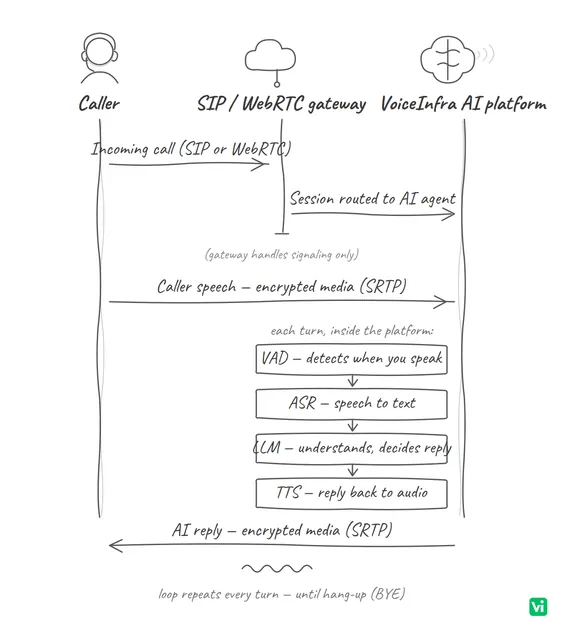
In this architecture:
SIP connects traditional phone systems.
WebRTC enables browser-based conversations.
VoiceInfra orchestrates the AI pipeline.
ASR converts speech into text.
LLM understands intent.
TTS generates natural voice responses.
This hybrid model provides flexibility without forcing businesses to replace their existing communication infrastructure.
Common Mistakes Businesses Make
When adopting Voice AI, organizations often run into avoidable issues.
❌ Assuming WebRTC Replaces SIP
WebRTC is not a replacement for SIP. In many enterprise deployments, both technologies work together.
❌ Ignoring Existing Infrastructure
Many businesses already have SIP trunks, PBXs, and telecom providers.
Replacing everything is expensive and usually unnecessary.
❌ Focusing Only on Technology
Choosing SIP or WebRTC is only one part of building a successful Voice AI solution.
Speech recognition, AI models, integrations, analytics, and workflows are equally important.
How VoiceInfra Brings SIP and WebRTC Together
VoiceInfra is designed to support modern enterprise communication by integrating both SIP and WebRTC into a unified Voice AI platform.
Businesses can:
Connect existing SIP trunks and PBXs.
Enable browser-based calling with WebRTC.
Automate inbound and outbound calls.
Connect CRMs and business systems.
Build AI voice agents without replacing existing infrastructure.
Monitor conversations through real-time analytics.
This hybrid approach allows organizations to modernize gradually while protecting previous technology investments.
Ready to Modernize Your Voice Infrastructure?
Whether you're running a traditional SIP-based phone system or building browser-first communication experiences with WebRTC, VoiceInfra helps you connect both worlds.
With VoiceInfra, you can:
Build AI voice agents.
Integrate SIP and WebRTC.
Automate customer conversations.
Connect existing PBXs.
Deploy multilingual AI assistants.
Scale with enterprise-grade reliability.
Final Thoughts
SIP and WebRTC are often presented as competing technologies, but in reality they solve different challenges.
SIP remains the backbone of enterprise telephony, powering PBXs, SIP trunks, contact centers, and traditional VoIP infrastructure. WebRTC brings secure, real-time communication directly to browsers and mobile applications without requiring dedicated softphones.
For most modern businesses, the best solution isn't choosing one over the other, it's using both together.
A hybrid architecture allows organizations to keep their existing SIP infrastructure while adding browser-based communication, AI voice agents, real-time analytics, and modern customer experiences.
That's exactly where VoiceInfra fits in.
VoiceInfra combines enterprise-grade Voice AI with SIP and WebRTC support, helping businesses automate customer conversations without replacing their current communication systems.
Whether you're deploying an AI receptionist, modernizing a contact center, or building intelligent voice applications, understanding how SIP and WebRTC work together is the foundation for creating scalable, future-ready communication platforms.
Key Takeaways
SIP manages call signaling and enterprise telephony.
WebRTC enables secure, browser-based real-time communication.
They are complementary technologies, not direct competitors.
Hybrid SIP + WebRTC architectures are common in modern Voice AI platforms.
VoiceInfra supports both, making it easier to modernize without replacing existing infrastructure.
Frequently Asked Questions
What is the main difference between SIP and WebRTC?
SIP is a signaling protocol used to establish and manage communication sessions, while WebRTC is a framework that enables real-time voice, video, and data communication directly in browsers and applications.
Is WebRTC better than SIP?
Neither is universally better. SIP is ideal for enterprise telephony, while WebRTC is best for browser-based communication. Many organizations use both together.
Can SIP and WebRTC work together?
Yes. SIP gateways and communication platforms bridge SIP-based phone systems with WebRTC applications, allowing seamless communication across devices.
Do I need WebRTC if I already use SIP?
If you want browser-based calling, video meetings, or web applications, WebRTC adds those capabilities while continuing to use your SIP infrastructure.
Which technology is better for AI voice agents?
Most enterprise Voice AI platforms combine SIP and WebRTC. SIP connects phone networks, while WebRTC powers browser interactions and monitoring dashboards.
Is WebRTC secure?
Yes. WebRTC uses encryption technologies such as DTLS and SRTP by default to secure media streams.
Does SIP carry voice data?
No. SIP handles signaling. The actual audio is typically transmitted using RTP or SRTP.
What industries use SIP and WebRTC?
Healthcare, banking, telecommunications, retail, logistics, education, hospitality, customer support, and enterprise collaboration platforms all rely on these technologies.
Related Articles
Continue exploring Voice AI and enterprise communication with these guides: