One of the first questions businesses ask before deploying an AI receptionist is:
"How many AI voice minutes will I actually use every month?"
It's an important question because most Voice AI platforms price their services based on usage, usually measured in minutes.
Choosing the wrong estimate can lead to paying for capacity you don't use or running out of minutes when customer calls increase.
The good news is that most small businesses don't need tens of thousands of AI minutes every month.
In fact, many businesses can automate after-hours calls with only a few hundred to a few thousand minutes per month, depending on their industry, call volume, and average conversation length.
This guide explains how to estimate your monthly AI voice usage, which factors affect your minute consumption, and how businesses can plan for growth without overspending.
Why Monthly Minutes Matter
Unlike traditional phone systems, AI voice platforms often charge based on conversation time.
Every answered call consumes AI processing resources, including:
The longer a conversation lasts, the more AI minutes are consumed.
Understanding your expected usage helps you:
Avoid unexpected usage charges.
Scale confidently as your business grows.
How to Estimate Monthly AI Voice Minutes
A simple calculation is:
Monthly Minutes = Number of Calls × Average Call Duration
Example:
250 after-hours calls per month
Average call length: 3 minutes
250 × 3 = 750 AI voice minutes per month
This simple formula provides a good starting point before selecting an AI voice plan.
Typical Monthly Usage by Business Size
The table below shows estimated monthly AI voice minutes for businesses using an AI receptionist primarily for after-hours calls.
| Business Size | Monthly Calls | Average Call Length | Estimated Monthly Minutes |
|---|---|---|---|
| Small | 100–300 | 2–4 min | 200–1,200 |
| Growing | 300–700 | 2–5 min | 600–3,500 |
| Medium | 700–1,500 | 3–5 min | 2,100–7,500 |
| High Volume | 1,500+ | 3–6 min | 4,500+ |
These estimates will vary depending on your industry and the complexity of customer conversations.
Typical Usage by Industry
Different industries receive different types of calls, resulting in different AI minute requirements.
| Industry | Typical Monthly Minutes |
|---|---|
| Dental Clinics | 300–1,000 |
| Medical Clinics | 500–2,000 |
| Law Firms | 300–1,500 |
| HVAC Companies | 400–2,500 |
| Plumbing Services | 300–2,000 |
| Restaurants | 500–3,000 |
| Real Estate Agencies | 300–1,200 |
| Accounting Firms | 200–800 |
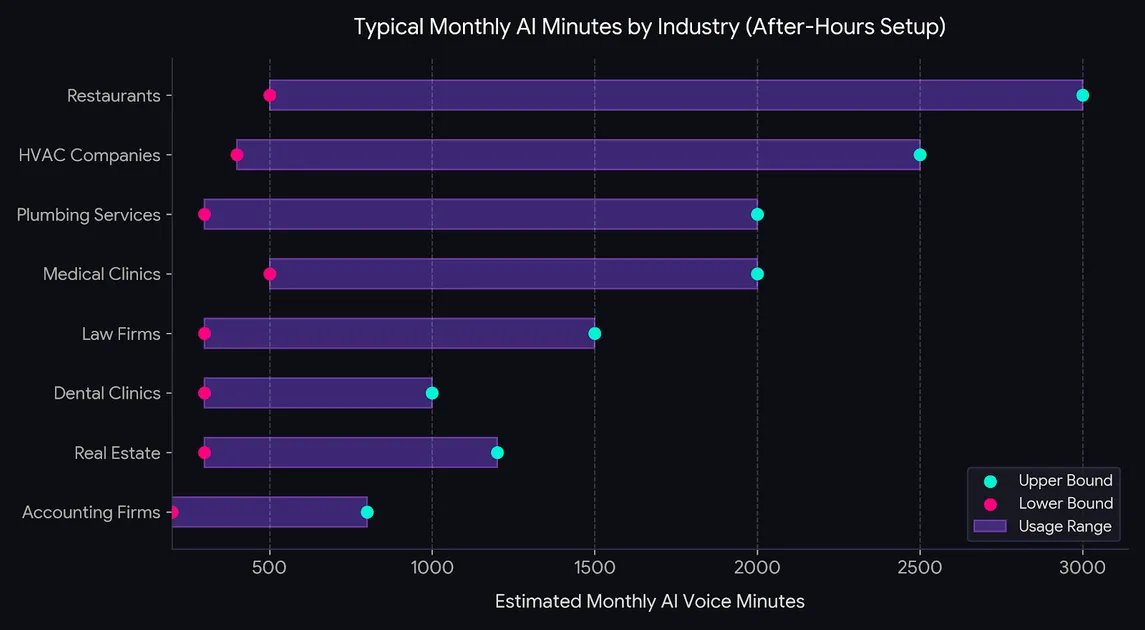
For example, a dental clinic may receive appointment requests that last only a few minutes, while an HVAC company handling emergency calls may have longer conversations.
What Increases AI Voice Minute Usage?
Several factors can increase the number of minutes your AI receptionist consumes each month.
Longer Conversations
Calls involving troubleshooting or detailed customer support naturally take longer than simple appointment bookings.
High Call Volume
Seasonal promotions, marketing campaigns, or business growth can significantly increase incoming calls.
Call Transfers
If your AI receptionist spends time gathering information before transferring the call to a human agent, total conversation time may increase.
Multiple Languages
Supporting multilingual conversations can sometimes extend average call duration, especially when callers switch languages or require additional clarification.
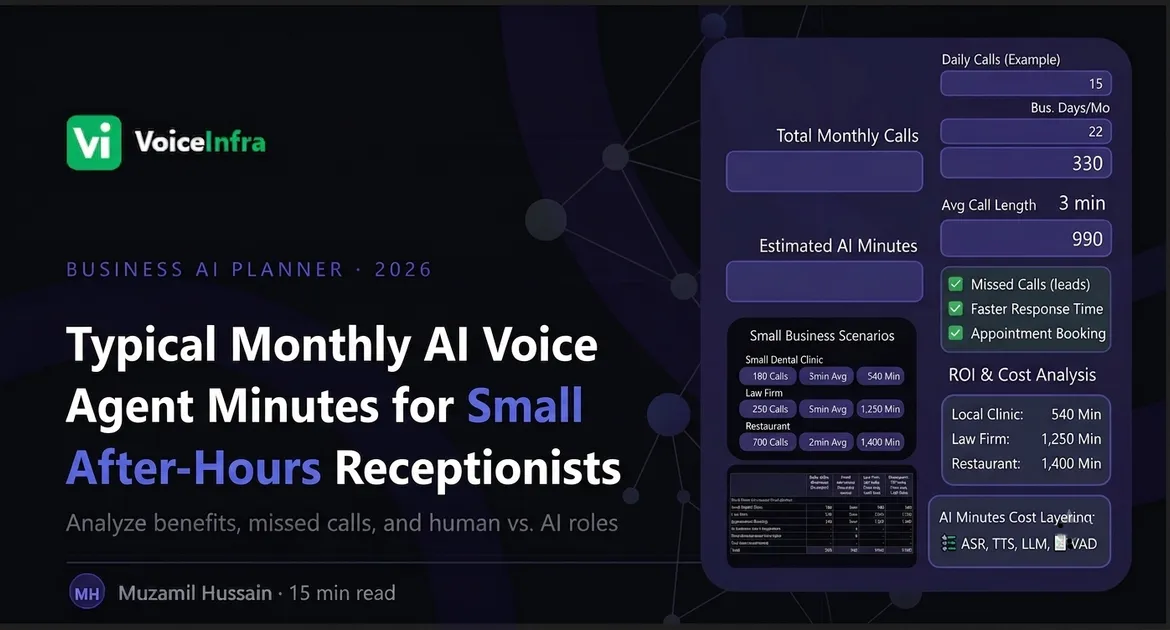
Monthly AI Minute Estimator
You can estimate your expected usage using this simple worksheet.
| Question | Example |
|---|---|
| Calls per Day | 15 |
| Business Days per Month | 22 |
| Monthly Calls | 330 |
| Average Call Duration | 3 minutes |
| Estimated Monthly AI Minutes | 990 |
This quick calculation helps businesses forecast usage before choosing an AI voice plan.
Custom Illustration
Title: Monthly AI Voice Minute Calculation
Daily Calls
      │
× Business Days
      │
Monthly Calls
      │
× Average Call Length
      │
Estimated AI Voice Minutes
💡 Did You Know?
Many small businesses discover that after-hours calls account for only a portion of their total call volume. Starting with after-hours automation allows teams to measure real usage before expanding AI to daytime customer support.
Typical AI Voice Agent Costs Based on Monthly Minutes
Once you've estimated your monthly AI voice minutes, the next question is:
"How much will those minutes actually cost?"
The answer depends on several factors, including your AI provider, telephony costs, speech recognition engine, language model, text-to-speech provider, and any additional platform fees.
Most modern Voice AI platforms charge based on one of the following pricing models:
Pay-as-you-go pricing
Monthly subscription with included minutes
Enterprise custom pricing
Hybrid pricing (base plan + usage)
Understanding these models helps businesses avoid unexpected costs as their call volume grows.
Example Monthly Usage Scenarios
The examples below illustrate how different businesses might use an AI receptionist after hours.
| Business Type | Monthly Calls | Avg. Call Length | Estimated Monthly Minutes |
|---|---|---|---|
| Local Dental Clinic | 180 | 3 min | 540 |
| HVAC Company | 450 | 4 min | 1,800 |
| Law Firm | 250 | 5 min | 1,250 |
| Restaurant | 700 | 2 min | 1,400 |
| Real Estate Agency | 320 | 4 min | 1,280 |
These are planning examples. Actual usage varies depending on call duration, seasonality, and customer behavior.
What Determines the Cost of an AI Voice Agent?
AI voice conversations involve multiple technologies working together.
A typical call includes:
Customer Call
      │
Telephony
      │
Voice Activity Detection (VAD)
      │
Automatic Speech Recognition (ASR)
      │
Large Language Model (LLM)
      │
Text-to-Speech (TTS)
      │
AI Response
Each layer contributes to the overall cost of processing a conversation.
Factors That Affect Monthly Costs
1. Call Duration
A business receiving 300 calls per month with an average duration of 2 minutes will consume far fewer AI minutes than another business receiving the same number of calls averaging 6 minutes.
Reducing unnecessary conversation time can significantly lower operating costs.
2. Call Volume
Businesses with higher customer interaction naturally consume more AI minutes.
Examples include:
Restaurants
Medical clinics
HVAC companies
Property management firms
Customer support teams
3. AI Complexity
Simple AI receptionists answering FAQs typically require less processing than advanced AI agents capable of:
Booking appointments
CRM lookups
Payment verification
Workflow automation
Multi-step conversations
More complex workflows may increase infrastructure usage.
4. Multiple Languages
Supporting multiple languages improves customer experience but can increase processing complexity and conversation length.
5. Human Transfers
Many businesses configure their AI receptionist to transfer complex calls to a human agent.
While this improves customer satisfaction, the AI still processes the initial portion of the conversation before the transfer.
Hidden Costs Businesses Often Overlook
When evaluating AI voice platforms, don't focus only on the advertised per-minute price.
Consider additional factors such as:
Phone number charges
SIP trunk costs
Premium voices
CRM integrations
API usage
Knowledge base hosting
Analytics features
Custom integrations
Professional onboarding
Enterprise support
Understanding the complete pricing structure helps prevent unexpected expenses later.
AI Receptionist vs Human Receptionist
Many businesses evaluate AI receptionists by comparing them with hiring additional staff.
| Comparison | Human Receptionist | AI Voice Agent |
|---|---|---|
| Available 24/7 | ❌ | ✅ |
| Handles Multiple Calls | Limited | ✅ |
| Vacation or Sick Leave | Yes | No |
| Scales During Busy Periods | Difficult | Easy |
| Consistent Responses | Varies | Yes |
| Appointment Booking | Manual | Automated |
| CRM Updates | Manual | Automated |
Rather than replacing staff entirely, many organizations use AI to handle repetitive after-hours calls while human employees focus on more complex customer interactions.
Estimating Return on Investment (ROI)
An AI receptionist can create value in several ways beyond direct cost savings.
Potential benefits include:
Fewer missed calls
Increased appointment bookings
Faster customer response times
Better lead capture
Reduced administrative workload
Improved customer satisfaction
24/7 availability
For service-based businesses, capturing even a small number of additional leads each month can often justify the investment in AI automation.
Industry Examples
Dental Clinic
An AI receptionist answers after-hours appointment requests, captures patient details, and schedules available time slots.
Benefits include:
Fewer missed appointments
Improved patient experience
Reduced front-desk workload
HVAC Company
Emergency service requests often occur outside normal business hours.
An AI voice agent can:
Gather customer information
Prioritize urgent cases
Dispatch technicians
Notify on-call staff
Law Firm
Potential clients frequently call after business hours.
An AI receptionist can:
Capture case information
Schedule consultations
Route urgent legal matters
Create CRM records automatically
Restaurant
Restaurants receive frequent calls regarding:
Reservations
Opening hours
Menu questions
Delivery information
Automating these conversations allows staff to focus on in-person guests.
💡 VoiceInfra Tip
If you're unsure how many AI minutes your business needs, start by measuring your average monthly after-hours call volume.
Launching with a smaller plan allows you to collect real usage data, optimize conversation flows, and scale confidently as customer demand grows.
How Many AI Voice Minutes Does Your Business Actually Need?
One of the biggest mistakes businesses make is purchasing far more AI voice minutes than they actually use.
The best approach is to estimate your expected call volume, monitor real usage during the first few months, and then upgrade only when necessary.
For most small businesses, after-hours calls represent only a fraction of total customer interactions. Starting with an after-hours AI receptionist is often the easiest and most cost-effective way to introduce Voice AI.
Monthly AI Minute Calculator
You can estimate your monthly AI usage with this simple formula:
Monthly AI Minutes = Monthly Calls × Average Call Duration (Minutes)
Example 1 – Small Dental Clinic
Monthly after-hours calls: 180
Average call duration: 3 minutes
180 × 3 = 540 AI Minutes
Example 2 – Plumbing Company
Monthly after-hours calls: 450
Average call duration: 4 minutes
450 × 4 = 1,800 AI Minutes
Example 3 – Law Firm
Monthly after-hours calls: 250
Average call duration: 5 minutes
250 × 5 = 1,250 AI Minutes
AI Voice Minute Planning by Business Size
The following estimates can help businesses choose a starting point.
| Business Size | Recommended Starting Minutes | Suitable For |
|---|---|---|
| Solo Business | 200–500 | Local service providers, freelancers |
| Small Business | 500–1,500 | Clinics, law firms, restaurants |
| Growing Business | 1,500–3,500 | Multi-location businesses |
| Medium Business | 3,500–7,500 | Customer support teams |
| Enterprise | 7,500+ | High-volume contact centers |
These are planning estimates and should be adjusted based on your actual call history.
Signs You Need More AI Minutes
As your business grows, you'll naturally consume more AI voice minutes.
Consider upgrading your plan if you notice:
Increasing after-hours call volume
Frequent overflow calls
Longer customer conversations
Expansion to multiple locations
Additional languages being supported
New AI workflows such as appointment booking or lead qualification
Scaling gradually based on real usage is usually more cost-effective than purchasing excessive capacity upfront.
Common Mistakes When Estimating AI Usage
Estimating Based on Total Calls
Many businesses calculate usage using all incoming calls.
If your AI receptionist only answers after-hours calls, you should estimate based on after-hours traffic, not your total monthly calls.
Ignoring Average Call Length
Two businesses receiving the same number of calls can have very different AI usage if one averages two-minute conversations and the other averages six-minute conversations.
Monitoring average call duration is just as important as tracking call volume.
Forgetting Seasonal Demand
Businesses often experience seasonal spikes.
Examples include:
Tax season for accountants
Holiday shopping for retailers
Summer demand for HVAC companies
Winter demand for plumbing services
Back-to-school periods for education providers
Planning for seasonal fluctuations helps avoid unexpected overages.
How VoiceInfra Helps You Optimize AI Usage
VoiceInfra is designed to help businesses maximize automation while keeping AI voice usage efficient.
With VoiceInfra, you can:
Monitor monthly AI minutes in real time.
Analyze conversation duration.
Track call outcomes and resolution rates.
Automate appointment booking.
Transfer complex conversations to human agents.
Integrate with CRMs and business systems.
Support multilingual conversations.
Scale from a few hundred to millions of monthly AI minutes.
Instead of guessing your requirements, VoiceInfra provides analytics that help you understand actual customer behavior and optimize future usage.
Who Should Use an AI After-Hours Receptionist?
An AI receptionist is especially valuable for businesses that regularly receive calls outside normal working hours.
Industries that benefit include:
Dental clinics
Medical practices
Veterinary clinics
Law firms
Accounting firms
Real estate agencies
HVAC companies
Plumbing services
Electricians
Roofing contractors
Restaurants
Hotels
Property management companies
Insurance agencies
Automotive repair shops
If every missed call represents a potential customer, an AI receptionist can help ensure those opportunities aren't lost.
People Also Ask
How many AI voice minutes does a small business usually need?
Many small businesses begin with approximately 500–1,500 AI voice minutes per month for after-hours call handling. Actual usage depends on call volume and conversation length.
How do I estimate AI receptionist minutes?
Multiply your expected monthly calls by the average call duration in minutes.
Monthly Calls × Average Call Length = Estimated AI Minutes
Does an AI receptionist answer every call?
It depends on how it's configured.
Some businesses use AI only after business hours, while others allow AI to answer all inbound calls or handle overflow during busy periods.
Can I increase my AI minutes later?
Yes. Most modern Voice AI platforms allow businesses to upgrade their plans as call volume grows.
Is an AI receptionist suitable for very small businesses?
Absolutely.
Even businesses receiving only a handful of after-hours calls each day can benefit from improved lead capture, appointment scheduling, and 24/7 customer availability.
Final Thoughts
Choosing the right number of AI voice minutes isn't about buying the biggest plan, it's about understanding your business.
By estimating monthly call volume, tracking average conversation length, and reviewing usage over time, businesses can confidently select a plan that matches their needs without overspending.
For many organizations, starting with an after-hours AI receptionist is the fastest way to improve customer service, reduce missed opportunities, and introduce AI into existing workflows.
As demand grows, VoiceInfra makes it easy to scale from a few hundred monthly minutes to enterprise-level deployments without changing your underlying communication infrastructure.
Ready to Deploy an AI Receptionist?
Whether you're answering 100 calls a month or 100,000, VoiceInfra helps businesses automate conversations with enterprise-grade Voice AI.
With VoiceInfra you can:
Build AI receptionists without complex coding
Handle inbound and outbound calls
Book appointments automatically
Integrate with CRMs and calendars
Support multilingual conversations
Monitor AI usage with detailed analytics
Scale as your business grows
Related Articles